

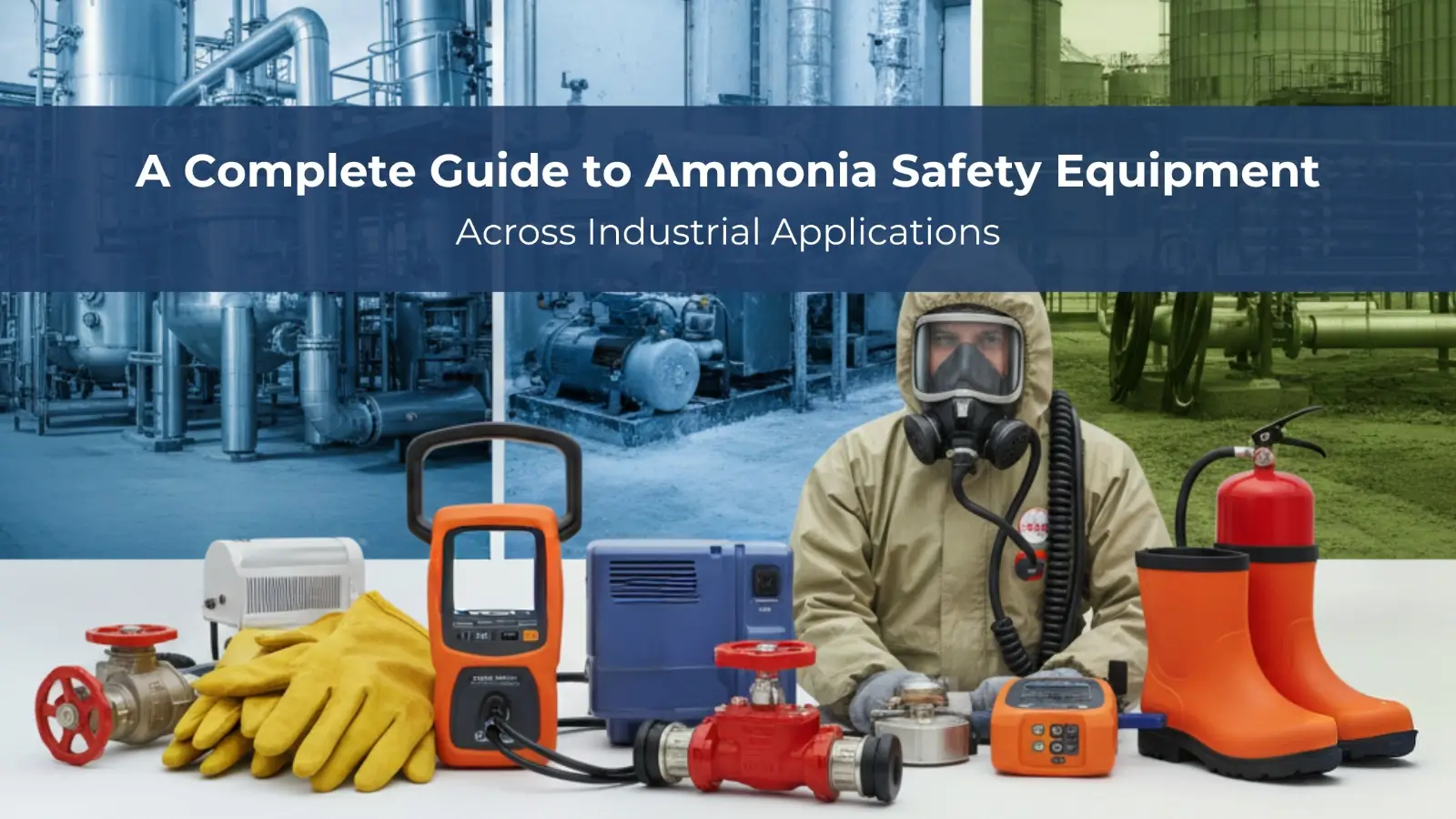
- Mandatory PPE: Full-face respirator with ammonia cartridges (or SCBA at/above 300 ppm IDLH), butyl rubber gloves, chemical-resistant apron/suit, and splash goggles are the minimum for any anhydrous ammonia handling.
- Gas detection: Fixed electrochemical detectors calibrated to alarm at 25 ppm (warning) and 150 ppm (evacuate) are mandatory in all ammonia storage and handling areas.
- Emergency shower: Within 10 seconds / 10 metres of any ammonia exposure area — minimum 15 minutes of tepid water flow required for adequate flushing.
- Ventilation: IS 660 requires minimum 10 air changes/hour normally and 30+ on alarm in ammonia machine rooms — discharge to open atmosphere away from occupied areas.
- SCBA: Minimum two complete sets mandatory at all significant ammonia facilities — stored accessible but outside the potential exposure zone.
- Maintenance: Calibration every 6 months (detectors), monthly flow tests (showers/eyewash), annual SCBA service — all with documented records for PESO inspection.
- Understanding Ammonia Safety Risks
- Respiratory Protection Equipment
- Protective Clothing and Gloves
- Fixed Gas Detection Systems
- Portable Gas Detection
- Emergency Shower and Eyewash Stations
- Ventilation Systems
- Self-Contained Breathing Apparatus (SCBA)
- Emergency Isolation and Shutdown Systems
- Safety Equipment by Ammonia Form
- Maintenance and Training Requirements
- Who Needs Ammonia Safety Equipment?
- Related Reading
- Frequently Asked Questions
Ammonia is one of the most hazardous industrial chemicals in common use. Its toxicity, corrosivity, flammability range, and pressurised storage conditions create a risk profile that demands a comprehensive, layered approach to safety equipment — from the individual worker’s PPE to facility-level gas detection, ventilation, and emergency response infrastructure. Getting this right is both a legal obligation and a moral imperative.
This guide covers every category of ammonia safety equipment required across industrial applications in India — what each does, the specifications it must meet, the regulatory standards it must comply with, and how to maintain it in a state of readiness. Jaysons Chemical Industries supplies both anhydrous ammonia and liquor ammonia to customers across India and provides MSDS, storage layout recommendations, and safety equipment guidance as part of every supply relationship.
1. Understanding Ammonia Safety Risks
Effective safety equipment selection begins with understanding the specific hazards that equipment must protect against. Ammonia presents four distinct hazard categories, each requiring different protective measures.
| Hazard Category | Mechanism | Key Threshold | Primary Protection |
|---|---|---|---|
| Inhalation toxicity | Ammonia vapour irritates and damages respiratory tract | TLV-TWA: 25 ppm; IDLH: 300 ppm | Respiratory protection, ventilation, gas detection |
| Eye and skin corrosivity | Ammonia solution causes chemical burns on contact | Any contact with concentrated solution | Goggles, face shield, gloves, protective clothing |
| Cryogenic hazard (anhydrous) | Liquid anhydrous ammonia at -33°C causes freeze burns | Any skin contact with liquid NH3 | Cryogenic-rated gloves, protective suit, face shield |
| Flammability | Ignition risk at 15-28% concentration in air | LFL: 15%; UFL: 28% | Ignition source control, ventilation, gas detection |
2. Respiratory Protection Equipment
Respiratory protection is the most critical category of ammonia PPE — the difference between adequate respiratory protection and none can be the difference between a manageable exposure and a fatality.
Air-Purifying Respirators (APR)
Full-face APRs with ammonia-specific organic vapour / acid gas combination cartridges are suitable for work in areas where ammonia concentrations are confirmed to be below 300 ppm (the IDLH). Half-mask APRs provide lower protection factors and are not recommended for ammonia handling applications where direct contact or higher concentrations are possible. APR cartridges have a finite service life — they must be replaced per the manufacturer’s schedule or after any use in an ammonia atmosphere, and must be discarded if the user detects ammonia odour (indicating cartridge breakthrough). Cartridges should never be stored out of their sealed packaging before use.
Powered Air-Purifying Respirators (PAPR)
PAPRs use a motorised blower to draw ambient air through filter cartridges into a hood or helmet. They provide continuous positive airflow that prevents ammonia-containing air from reaching the wearer’s face even if the seal to the face is imperfect — making them more comfortable for extended wear than tight-fitting APRs. PAPRs are suitable for the same concentration range as standard APRs (below IDLH) and are valued in applications requiring extended wear such as maintenance work in low-level ammonia environments.
Self-Contained Breathing Apparatus (SCBA)
SCBA supplies compressed clean air from a cylinder worn on the user’s back, through a full-face pressure-demand regulator. SCBA provides full respiratory protection regardless of ambient ammonia concentration or oxygen level and is mandatory for any entry into atmospheres at or above 300 ppm, any unknown concentration, or any oxygen-deficient atmosphere. Industrial SCBA sets typically provide 30–60 minutes of air supply from a 6–9 litre composite cylinder at 300 bar. SCBA is detailed further in Section 8.
3. Protective Clothing and Gloves
Chemical-Resistant Gloves
Gloves for ammonia handling must be made from materials proven to resist permeation by concentrated ammonia solution. Butyl rubber and neoprene are the preferred materials — both provide excellent resistance to ammonium hydroxide solution at all industrial concentrations. Natural rubber provides moderate protection but degrades faster. Nitrile is adequate for dilute concentrations but is not recommended for concentrated liquor ammonia or anhydrous work. Minimum glove thickness should be 0.38 mm for chemical resistance; inner cotton liner gloves improve comfort for extended wear. Gloves must be inspected before each use — any visible damage, holes, or stiffness indicates they should be replaced.
Protective Aprons and Suits
For routine ammonia handling, a chemical-resistant apron made from PVC, neoprene, or polyethylene provides adequate body protection for most exposure scenarios. For major transfer operations involving bulk anhydrous ammonia or large volumes of liquor ammonia, a full chemical-resistant suit (Level B or Level C depending on the risk assessment) provides comprehensive body protection. All suits must be regularly inspected for tears, seam failure, or material degradation — chemical resistance deteriorates with age even without visible damage.
Eye and Face Protection
Chemical splash goggles (indirect vented, EN166 or equivalent standard) are the minimum eye protection for any ammonia handling. A full-face shield provides additional face and neck protection and is mandatory during bulk transfer operations where splashing risk is higher. When using a full-face APR or SCBA, the face shield of the respirator provides eye protection — but goggles should still be worn during equipment connection/disconnection when the respirator may not yet be fully on.
4. Fixed Gas Detection Systems
Fixed ammonia gas detection is one of the most important engineering controls in any ammonia storage or handling facility. Unlike PPE which protects individuals, fixed detection protects the entire facility by providing early warning that enables evacuation, ventilation activation, and source isolation before concentrations reach dangerous levels.
Electrochemical Sensor Technology
The dominant technology for fixed ammonia detection is the electrochemical sensor — a device in which ammonia reacts at an electrode surface, generating an electrical current proportional to the ammonia concentration. Electrochemical sensors are highly sensitive (typical detection range 0–100 ppm or 0–500 ppm), reasonably selective for ammonia versus common interferents, and relatively low cost. Sensor lifetime is typically 2–3 years; replacement at manufacturer-specified intervals is mandatory.
Alarm Levels and Outputs
Per IS 660 and PESO licence conditions, ammonia detectors must be set to alarm at two minimum thresholds: 25 ppm (Level 1 Warning) and 150 ppm (Level 2 Evacuate). Level 1 alarm outputs typically include: audible horn, visual flashing beacon, and notification to control room or security. Level 2 alarm outputs additionally activate: automatic mechanical ventilation ramp-up, automatic compressor isolation (in refrigeration systems), and potentially automatic water curtain activation where fitted.
Detector Placement
Detectors should be placed at: the lowest points of machine rooms (where heavier-than-air ammonia concentrations may occur if liquid spills generate vapour), at the breathing zone height of 1.5 metres near high-risk areas (compressor connections, valve manifolds), and at room entry points so that personnel receive warning before entering a contaminated space. Detectors must not be placed in dead-air corners where air circulation is poor — they must be in locations where representative air samples reach the sensor promptly following a release.
5. Portable Gas Detection
Portable personal ammonia gas detectors — worn clipped to the lapel or belt of individual workers — provide real-time personal exposure monitoring and serve as a backup to fixed detection. They are particularly important during: confined space entry assessments; maintenance work in areas not covered by fixed detection; routine inspection rounds in ammonia plant areas; and emergency response to investigate a suspected leak source.
Portable detectors should alarm at the same thresholds as fixed systems (25 ppm warning, 150 ppm evacuate). Battery life should be sufficient for a full work shift; units should be charged and bump-tested before each shift. Like fixed sensors, portable sensors have limited service lives and must be replaced per the manufacturer’s schedule — typically annually.
6. Emergency Shower and Eyewash Stations
Emergency shower and eyewash stations are life-safety equipment — in the event of ammonia liquid contact with eyes or skin, immediate and prolonged flushing dramatically reduces the severity of injury. Their placement, performance, and maintenance are non-negotiable.
Location Requirements
Emergency shower and eyewash stations must be located within 10 seconds walking distance — approximately 10 metres — of any area where workers may be exposed to ammonia liquid or high concentrations of ammonia vapour. The path from the exposure point to the station must be unobstructed, clearly marked, and navigable even by a worker with impaired vision from eye contamination.
Performance Requirements
Emergency showers must deliver a minimum of 75.7 litres per minute of water at a temperature of 15–37°C. Eyewash stations must deliver a minimum of 1.5 litres per minute per eye for 15 minutes of continuous flushing — the minimum recommended flushing time for ammonia eye exposure. Combined shower/eyewash units that can operate both simultaneously are the preferred design for ammonia handling areas.
Maintenance
Weekly flow testing of all emergency shower and eyewash stations is mandatory — actuate the station for 5 minutes to flush the supply lines, confirm adequate water flow, and record the test in the maintenance log. Annual plumbing inspection and pressure test ensures the supply remains functional and free from blockage. In cold-weather installations or locations exposed to low temperatures, trace heating must prevent freezing of supply lines.
7. Ventilation Systems
Mechanical ventilation is both an engineering control for routine operations (preventing gradual vapour accumulation) and an emergency response measure (accelerating dilution following a release). Ventilation system design must account for both functions.
Normal Operation Requirements
IS 660 specifies a minimum of 10 air changes per hour for ammonia machine rooms during normal operation. This ventilation rate prevents gradual ammonia accumulation from small valve seeps, seal leaks, and other minor emission sources. Fan selection should provide this minimum air change rate at the maximum anticipated room temperature — fan performance decreases significantly at high ambient temperatures without appropriate derating.
Emergency Operation Requirements
On activation of the Level 2 alarm (150 ppm), ventilation must automatically increase to 30 or more air changes per hour. This emergency ventilation rate is designed to rapidly dilute a major ammonia release before concentrations reach the IDLH of 300 ppm. The ventilation system must be interlocked with the gas detection alarm system — manual-only ventilation is not acceptable for emergency function. Ventilation discharge must be directed to open atmosphere, away from air intakes, occupied buildings, and potential ignition sources.
IS-Compliant Ammonia Supply with Safety Documentation
Jaysons Chemical Industries provides MSDS, storage layout guidance, PESO licence support, and safety equipment checklists with every supply agreement. We help Indian industrial customers build compliant, safe ammonia operations from day one.
8. Self-Contained Breathing Apparatus (SCBA)
SCBA is the highest level of respiratory protection available and is mandatory for emergency response in ammonia facilities. Every significant ammonia storage and handling operation must maintain SCBA in ready condition, and emergency responders must be trained and regularly practised in its use.
SCBA Specifications for Ammonia Applications
Industrial SCBA for ammonia applications must be: positive-pressure demand type (pressure in the facepiece is always positive, preventing any inward leakage); equipped with a full-face mask providing eye and face protection as well as respiratory protection; supplied with 30-minute or 60-minute air cylinder (30-minute minimum for emergency response); and certified to applicable IS or international standards. The SCBA facepiece must be compatible with the user’s facial geometry — fit testing is mandatory before any SCBA is deployed for emergency use.
SCBA Maintenance and Readiness
SCBA cylinders must be checked monthly for pressure — a full 300-bar cylinder is mandatory for emergency readiness. Any cylinder below 90% full must be recharged before being returned to emergency standby. Annual servicing by a qualified SCBA technician includes: regulator function test, demand valve inspection, harness inspection, facepiece seal inspection and lens replacement if scratched. SCBA storage must be in a clearly marked, accessible location outside the potential ammonia exposure zone — typically a wall-mounted cabinet at the facility entrance.
9. Emergency Isolation and Shutdown Systems
Beyond PPE and detection, safety systems that can isolate and contain an ammonia release are critical engineering controls.
Emergency Stop Systems
Large ammonia refrigeration and chemical process systems must be equipped with emergency stop (e-stop) stations that simultaneously isolate the entire ammonia circuit and shut down all compressors. E-stop buttons must be located at all facility entry points and at key operational locations — positioned so that they can be activated by anyone evacuating the facility without needing to re-enter the hazard zone. E-stop system function must be tested at least annually with documented results.
Automatic Isolation Valves
Solenoid-operated isolation valves on major ammonia liquid and vapour lines, interlocked with the gas detection alarm system at Level 2, automatically stop ammonia flow following a major release. These valves close within seconds of alarm activation without requiring manual intervention. Regular testing — at least quarterly — confirms that valves operate correctly on alarm signal.
10. Safety Equipment by Ammonia Form
| Equipment Category | Anhydrous Ammonia | Liquor Ammonia (20–28%) |
|---|---|---|
| Respiratory protection (routine) | Full-face APR with ammonia cartridges | Half-face APR for routine; full-face for transfers |
| Respiratory protection (emergency) | SCBA — mandatory for all major releases | SCBA — required for enclosed space major spills |
| Gloves | Cryogenic + chemical resistant (butyl/neoprene) | Chemical resistant (butyl/neoprene) |
| Protective suit | Full chemical suit for major transfer operations | Chemical apron for routine; full suit for major transfers |
| Fixed gas detection | Mandatory — 25 ppm warning, 150 ppm evacuate | Mandatory — same thresholds |
| Emergency shower/eyewash | Within 10 seconds — mandatory | Within 10 seconds — mandatory |
| Machine room ventilation | 10 ACH normal, 30+ ACH emergency — mandatory | Adequate ventilation required — IS 660 where applicable |
| SCBA sets on site | Minimum 2 complete sets — mandatory | Minimum 1–2 sets recommended; licence conditions may require |
11. Maintenance and Training Requirements
Equipment Maintenance Schedule
- Weekly: Emergency shower and eyewash flow test — 5 minutes, record result; visual inspection of all PPE storage areas for completeness and condition.
- Monthly: SCBA cylinder pressure check — must be above 90% full; portable detector bump test; visual inspection of fixed detector units for damage or obstruction.
- Quarterly: Emergency isolation valve function test — activate and confirm closure; e-stop system test with documented response times; ventilation system inspection and airflow measurement.
- Semi-annually: Fixed ammonia detector calibration with certified test gas — full calibration record retained; SCBA regulator inspection.
- Annually: Full SCBA service by qualified technician; emergency shower plumbing inspection; mock emergency drill — evacuation, muster, SCBA donning, first aid response; review and update of emergency response plan.
Training Requirements
All workers who may be exposed to ammonia or who may need to respond to an ammonia emergency must receive documented training covering: ammonia hazard recognition (odour, symptoms of exposure at different concentrations); PPE selection, donning, doffing, and inspection; gas detector operation and alarm response; emergency evacuation routes and muster points; first aid for ammonia exposure; and SCBA donning, operation, and doffing. Training must be refreshed annually and whenever procedures change. Training records must be maintained for regulatory inspection.
- Cold Storage and Refrigeration — IS 660 full safety system requirements
- Textile and Dyeing Units — liquor ammonia handling PPE and detection
- Food Processing and Ice Plants — FSSAI-compliant safety management
- Agricultural Operations — field-level PPE and emergency water supply
- Power Plants (SCR systems) — large-volume anhydrous ammonia safety
- Water Treatment Plants — chloramination system safety equipment
12. Related Reading
Frequently Asked Questions
What PPE is mandatory for workers handling anhydrous ammonia?
Mandatory PPE includes: full-face APR with ammonia cartridges (SCBA mandatory at/above 300 ppm IDLH); butyl rubber or neoprene gloves (minimum 0.38mm); chemical-resistant suit or heavy apron; chemical splash goggles; and safety boots with chemical-resistant soles. All PPE must be inspected before each use and replaced at manufacturer-specified intervals.
What is the difference between an air-purifying respirator and SCBA for ammonia?
An APR with ammonia cartridges filters ambient air — effective up to 300 ppm IDLH for confirmed-concentration environments. SCBA supplies compressed clean air from a cylinder — mandatory at/above 300 ppm, in unknown concentrations, or in oxygen-deficient atmospheres. SCBA provides full protection regardless of ammonia concentration.
How often must fixed ammonia gas detectors be calibrated?
Fixed detectors must be fully calibrated at least every 6 months using certified test gas. Calibration records must be maintained for regulatory inspection. Bump testing (rapid operability check) should be performed monthly or quarterly. PESO licence conditions may specify stricter intervals — those take precedence.
What is the minimum response time requirement for emergency shower and eyewash stations?
Emergency shower and eyewash stations must be within 10 seconds walking distance (approximately 10 metres) of any ammonia exposure area. Water flow must support 15 minutes of continuous flushing at tepid temperature (15–37°C) — the minimum flushing time for ammonia eye exposure.
What alarm levels should ammonia gas detectors be set to?
Minimum two alarm levels: Level 1 Warning at 25 ppm (TLV-TWA) — investigate and identify source; Level 2 Evacuate at 150 ppm — immediate evacuation, automatic ventilation activation, compressor isolation, and emergency response. Some facilities add intermediate levels for graduated response.
What ventilation rate is required in ammonia machine rooms in India?
IS 660 requires minimum 10 air changes per hour under normal operation and automatic increase to 30+ air changes per hour on Level 2 alarm activation. Ventilation discharge must go to open atmosphere away from air intakes and occupied areas.
Is it mandatory to have SCBA at every ammonia facility in India?
Yes — PESO licence conditions and MSIHC Rules requirements typically mandate a minimum of two complete SCBA sets at every significant ammonia facility. SCBA must be stored in accessible locations outside the potential exposure zone and maintained in serviceable condition with regular pressure checks and annual professional service.
What maintenance is required for ammonia safety equipment?
Key intervals: weekly — emergency shower/eyewash flow test; monthly — SCBA cylinder pressure check, detector bump test; semi-annually — full detector calibration with certified gas; annually — full SCBA service, emergency shower plumbing inspection, mock emergency drill. All maintenance must be documented with records retained for PESO inspection.