

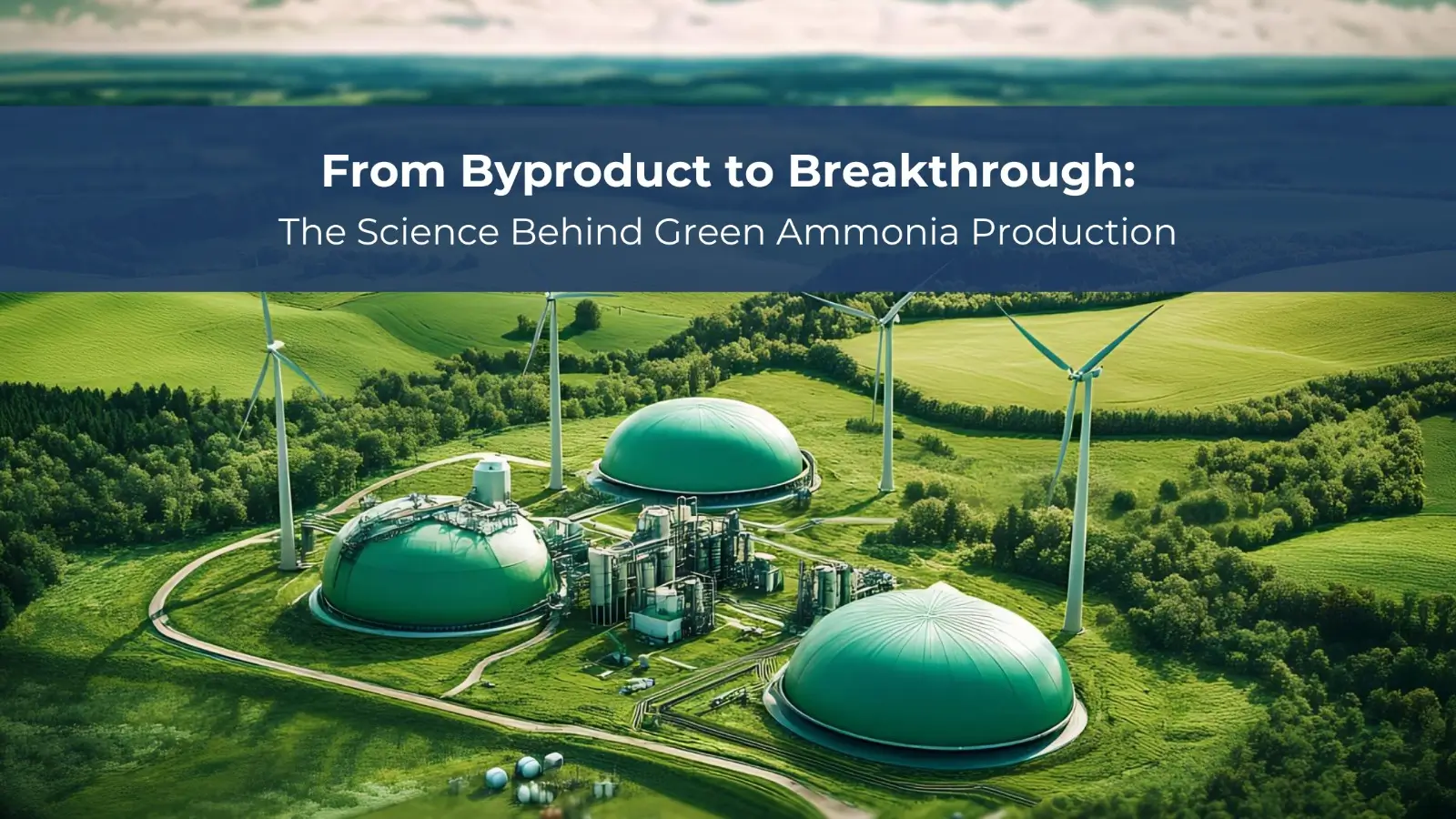
- Three steps: Green ammonia is made by combining water electrolysis (producing green H2), air separation (producing N2), and Haber-Bosch synthesis (combining H2 + N2 → NH3) — all powered by renewable electricity.
- Electricity requirement: Approximately 10–12 MWh of renewable electricity per tonne of green ammonia — declining toward 8–9 MWh/tonne as electrolyser technology matures.
- Carbon footprint: Green ammonia lifecycle CO2 is approximately 0.03–0.1 tonne CO2-eq/tonne NH3 versus 1.8–2.0 tonne CO2-eq/tonne for grey ammonia — a 95–98% reduction.
- Key challenge: Variable renewable power requires hydrogen buffer storage and dynamic Haber-Bosch operation — both technically solved but adding cost and complexity versus steady-state conventional plants.
- Cost trajectory: Production costs in India projected to fall from USD 600–900/tonne today to USD 300–500/tonne by 2030 as electrolyser costs decline and renewable electricity remains low-cost.
- India position: World-class solar irradiation, rapidly expanding renewable capacity, and an experienced ammonia production industry make India one of the most competitive future green ammonia producers globally.
- The Problem with Conventional Ammonia
- What Is Green Ammonia?
- Water Electrolysis: The Core Step
- Air Separation: Extracting Nitrogen
- Haber-Bosch Synthesis in a Green Context
- Managing Variable Renewable Power
- Lifecycle Carbon Accounting
- Catalyst and Process Advances
- Green Ammonia Plant Design
- India’s Green Ammonia Production Landscape
- Cost Outlook to 2030
- Related Reading
- Frequently Asked Questions
The science behind green ammonia production is both ancient and radically new. Ancient because the core chemistry — nitrogen and hydrogen combining over an iron catalyst at high temperature and pressure to form ammonia — was discovered over 110 years ago and has not fundamentally changed. Radically new because the source of the hydrogen has been transformed: instead of methane reformed with steam, releasing CO2 at every step, the hydrogen now comes from water split by electricity derived from sunlight or wind — emitting no carbon dioxide at all.
This guide explains the science of green ammonia production in depth — the electrochemistry of water splitting, the thermodynamics of Haber-Bosch synthesis, the engineering challenges of coupling variable renewable power to continuous chemical production, and what it all means for India’s emerging position in the global green ammonia market. Jaysons Chemical Industries supplies green ammonia and conventional anhydrous ammonia to industrial customers across India.
1. The Problem with Conventional Ammonia
Conventional ammonia is produced by the Haber-Bosch process using hydrogen derived from steam methane reforming (SMR) of natural gas — a process that releases approximately 1.8–2.0 tonnes of CO2 for every tonne of ammonia produced. The global ammonia industry produces approximately 185 million MT per year, generating approximately 350–370 million MT of CO2 annually — equivalent to approximately 1% of total global greenhouse gas emissions and approximately 2% of global energy consumption.
For the world to meet its climate targets, this CO2 must be eliminated. There are two pathways: blue ammonia (capturing and storing the CO2 from SMR using CCS technology) or green ammonia (replacing SMR hydrogen with electrolytic hydrogen from renewable electricity). Green ammonia eliminates the CO2 at source; blue ammonia manages it after production. The scientific community and major importing countries increasingly favour green ammonia as the more durable long-term solution.
The ammonia industry’s CO2 footprint is not just from combustion — it is embedded in the hydrogen production chemistry. Each mole of methane reformed to produce 4 moles of hydrogen also produces 1 mole of CO2: CH4 + 2H2O → CO2 + 4H2. This carbon is intrinsic to the SMR process — it cannot be eliminated without either using a different feedstock (electrolytic hydrogen) or capturing the CO2 after it is produced (CCS). Green ammonia is the only pathway that eliminates this CO2 at the molecular chemistry level.
2. What Is Green Ammonia?
Green ammonia is chemically identical to conventional ammonia — NH3, one nitrogen atom bonded to three hydrogen atoms, with all the same physical and chemical properties. The difference is exclusively in how it is made: using hydrogen produced from water electrolysis powered by renewable electricity, rather than from fossil fuel reforming. Green ammonia can be used in every application where conventional ammonia is used — fertiliser, refrigeration, industrial chemicals, and increasingly as a fuel and hydrogen carrier.
3. Water Electrolysis: The Core Step
Water electrolysis is the electrochemical process that splits water molecules into hydrogen and oxygen using electrical energy. The overall reaction is:
2H2O → 2H2 + O2 (requires 286 kJ per mole of H2 produced, from thermodynamics)
This reaction is thermodynamically uphill — it requires energy input. The electrical energy that drives the reaction is the point where renewable electricity is converted into chemical energy stored in the H-H bond of molecular hydrogen.
Alkaline Electrolysis (AWE)
The most commercially mature electrolyser type. Two electrodes (anode and cathode) are immersed in a concentrated potassium hydroxide (KOH) electrolyte solution. At the cathode: 2H2O + 2e⁻ → H2 + 2OH⁻. At the anode: 2OH⁻ → ½O2 + H2O + 2e⁻. Hydrogen and oxygen are separated by a diaphragm between the electrodes. AWE operates at 60–80°C and achieves efficiency of 62–70% (electrical energy to hydrogen chemical energy). Current commercial systems from Nel Hydrogen, ThyssenKrupp Nucera, and John Cockerill operate at megawatt scale with stack lifetimes exceeding 80,000 hours.
Proton Exchange Membrane (PEM) Electrolysis
PEM electrolysers use a solid polymer membrane (Nafion) as the electrolyte. Water is oxidised at the anode: H2O → ½O2 + 2H⁺ + 2e⁻. Protons (H⁺) migrate through the membrane to the cathode where they are reduced to hydrogen: 2H⁺ + 2e⁻ → H2. PEM achieves higher current densities and faster dynamic response to variable power than AWE — important advantages for renewable-coupled operation. PEM efficiency is 65–75% at current commercial technology. Major developers include ITM Power, Siemens Energy, and Cummins.
Water Purity Requirements
Both AWE and PEM electrolysers require high-purity deionised water feed — conductivity below 1 μS/cm for PEM systems. Water purification (reverse osmosis + deionisation) is a significant operational requirement for green ammonia plants in water-stressed locations. For large coastal plants, seawater desalination adds another energy requirement: approximately 0.003–0.005 MWh of electricity per tonne of ammonia produced for desalination — a minor but non-zero addition to the plant energy balance.
4. Air Separation: Extracting Nitrogen
The nitrogen used in green ammonia synthesis comes from atmospheric air — just as in conventional ammonia production. Air is approximately 78% N2, 21% O2, and 1% Ar and other gases. Two technologies are used to extract pure nitrogen from air.
Cryogenic Air Separation
The standard technology for large-scale nitrogen production: air is compressed, cooled to cryogenic temperatures, and distilled to separate N2 (boiling point -196°C) from O2 (boiling point -183°C). Cryogenic ASUs produce high-purity nitrogen (99.999%+) suitable for Haber-Bosch synthesis without further treatment. Energy consumption is approximately 0.5–0.8 MWh per tonne of liquid nitrogen produced.
Pressure Swing Adsorption (PSA)
For smaller green ammonia plants, PSA technology adsorbs oxygen onto zeolite or carbon molecular sieve beds under pressure, leaving a nitrogen-enriched stream. PSA nitrogen is typically 95–99.5% pure — adequate for most ammonia synthesis applications but containing argon and some oxygen that must be managed in the synthesis loop. PSA has lower capital cost and energy consumption per unit of nitrogen at small scale but is less efficient than cryogenic separation for large-scale production.
5. Haber-Bosch Synthesis in a Green Context
The Haber-Bosch synthesis loop in a green ammonia plant is chemically and mechanically identical to a conventional ammonia plant’s synthesis loop. The difference is in what feeds into it: electrolytic hydrogen (zero CO2) rather than SMR hydrogen (high CO2). The synthesis reaction remains:
N2 + 3H2 ⇌ 2NH3 (exothermic, ΔH = -92 kJ/mol)
Operating conditions remain 400–500°C, 150–300 bar, over an iron-based catalyst with alumina and potassium oxide promoters. Single-pass conversion is 15–25%, with unreacted gases recycled. Ammonia is separated by condensation from the synthesis loop — it liquefies at approximately -33°C under atmospheric pressure or at higher temperatures under pressure. The exothermic heat of the synthesis reaction provides significant energy for steam generation and heat recovery within the plant.
Purge Gas Management
In conventional Haber-Bosch plants, inert gases (argon, methane from natural gas) that accumulate in the synthesis loop are periodically purged. In a green ammonia plant using high-purity electrolytic hydrogen and cryogenic nitrogen, the inert gas content is much lower — primarily trace argon from the air separation unit. This reduces the purge rate and improves synthesis loop efficiency slightly versus conventional plants.
6. Managing Variable Renewable Power
The most significant engineering challenge unique to green ammonia production is coupling variable renewable power sources — solar and wind — to the continuous chemical process of ammonia synthesis. Solar generation follows a diurnal cycle with zero output at night; wind generation is intermittent and unpredictable. Conventional Haber-Bosch plants are designed for steady-state continuous operation.
Hydrogen Buffer Storage
The primary solution is hydrogen buffer storage — steel pressure vessels or salt cavern storage that accumulate electrolytic hydrogen during periods of high renewable generation and feed this stored hydrogen to the Haber-Bosch synthesis loop at a steady rate during periods of low generation. The storage capacity required depends on the renewable power profile: a solar-only plant needs approximately 12 hours of synthesis hydrogen consumption in buffer storage to bridge the overnight generation gap; a wind-plus-solar hybrid plant needs less storage due to the complementary generation profiles.
Dynamic Synthesis Operation
Advanced Haber-Bosch synthesis loop designs allow stable operation across a turndown range of 30–100% of rated capacity — enabling the synthesis loop to reduce its production rate during periods of limited renewable generation rather than shutting down completely. Catalyst management during turndown requires careful control of temperature and pressure profiles to prevent damage to the iron catalyst. Several technology developers including Casale, Haldor Topsoe, and KBR have developed dynamic synthesis loop designs specifically for renewable-coupled operation.
7. Lifecycle Carbon Accounting
Demonstrating that green ammonia is genuinely low-carbon requires a rigorous lifecycle assessment (LCA) that accounts for all CO2 emissions across the production process.
| Lifecycle Stage | Grey Ammonia CO2 (tonne/tonne NH3) | Green Ammonia CO2 (tonne/tonne NH3) |
|---|---|---|
| Hydrogen production | 1.6–1.8 (SMR natural gas) | 0.0 (renewable electrolysis) |
| Synthesis loop energy | 0.1–0.2 (fossil-derived electricity/steam) | 0.01–0.05 (renewable electricity) |
| Equipment manufacturing | 0.05–0.1 (embodied carbon) | 0.02–0.05 (electrolysers, renewable plant) |
| Total lifecycle CO2 | 1.8–2.0 | 0.03–0.1 |
| Reduction vs grey | Baseline | 95–98% reduction |
For green ammonia to qualify for certification under the EU’s RFNBO standard or Japan’s METI low-carbon ammonia framework, the full lifecycle carbon intensity must fall below the specified threshold — typically 3.38 kg CO2-eq per kg H2 equivalent, or approximately 0.58 tonne CO2/tonne NH3. Well-designed green ammonia plants with high-quality renewable power sources comfortably satisfy this threshold.
8. Catalyst and Process Advances
Research continues into more efficient catalysts and lower-energy pathways for ammonia synthesis — driven by the green ammonia opportunity.
Ruthenium Catalysts
Ruthenium-based catalysts (typically Ru on carbon or metal oxide support with barium or caesium promoters) are approximately 10–50 times more active than iron catalysts for nitrogen activation — the rate-limiting step of Haber-Bosch synthesis. Higher activity at lower temperatures would allow synthesis at 300–350°C rather than 400–500°C, reducing the compression energy requirement and potentially enabling operation at lower pressure. Ruthenium catalyst cost (ruthenium is a rare platinum-group metal) currently limits commercial deployment, but process designs using smaller ruthenium catalyst beds in a second synthesis stage are commercially deployed in some plants.
Electrochemical Nitrogen Reduction
The ultimate low-energy pathway — direct electrochemical reduction of N2 to NH3 at ambient temperature and pressure — would eliminate both the electrolysis and Haber-Bosch steps. Faradaic efficiencies (the fraction of electrical charge that produces ammonia rather than hydrogen from water reduction) of practical significance have been achieved only in research settings; current best results remain far below commercial viability. This remains a research frontier rather than a near-term production technology.
9. Green Ammonia Plant Design
A complete green ammonia plant integrates four major system blocks:
- Renewable Power Generation: Solar PV, wind turbines, or a hybrid combination — sized to provide the full electricity requirement for electrolysis, compression, and plant utilities.
- Electrolyser System: AWE or PEM electrolyser stacks, power conditioning electronics, water purification, hydrogen compression and buffer storage.
- Air Separation Unit: Cryogenic distillation (large scale) or PSA (smaller scale) for nitrogen production.
- Haber-Bosch Synthesis Loop: Feed gas compression, synthesis converter, ammonia separator (condenser), refrigeration system for ammonia liquefaction, and ammonia storage tanks.
The integration of variable renewable power with continuous synthesis chemistry requires sophisticated process control systems managing hydrogen buffer levels, synthesis loop operating conditions, electrolyser power setpoints, and grid electricity import/export (where a grid connection is available) to optimise production efficiency and cost.
10. India’s Green Ammonia Production Landscape
India’s green ammonia production landscape in 2026 spans from feasibility studies to pilot plants to early commercial projects, across multiple states and technology approaches.
ACME Solar’s green hydrogen/ammonia plant at Thoothukudi (Tamil Nadu) is among the most advanced commercial projects — targeting 1,000 MT/day of green ammonia using offshore wind and solar power with PEM electrolysers. Adani’s green ammonia projects in Rajasthan and Gujarat leverage the company’s solar manufacturing and generation assets. Greenko is developing a pump hydro-integrated green ammonia concept in Andhra Pradesh, using pumped hydro storage to provide 24/7 stable renewable power for continuous electrolysis. ReNew Power is developing offshore wind-anchored green ammonia in Andhra Pradesh targeting Japanese off-take.
11. Cost Outlook to 2030
The green ammonia cost reduction trajectory is driven by three parallel learning curves: renewable electricity costs, electrolyser capital costs, and engineering/construction learning for green ammonia plants. India sits in an advantageous position on all three.
| Cost Component | 2024 (Estimated) | 2030 (Projected, India solar belt) |
|---|---|---|
| Renewable electricity (Rs/kWh) | 1.8–2.5 | 1.2–1.8 |
| Electrolyser CAPEX (USD/kW) | 600–1,200 | 200–400 |
| Green ammonia LCOE (USD/tonne) | 600–900 | 300–500 |
| Grey ammonia (USD/tonne) | 250–400 | 250–400 (gas-price dependent) |
| Green premium (USD/tonne) | 300–500 | 50–200 |
By 2030, green ammonia from India’s solar belt is projected to be within USD 50–200 per tonne of grey ammonia — a range that becomes competitive with even modest carbon pricing (at USD 30–50 per tonne CO2, the carbon cost embedded in grey ammonia is USD 54–100 per tonne). This is the basis for optimism about the commercial viability of India’s green ammonia export ambitions through the early 2030s.
- Rajasthan — highest solar irradiation in India, large land availability
- Gujarat — solar and wind, Kandla port access
- Andhra Pradesh — offshore wind, Vizag and Krishnapatnam ports
- Tamil Nadu — offshore wind, Kamarajar port
- Karnataka — renewable energy hub, New Mangalore port
- Odisha — solar, Paradip port
12. Related Reading
Frequently Asked Questions
What is the step-by-step process for making green ammonia?
Three steps: (1) Water electrolysis — renewable electricity splits H2O into green H2 and O2; (2) Air separation — N2 extracted from atmospheric air by cryogenic distillation or PSA; (3) Haber-Bosch synthesis — H2 and N2 combined at 400–500°C, 150–300 bar over iron catalyst to produce NH3. The ammonia is condensed and stored as liquid.
Why is water electrolysis the key step in green ammonia production?
Electrolysis is the step where renewable electricity converts to chemical energy in green hydrogen — making ammonia carbon-free. It is also the most expensive component (40–60% of plant capital cost), making electrolyser cost reduction the primary lever for green ammonia cost competitiveness. The Haber-Bosch synthesis step is unchanged from conventional production.
How much renewable electricity does it take to produce one tonne of green ammonia?
Approximately 10–12 MWh of renewable electricity per tonne of NH3 using current commercial electrolyser technology. This is expected to decline toward 8–9 MWh/tonne by the early 2030s as electrolyser efficiency improves. At India’s solar electricity cost of ~Rs 2/kWh, electricity alone costs approximately Rs 20,000–24,000 per tonne of ammonia.
What is the carbon footprint of green ammonia compared to grey ammonia?
Green ammonia: approximately 0.03–0.1 tonne CO2-eq per tonne NH3 (lifecycle). Grey ammonia: approximately 1.8–2.0 tonne CO2-eq per tonne NH3. Green ammonia achieves a 95–98% reduction. The residual footprint in green ammonia comes from equipment manufacturing embodied carbon and minor non-renewable energy inputs.
Can existing conventional ammonia plants be converted to green ammonia production?
Yes — by replacing SMR hydrogen with electrolytic hydrogen. The Haber-Bosch synthesis loop, compressors, and storage can be reused. Full conversion requires electrolyser capacity equal to the plant’s full hydrogen demand. Capital cost is dominated by electrolyser procurement and installation. Partial conversion (hydrogen blending) is a lower-cost intermediate step.
What is the difference between green ammonia and blue ammonia?
Green ammonia uses electrolytic hydrogen from renewable electricity — near-zero CO2 lifecycle. Blue ammonia uses SMR hydrogen from natural gas with CCS, reducing but not eliminating CO2 (approximately 0.2–0.4 tonne CO2/tonne NH3 remaining). Green is the only truly zero-carbon pathway; blue is a lower-carbon fossil-fuel-dependent intermediate option.
How does variable renewable power affect Haber-Bosch synthesis?
Variable solar and wind create intermittent hydrogen production — conventional Haber-Bosch was designed for steady-state operation. Solutions include: hydrogen buffer storage (tanks smoothing the synthesis feed); dynamic synthesis loop design (stable operation at 30–100% rated capacity); advanced process control; and battery storage for short-term power fluctuation buffering.
What is the outlook for green ammonia production costs in India?
Current costs: USD 600–900/tonne. Projected by 2030 in India’s solar belt: USD 300–500/tonne as electrolyser costs fall from ~USD 800–1,200/kW to ~USD 200–400/kW and renewable electricity costs remain among the world’s lowest. At USD 300–400/tonne, green ammonia becomes cost-competitive with grey ammonia in markets with modest carbon pricing.