

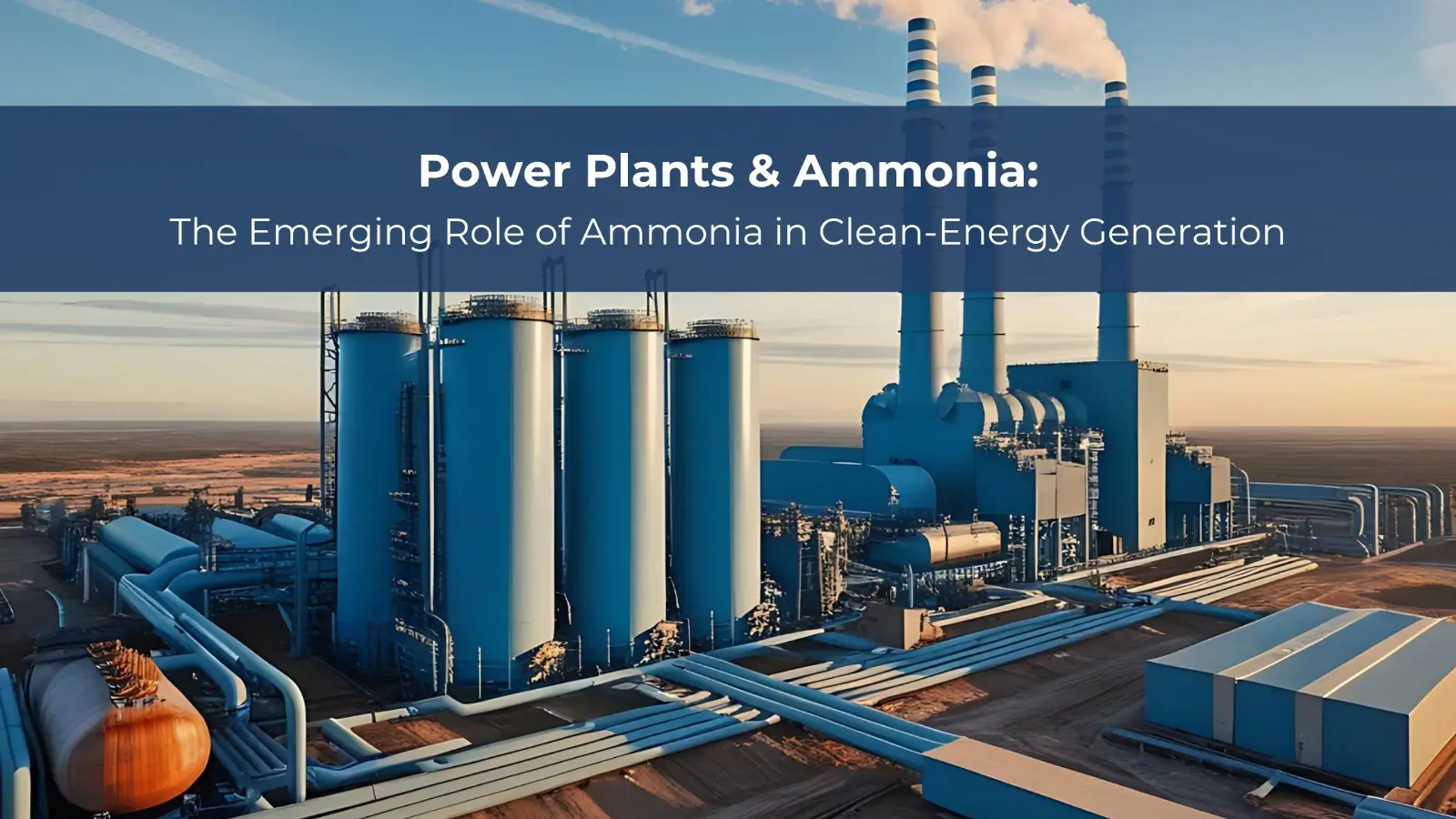
- SCR DeNOx today: Ammonia is already critical to Indian power plants for Selective Catalytic Reduction (SCR) — reducing NOx emissions to meet CPCB standards across India’s ~200 GW coal fleet.
- Co-firing potential: Japan has demonstrated 20% ammonia co-firing in coal plants (reducing CO2 by 20%) — a pathway India is evaluating for its large coal-fired power plant fleet.
- Green hydrogen mission: India’s National Green Hydrogen Mission targets 5 MT/year green hydrogen by 2030, with green ammonia as the primary export vehicle — central to India’s energy trade strategy.
- Fuel cells: Solid oxide fuel cells can operate directly on ammonia; PEM fuel cells can use cracked ammonia after purification — opening distributed clean power applications.
- SCR ammonia demand: A 500 MW coal plant consumes 5,000–8,000 tonnes of anhydrous ammonia per year for SCR — creating substantial ongoing demand as India’s power fleet installs emission controls.
- Zero carbon combustion: When green ammonia is the fuel source, combustion produces only N2 and H2O — achieving net-zero CO2 power generation from existing combustion infrastructure.
- Ammonia’s Role in the Energy Transition
- SCR DeNOx: Ammonia in Indian Power Plants Today
- SCR Chemistry and System Design
- SNCR vs SCR: Comparison
- Ammonia Co-Firing in Coal Power Plants
- Ammonia in Gas Turbine Power Generation
- Ammonia in Fuel Cell Power Systems
- Ammonia as a Hydrogen Carrier for Energy
- India’s National Green Hydrogen Mission
- Sourcing Ammonia for Power Sector Applications
- Who Uses Ammonia in India’s Energy Sector?
- Related Reading
- Frequently Asked Questions
Ammonia has always been a chemical that keeps the world running — feeding crops, cooling food, and processing materials across every sector of the economy. Now it is taking on a new and arguably more consequential role: as a tool for cleaning up the energy sector that powers those same industries. In India, this transition is already underway in power plant emission control, and is being planned at national scale for the green hydrogen export trade that could reshape the country’s energy economy through the 2030s.
Jaysons Chemical Industries, a division of Jaysons Chemical Industries, supplies anhydrous ammonia to power sector customers including thermal power plants with SCR systems, DeNOx project operators, and emerging clean energy developers. This guide covers every dimension of ammonia’s role in the energy transition — from the practical and present to the strategic and future.
1. Ammonia’s Role in the Energy Transition
The global energy system faces a fundamental challenge: reducing CO2 emissions while maintaining reliable, affordable power supply. The challenge is most acute in countries like India, where a large fleet of coal-fired power plants provides the baseload generation that variable renewables cannot yet replace, and where rapid economic growth is driving electricity demand upward even as the world demands lower emissions.
Ammonia addresses this challenge at multiple points simultaneously. In the near term, it enables emission compliance at existing coal plants through SCR DeNOx systems — reducing NOx pollution without retiring plant prematurely. In the medium term, co-firing ammonia with coal offers a pathway to reduce CO2 from existing plants while new renewable capacity is built. In the long term, green ammonia produced from renewable electricity is positioned as a globally traded zero-carbon energy commodity and hydrogen carrier.
2. SCR DeNOx: Ammonia in Indian Power Plants Today
The most immediate and commercially significant energy sector application of ammonia in India is in Selective Catalytic Reduction (SCR) and Selective Non-Catalytic Reduction (SNCR) systems for NOx emission control. India’s Central Pollution Control Board (CPCB) mandated emission standards for large thermal power plants in 2015, requiring compliance with NOx limits of 300–600 mg/Nm3 (depending on plant vintage) — achievable only through post-combustion treatment using ammonia-based reagents.
India operates approximately 200 GW of coal-fired power plant capacity, primarily in states including Uttar Pradesh, Maharashtra, Jharkhand, Odisha, Chhattisgarh, Gujarat, Andhra Pradesh, and Telangana. Installing SCR or SNCR systems on this fleet represents a major capital investment programme — and a major sustained demand stream for anhydrous ammonia or urea solution as the NOx-reducing reagent.
3. SCR Chemistry and System Design
The SCR process injects gaseous ammonia (or urea solution that thermally decomposes to ammonia) into the hot flue gas stream before it passes over a honeycomb catalyst bed. The catalyst — typically vanadium pentoxide (V2O5) on titanium dioxide (TiO2) support — facilitates the selective reaction of ammonia with NOx at flue gas temperatures of 300–400°C:
4NH3 + 4NO + O2 → 4N2 + 6H2O (dominant reaction)
8NH3 + 6NO2 → 7N2 + 12H2O (with NO2 present)
The reaction is selective — ammonia preferentially reacts with NOx rather than with oxygen, hence “selective” catalytic reduction. NOx reduction efficiencies of 80–95% are achievable with properly designed systems operating within the catalyst’s temperature window. The only reaction products are molecular nitrogen (a harmless atmospheric constituent) and water — making this one of the cleanest pollution control technologies available.
Ammonia Injection System Design
Ammonia injection must be carefully designed for uniform mixing with the flue gas to avoid “ammonia slip” — unreacted ammonia passing through the catalyst and exiting the stack. Excessive ammonia slip can cause secondary pollution and react with SO3 in the flue gas to form ammonium sulphate deposits that foul downstream equipment. Proper injection grid design, flow distribution, and ammonia-to-NOx ratio control are critical engineering requirements for effective SCR operation.
4. SNCR vs SCR: Comparison
| Parameter | SCR | SNCR |
|---|---|---|
| Reagent | Anhydrous ammonia or urea solution | Urea solution or aqueous ammonia |
| Reaction temperature | 300–400°C (catalyst zone) | 850–1,100°C (furnace injection) |
| NOx reduction efficiency | 80–95% | 30–60% |
| Capital cost | High (catalyst beds, ducting, support structure) | Low (injection lances, dosing system only) |
| Operating cost | Moderate (reagent + catalyst replacement) | Low (reagent only) |
| Ammonia slip risk | Manageable with proper design | Higher (temperature window is critical) |
| Applicable emission standard | Strict (300 mg/Nm3 and below) | Intermediate (600 mg/Nm3) |
For India’s newest and largest power plants required to meet the strictest CPCB emission standards, SCR is mandatory. For older plants with less stringent compliance targets or interim compliance requirements, SNCR may be sufficient. Many plants are installing SNCR first as an interim measure while evaluating SCR installation during the next major planned outage.
5. Ammonia Co-Firing in Coal Power Plants
Ammonia co-firing — replacing a fraction of coal fuel with ammonia in a thermal power plant boiler — is the most commercially advanced pathway for reducing CO2 from existing coal generation assets without retiring them. Japan’s JERA utility demonstrated 20% ammonia co-firing (by energy fraction) at its Hekinan Unit 4 (1,000 MW) in 2023, achieving approximately 20% CO2 reduction per unit of electricity generated.
The technical requirements for coal co-firing include: burner modification to handle ammonia’s different flame characteristics (higher ignition temperature, narrower flammability range than coal volatiles); NOx management to control ammonia-derived NOx from nitrogen in the fuel; and materials assessment to confirm boiler tube compatibility with ammonia combustion gases. These are manageable engineering challenges — not fundamental barriers — but they require capital investment and planned plant outage for retrofitting.
For India, the key enabler for ammonia co-firing at scale is the development of competitive domestic green ammonia supply. At current grey ammonia prices, co-firing economics do not stack up without carbon pricing or policy support. But as green ammonia production scales and costs decline — driven by India’s abundant solar and wind resources — co-firing becomes progressively more attractive, particularly if a carbon price or coal tax creates a financial incentive to reduce CO2 intensity.
6. Ammonia in Gas Turbine Power Generation
Gas turbines can be modified to combust ammonia-hydrogen blends — typically 70:30 or 60:40 by energy fraction — with the hydrogen improving flame stability and combustion completeness. Pure ammonia combustion in gas turbines is challenging due to its high ignition temperature (651°C) and narrow flammability range (15–28%), but blending with a fraction of hydrogen or natural gas significantly improves these characteristics.
Japanese manufacturers IHI Corporation and Mitsubishi Heavy Industries (MHI) have both demonstrated ammonia combustion in gas turbines at multi-MW scale. MHI’s H-25 gas turbine has been tested on 20% ammonia-hydrogen blends. Commercial deployment of ammonia-capable gas turbines for power generation is targeted for the late 2020s, with initial applications likely in dedicated ammonia import terminals where fuel is already available.
7. Ammonia in Fuel Cell Power Systems
Fuel cells convert chemical energy directly to electricity with high efficiency and zero emissions at the point of use. Ammonia can power fuel cells either directly or as a cracked hydrogen source, enabling distributed clean power generation using ammonia’s convenient storage and supply infrastructure.
Solid Oxide Fuel Cells
Solid oxide fuel cells (SOFCs) operating at 700–900°C can use ammonia directly as fuel — the high temperature enables in-situ cracking of NH3 to H2 and N2 inside the fuel cell stack, after which the hydrogen is electrochemically oxidised to produce electricity. SOFC systems operating on ammonia achieve electrical efficiencies of 50–60%, comparable to hydrogen-fuelled performance. Several SOFC developers globally are developing ammonia-compatible systems for stationary power generation applications.
PEM Fuel Cells via Cracking
Proton exchange membrane (PEM) fuel cells require high-purity hydrogen and cannot tolerate even ppm-level ammonia in the fuel stream. Using ammonia as a PEM fuel cell feed requires: an upstream ammonia cracker to decompose NH3 to H2 and N2; and downstream pressure swing adsorption (PSA) or membrane purification to achieve hydrogen purity levels below 0.1 ppm ammonia and below 10 ppm nitrogen. The total system — cracker + purifier + PEM — achieves high efficiency but at higher capital cost and complexity than SOFC direct ammonia systems.
8. Ammonia as a Hydrogen Carrier for Energy
Beyond direct combustion, ammonia’s most strategically important energy role is as a hydrogen carrier — enabling large-scale trade in renewable energy between producing and consuming regions. The pathway is: renewable electricity (solar/wind) → water electrolysis → green hydrogen → Haber-Bosch synthesis → green ammonia → shipping → ammonia cracking → green hydrogen → fuel cell or industrial use.
This pathway is preferred over direct hydrogen shipping because ammonia is liquid at ambient temperature under modest pressure (8–10 bar), making it practical to ship in conventional tankers. Liquid hydrogen requires storage at -253°C — extreme conditions that make shipping costly and technically demanding at scale. Ammonia’s existing global shipping and port infrastructure — built for the fertiliser trade — provides a ready-made logistics network for hydrogen carrier trade.
9. India’s National Green Hydrogen Mission
India’s National Green Hydrogen Mission (NGHM), launched in January 2023, commits Rs 19,744 crore of government support to achieve 5 MT/year of green hydrogen production by 2030 — a target that includes green ammonia as one of the primary outputs. The mission has three strategic objectives: making India energy-independent by replacing imported fossil fuels with domestically produced green hydrogen and ammonia; making India a major green hydrogen and green ammonia exporter to Japan, South Korea, Germany, and the Netherlands; and driving decarbonisation of India’s fertiliser, steel, and chemicals sectors.
Export Market Opportunity
Japan has committed to importing 3 million MT of ammonia per year by 2030 for power plant co-firing. South Korea, Germany, and the Netherlands have identified India as a priority green ammonia supplier. If India can develop green ammonia production at competitive cost — leveraging its abundant solar and offshore wind resources — the export revenue opportunity is substantial: potentially USD 10–15 billion per year by 2030 at projected green ammonia prices.
Project Pipeline
Major industrial groups including Adani Green Energy, Reliance New Energy, NTPC, ACME Solar, ReNew Power, and Greenko are developing green ammonia projects at various stages of planning and execution. Key project locations include Kandla and Hazira in Gujarat, Visakhapatnam and Krishnapatnam in Andhra Pradesh, and Tuticorin in Tamil Nadu — all coastal locations with access to deep-water shipping terminals.
10. Sourcing Ammonia for Power Sector Applications
Power plant SCR systems have specific ammonia procurement requirements that differ from fertiliser or refrigeration applications. Key considerations include:
- Grade: Standard industrial-grade anhydrous ammonia (99.5%+ NH3) is typically adequate for SCR applications — the catalyst is not poisoned by trace impurities at levels present in standard industrial product. Some system designers specify higher purity to reduce catalyst deactivation risk over multi-year operating campaigns.
- Volume and reliability: Power plants require continuous ammonia supply during operation — typically 6,000–8,000 operating hours per year. Supply interruption causes immediate compliance risk. Qualified suppliers must demonstrate fleet capacity, backup stocking, and 24/7 emergency delivery capability.
- Storage: On-site ammonia storage at power plants is typically designed for 7–30 days of operation at full load — 100–500 tonne bulk storage is common. All storage must comply with PESO licensing and MSIHC Rules requirements.
- Safety documentation: Power plant operators require full MSDS, regulatory compliance documentation, PESO transport certificates, and emergency response information for all ammonia deliveries.
11. Who Uses Ammonia in India’s Energy Sector?
- Thermal Power Plants — SCR and SNCR DeNOx systems
- Green Hydrogen Projects — ammonia cracking for H2 production
- Port Terminal Operators — ammonia import/export for energy trade
- Fuel Cell Developers — SOFC direct ammonia and PEM cracker systems
- Green Ammonia Producers — renewable electrolysis and Haber-Bosch
- Ammonia Export Projects — major conglomerate green energy investments
- Gujarat — thermal power plants, green ammonia export terminals
- Andhra Pradesh — offshore wind, green ammonia export, power plants
- Rajasthan — large solar parks for green ammonia production
- Tamil Nadu — offshore wind, Tuticorin port
- Odisha — thermal power clusters, eastern coast ports
- Maharashtra — large thermal power fleet, industrial clusters
12. Related Reading
Frequently Asked Questions
What is the role of ammonia in India’s power sector today?
Ammonia’s primary role in India’s power sector today is in SCR and SNCR DeNOx systems — reducing nitrogen oxide emissions from coal-fired plants to meet CPCB standards. India’s ~200 GW coal fleet installing these systems creates significant ongoing ammonia demand. Future roles as co-firing fuel and hydrogen carrier are at earlier development stages.
What is SCR and how does ammonia work in it?
SCR (Selective Catalytic Reduction) injects ammonia into hot flue gas before it passes over a vanadium-titanium catalyst. The ammonia reacts with NOx to produce harmless nitrogen and water: 4NH3 + 4NO + O2 → 4N2 + 6H2O. SCR achieves 80–95% NOx reduction, enabling compliance with strict CPCB emission standards.
What is ammonia co-firing in coal power plants?
Co-firing substitutes a portion of coal fuel with ammonia in a boiler, reducing the fraction of fossil carbon burned and proportionally reducing CO2 emissions. Japan’s JERA demonstrated 20% ammonia co-firing at a 1,000 MW plant — reducing CO2 by approximately 20%. India is evaluating this pathway as a near-term decarbonisation option for its large coal fleet.
What is India’s National Green Hydrogen Mission and what role does ammonia play?
India’s NGHM (launched January 2023) targets 5 MT/year of green hydrogen production by 2030, with green ammonia as the primary export vehicle. Green hydrogen is synthesised into ammonia in India using renewable electricity, shipped to importing countries, and cracked back to hydrogen at the destination. Ammonia is central to India’s clean energy trade strategy.
How much ammonia does a typical coal power plant need for SCR?
A 500 MW coal plant with SCR typically consumes 5,000–8,000 tonnes of anhydrous ammonia per year. A 1,000 MW plant may consume 10,000–16,000 tonnes per year. India’s full 200 GW coal fleet fully equipped with SCR could create 2–4 million tonnes of annual ammonia demand for NOx control alone.
What purity of ammonia is required for power plant SCR systems?
Standard industrial-grade anhydrous ammonia (99.5%+ NH3) is typically adequate for SCR. Some designers specify higher purity to reduce long-term catalyst deactivation risk. All ammonia for power plant use must comply with PESO storage requirements and Gas Cylinders Rules 2016 for on-site bulk storage.
What is the difference between SCR and SNCR for NOx control?
SCR uses ammonia plus a catalyst at 300–400°C, achieving 80–95% NOx reduction — required for the strictest emission standards. SNCR injects ammonia or urea directly into the furnace at 850–1,100°C without a catalyst, achieving only 30–60% reduction — sufficient for intermediate compliance. SCR has higher capital cost but is necessary for plants requiring 80%+ NOx reduction.
Which Indian states have the most power plants using ammonia for SCR?
States with the largest coal power plant concentrations include Uttar Pradesh, Maharashtra, Jharkhand, Odisha, Chhattisgarh, Gujarat, Andhra Pradesh, and Telangana. NTPC, Adani Power, Tata Power, and Reliance Power plant clusters in these states represent the primary institutional customers for SCR ammonia supply.