

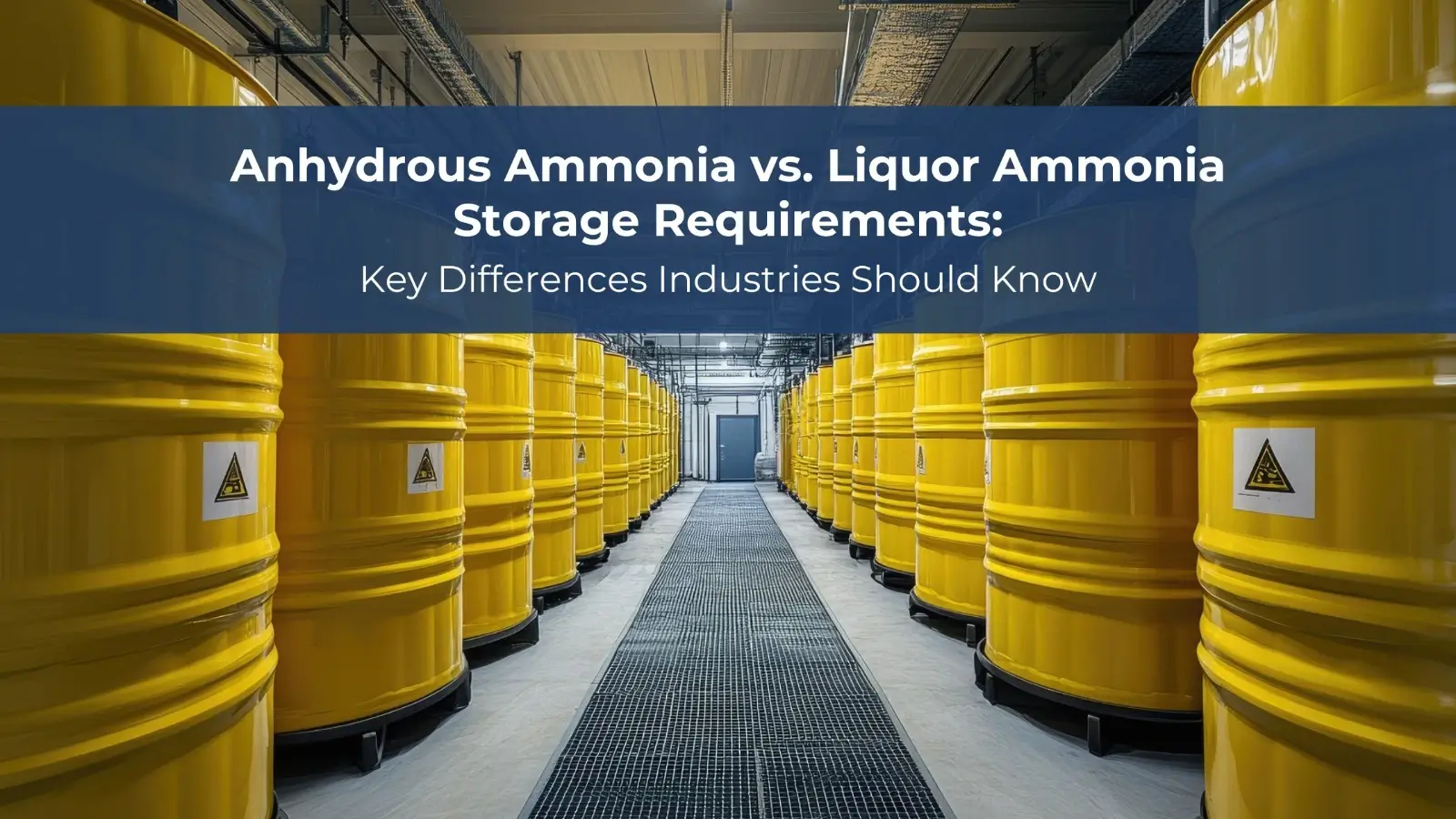
- Fundamental difference: Anhydrous ammonia requires pressure vessel storage (7–10 bar at ambient temperature); liquor ammonia can be stored in atmospheric HDPE or SS tanks — the single biggest difference driving all other storage requirement variations.
- PESO licensing: Both forms require PESO licensing above threshold quantities in India — anhydrous ammonia has stricter requirements due to its pressurised, pure-gas form.
- Testing intervals: Anhydrous ammonia pressure vessels require hydrostatic testing every 5 years; safety relief valves annually. Liquor ammonia atmospheric tanks have less frequent formal testing requirements but must be included in the facility’s PESO licence.
- Material compatibility: Both forms are incompatible with copper, copper alloys, and zinc. Anhydrous requires carbon steel pressure vessels; liquor ammonia uses HDPE or stainless steel at atmospheric pressure.
- Secondary containment: Both require bunded storage areas capable of containing 110% of the largest tank volume — impermeable construction, controlled drainage, no connection to surface water.
- Vapour hazard: Anhydrous ammonia leaks create faster, higher-concentration toxic gas releases than equivalent liquor ammonia spills — requiring more robust emergency detection and response systems.
- The Core Physical Difference
- Anhydrous Ammonia: Pressure Vessel Requirements
- Liquor Ammonia: Atmospheric Tank Requirements
- Side-by-Side Storage Requirement Comparison
- Safety Systems Comparison
- Inspection and Testing Requirements
- PESO Licensing Differences
- Secondary Containment Requirements
- Emergency Response Differences
- Infrastructure and Space Planning
- Choosing the Right Storage Approach for Your Application
- Related Reading
- Frequently Asked Questions
Ammonia is widely used across Indian industry in two fundamentally different forms — anhydrous ammonia (pure NH3, pressurised) and liquor ammonia (aqueous ammonia solution, atmospheric pressure). The storage requirements for these two forms differ substantially across every dimension: vessel design, pressure containment, material selection, safety systems, PESO licensing, inspection intervals, and emergency response protocols. Understanding these differences is essential for facility designers, plant managers, EHS officers, and procurement teams planning ammonia storage infrastructure.
This guide provides a practical, comprehensive side-by-side comparison of the storage requirements for both forms. Jaysons Chemical Industries supplies both anhydrous ammonia and liquor ammonia to industrial customers across India and advises on storage infrastructure design as part of our supply service.
1. The Core Physical Difference
The storage requirement difference between anhydrous and liquor ammonia flows from one fundamental physical fact: anhydrous ammonia is a pressurised liquefied gas at ambient temperature, while liquor ammonia is an atmospheric-pressure aqueous solution.
Pure anhydrous ammonia has a boiling point of -33.3°C at atmospheric pressure. At ambient Indian temperatures (25–45°C), it exists as a liquid only when contained under its own vapour pressure — approximately 10–17 bar depending on temperature. Release of this containment causes the liquid to immediately flash-vaporise, generating large volumes of toxic ammonia gas at high concentration. This physical behaviour is what makes anhydrous ammonia storage so demanding.
Liquor ammonia at 20–28% NH3 concentration has its ammonia dissolved in water. The water suppresses the vapour pressure dramatically — liquor ammonia at 25°C has a vapour pressure of approximately 0.3–0.6 bar above atmospheric, compared to anhydrous ammonia’s approximately 10 bar. This means liquor ammonia can be stored in sealed atmospheric tanks — no pressure containment is required. A liquor ammonia spill produces a liquid pool that vaporises gradually, creating a lower-concentration vapour hazard compared to an anhydrous ammonia release of equivalent mass.
2. Anhydrous Ammonia: Pressure Vessel Requirements
Anhydrous ammonia storage in India at all scales — from individual cylinders to bulk storage tanks — requires pressure-rated vessels designed and constructed to applicable BIS standards and approved by PESO.
Cylinders and Tonners
Standard cylinders (47 kg, 100 kg, 150 kg) must comply with IS 7285 (seamless steel gas cylinders) with BIS certification marks. Tonners (900–1,000 kg) must comply with IS 3196 (welded pressure vessels for liquefied gas). All valves must be IS 5765-compliant left-hand thread design. Every vessel must carry its design pressure, tare weight, water capacity, manufacture date, and hydrostatic test date stamped on the body. Full details on cylinder and tonner sizes and specifications are in our dedicated guide.
Bulk Storage Tanks
Bulk anhydrous ammonia storage tanks above tonner scale must be designed and constructed to IS 2825 (Code for Unfired Pressure Vessels) and approved by PESO before commissioning. The design pressure must account for the maximum expected operating temperature at the site — a bulk tank in Rajasthan where ambient temperature may reach 45°C in summer must be designed for a significantly higher vapour pressure than the same tank in Himachal Pradesh. Design pressure of 25–30 bar is typical for Indian bulk ammonia storage. Tanks must be provided with: pressure relief valves, liquid level gauges, pressure gauges, temperature gauges, fill connections with excess flow valve, withdrawal connections with emergency isolation valve, and vent/bleed connections for safe maintenance isolation.
3. Liquor Ammonia: Atmospheric Tank Requirements
Liquor ammonia can be stored in standard atmospheric-pressure chemical tanks — a significant capital and operational simplification compared to pressure vessel storage. However, atmospheric storage does not eliminate the safety requirements — it changes them.
Tank Construction
HDPE tanks are the most common choice for liquor ammonia storage up to approximately 50,000 litres. HDPE is fully compatible with ammonium hydroxide solutions across the full 10–28% concentration range, is corrosion-proof, and is manufactured in standard sizes by multiple Indian suppliers at reasonable cost. Tanks above 50,000 litres are typically constructed in stainless steel (304 or 316 grade) — HDPE tanks of this capacity become structurally challenging and expensive.
Vent Management
Even at atmospheric pressure, liquor ammonia tanks must be provided with vented pressure relief — the ammonia vapour above the liquid surface must be able to escape if the tank is overfilled or heated, without causing tank over-pressurisation. Vents must be directed to a safe discharge point — not into occupied areas. For large tanks or tanks in enclosed buildings, vent scrubbers (water scrubbers absorbing ammonia vapour before atmospheric release) may be required as part of the PESO licence conditions or air permit requirements.
Fill and Withdrawal Connections
Liquor ammonia is pumped in and out of atmospheric tanks using chemical-resistant centrifugal or diaphragm pumps. Fill connections should include a ball valve and a check valve to prevent backflow during filling. Withdrawal connections require isolation valves to allow safe maintenance. All pump seals must be compatible with ammonium hydroxide solution — PTFE or EPDM seals are typically specified.
4. Side-by-Side Storage Requirement Comparison
| Parameter | Anhydrous Ammonia | Liquor Ammonia (20–28%) |
|---|---|---|
| Storage pressure | 7–17 bar (vapour pressure at ambient temp) | Atmospheric (slight positive vapour pressure) |
| Vessel type | IS 3196 / IS 2825 pressure vessel | HDPE or SS atmospheric tank |
| Preferred tank material | Carbon steel (pressure vessel grade) | HDPE or SS 304/316 |
| BIS standard (vessel) | IS 7285 (cylinders), IS 3196 (tonners), IS 2825 (bulk) | No specific BIS vessel standard — chemical tank standards |
| Pressure relief required | Yes — PRV mandatory on all vessels | Vent system required — no PRV typically needed |
| Hydrostatic test interval | Every 5 years (cylinders/tonners); per PESO licence (bulk) | No hydrostatic test — visual and leak inspection |
| Safety relief valve test interval | Annually | Not applicable for atmospheric tanks |
| PESO licence required | Yes — above threshold quantities | Yes — above threshold quantities |
| Secondary bunding required | Yes — 110% of largest tank volume | Yes — 110% of largest tank volume |
| Capital cost (per tonne NH3) | Higher | Lower |
5. Safety Systems Comparison
Both forms of ammonia storage require comprehensive safety systems, but the specific requirements differ reflecting the different vapour release characteristics of each form.
Gas Detection
Both anhydrous and liquor ammonia storage areas require fixed electrochemical ammonia gas detectors calibrated to alarm at 25 ppm (warning) and 150 ppm (evacuate). For anhydrous ammonia, detector placement should account for the rapid gas dispersion that follows a leak — multiple detectors positioned at different heights and locations are typically required. For liquor ammonia, gas concentrations near a spill build more slowly, but detectors are still mandatory. All detector alarms must be connected to audible/visual alarms and automatic ventilation activation.
Ventilation
Both storage types require ventilation. Anhydrous ammonia pressure vessel storage areas — particularly enclosed machine rooms and storage buildings — require mechanical ventilation providing minimum 10 air changes per hour normally and 30+ air changes per hour on alarm activation. Liquor ammonia storage areas require ventilation to prevent vapour accumulation, but the lower vapour pressure means the ventilation rate requirements are somewhat less demanding in equivalent-sized spaces.
Emergency Shower and Eyewash
Both forms require emergency shower and eyewash stations within 10 seconds walking distance of all storage and handling areas. This is non-negotiable for both forms — contact of either concentrated anhydrous ammonia (as liquid or gas) or liquor ammonia with eyes or skin requires immediate flushing with large volumes of water.
Expert Guidance on Ammonia Storage Design from Jaysons Chemical Industries
Jaysons Chemical Industries provides storage layout guidance, PESO licence application support, and IS-compliant ammonia supply with full documentation. Our experienced team helps customers design compliant ammonia storage from the start.
6. Inspection and Testing Requirements
Anhydrous Ammonia Pressure Vessels
- Cylinders and tonners: Hydrostatic test every 5 years at PESO-approved testing station. Visual inspection at every filling. Safety relief valve bench test annually.
- Bulk storage tanks: External visual inspection annually. Ultrasonic thickness measurement every 2–3 years. Internal inspection per PESO licence conditions (typically every 5–10 years). Safety relief valve bench test every 2–3 years.
- All inspection results must be documented and retained for PESO licence renewal and regulatory inspection.
Liquor Ammonia Atmospheric Tanks
- No formal hydrostatic test requirement — atmospheric tanks are not pressure vessels.
- Annual external visual inspection for corrosion, coating damage, mechanical damage, and joint/weld integrity.
- Tank wall thickness measurement every 3–5 years using ultrasonic testing to monitor corrosion rate.
- Pump, valve, and fitting inspection at every maintenance opportunity.
- Vent system inspection and cleaning annually to ensure free discharge.
7. PESO Licensing Differences
Both anhydrous ammonia and liquor ammonia storage above specified threshold quantities require PESO licences under the Gas Cylinders Rules 2016. However, the licence requirements differ in complexity and content.
Anhydrous ammonia PESO licences specify: approved vessel identifiers (serial numbers, design pressure, water capacity); maximum stored quantity; storage location and safety distance compliance; safety system specifications (PRVs, detection, ventilation); testing intervals for vessels and safety devices; and operator training requirements. Licences require renewal periodically and amendment for any changes to vessel inventory or storage configuration.
Liquor ammonia PESO licences are generally less complex — specifying tank capacity, location, containment provisions, detection, and ventilation — but are still mandatory above threshold quantities. For sites storing both forms, separate licence conditions typically apply to each storage area, and both must be current at all times.
8. Secondary Containment Requirements
Secondary containment — bunding — is mandatory for all ammonia storage above relatively small quantities. The bund must contain 110% of the largest tank volume in the bunded area, allowing for the full contents of the largest tank to be contained in the event of catastrophic failure plus an allowance for precipitation accumulation.
For anhydrous ammonia pressure vessels, secondary bunding serves to contain any liquid ammonia that escapes before vaporising — it does not prevent atmospheric vapour dispersion from a major release, but it limits the area over which liquid ammonia pools and vaporises, controlling the source of the vapour hazard. The bund floor must be sealed and impermeable, and drainage controlled to a sealed sump.
For liquor ammonia, the bund serves a more conventional chemical spill containment function — retaining the aqueous spill, preventing it from reaching drains or waterways where it would cause environmental contamination. Liquor ammonia spills, while hazardous, do not flash-vaporise like anhydrous — the spill can be recovered and neutralised if contained within the bund.
9. Emergency Response Differences
Anhydrous Ammonia Emergency Response
A major anhydrous ammonia release requires immediate area evacuation, SCBA for responders entering the affected zone, and activation of water curtains (if available) to suppress vapour cloud dispersion. Water spray onto anhydrous liquid ammonia spills must be applied carefully — water accelerates vaporisation of cold liquid ammonia if applied as a direct stream, but can be used as a dilute water curtain at distance to suppress the vapour cloud. Emergency isolation of the release source from outside the affected zone is the priority action. Full details are in our ammonia handling and storage safety guide.
Liquor Ammonia Emergency Response
A major liquor ammonia spill within the secondary bund is typically manageable — evacuate the immediate area, don PPE, isolate the source, and apply water dilution to the bund contents to reduce ammonia vapour emission from the spill pool. The aqueous nature of the spill means it can be neutralised with a weak acid (dilute hydrochloric acid or citric acid solution) and the resulting ammonium salt solution safely disposed of through the effluent treatment system. Full guidance is in our liquor ammonia storage procedures guide.
10. Infrastructure and Space Planning
When planning a new ammonia storage installation, the choice between anhydrous and liquor ammonia forms has significant implications for facility layout, capital expenditure, and ongoing operating cost.
| Planning Consideration | Anhydrous Ammonia | Liquor Ammonia |
|---|---|---|
| Safety distance from buildings | Larger — per PESO licence based on stored quantity | Smaller — lower vapour release risk |
| Civil works complexity | High — pressure vessel foundations, bunding, emergency systems | Moderate — atmospheric tank pad, bunding, ventilation |
| Typical capex per tonne NH3 stored | Higher | Lower |
| Operating cost drivers | Inspection, testing, safety system maintenance, PESO renewal | Pump maintenance, ventilation, periodic inspection |
| Lead time for installation | Longer — PESO approval required before commissioning | Shorter — less complex regulatory approval |
11. Choosing the Right Storage Approach for Your Application
The choice between anhydrous and liquor ammonia storage is ultimately determined by the form of ammonia your process requires. If your application uses anhydrous ammonia — refrigeration, direct soil injection, SCR systems — you must store anhydrous. If your application uses liquor ammonia — textile processing, cleaning, water treatment, rubber processing — you store liquor. Where both forms could potentially serve the application, the decision should weigh: nitrogen content requirements, capital cost, safety management complexity, PESO compliance burden, and supply logistics in your location.
- Industrial Refrigeration — Anhydrous ammonia mandatory (IS 5116 grade)
- Agricultural Direct Injection — Anhydrous ammonia (82% N)
- Textile and Dyeing — Liquor ammonia (20–28%)
- Water Treatment Chloramination — Liquor or anhydrous (larger plants)
- Cleaning Product Manufacturing — Liquor ammonia (IS 6099)
- Power Plant SCR — Anhydrous or urea solution (site-specific)
Frequently Asked Questions
What is the main difference between anhydrous ammonia and liquor ammonia storage?
The fundamental difference is pressure: anhydrous ammonia must be stored under its own vapour pressure (7–17 bar at ambient temperature) in IS 3196 or IS 2825-certified pressure vessels. Liquor ammonia’s water content dramatically suppresses vapour pressure, allowing storage in atmospheric HDPE or stainless steel tanks. This drives all other storage requirement differences — vessel cost, safety complexity, PESO licensing strictness, and emergency response protocols.
Does liquor ammonia storage require PESO licensing in India?
Yes — liquor ammonia storage above threshold quantities requires a PESO licence under the Gas Cylinders Rules 2016, even at atmospheric pressure. The exact threshold depends on state-specific interpretation and site classification. Contact your regional PESO office or Jaysons Chemical Industries for guidance on the applicable threshold for your facility configuration.
What tank materials are compatible with anhydrous ammonia storage?
Anhydrous ammonia storage tanks must be carbon steel or low-alloy steel to IS 2825 specification. Copper, brass, bronze, zinc, galvanised steel, and aluminium are all incompatible — ammonia corrodes these materials and forms contaminating compounds. All internal fittings, valves, gauges, and instrumentation must be verified for ammonia compatibility.
What tank materials are compatible with liquor ammonia storage?
Liquor ammonia is compatible with HDPE (most common choice), stainless steel (SS 304/316), and FRP. Mild carbon steel is not recommended for long-term liquor ammonia storage. Copper and copper alloys are incompatible, as with anhydrous ammonia. HDPE tanks are the most cost-effective choice for capacities up to approximately 50,000 litres.
How often must anhydrous ammonia pressure vessels be inspected in India?
Cylinders and tonners: hydrostatic test every 5 years at a PESO-approved station; safety relief valve bench test annually. Bulk storage tanks: external visual inspection annually; ultrasonic thickness testing every 2–3 years; internal inspection per PESO licence conditions (typically every 5–10 years). All results must be documented and retained for PESO renewal.
What secondary containment is required for ammonia storage in India?
Both anhydrous and liquor ammonia storage require bunded areas capable of containing 110% of the largest tank volume. Bund construction must be impermeable and chemically resistant. Drainage must be controlled — never directed to surface water. PESO licence conditions specify bunding requirements for each facility.
Can anhydrous and liquor ammonia be stored in the same facility?
Yes — many facilities store both forms for different applications, but they must be stored in separate dedicated areas with appropriate segregation. Clear labelling, colour coding, and written procedures are essential when both forms are present, as the handling equipment, PPE, and emergency procedures differ significantly between the two forms.
What is the risk difference between an anhydrous ammonia leak and a liquor ammonia spill?
An anhydrous ammonia leak produces a rapid two-phase release — part flashes to gas creating a high-concentration toxic cloud and a cold liquid that continues vaporising. A liquor ammonia spill releases a liquid solution that vaporises more slowly with lower peak concentrations. Anhydrous leaks generally create a more severe immediate toxic exposure risk over a wider area than equivalent liquor ammonia spills — though both require immediate emergency response.