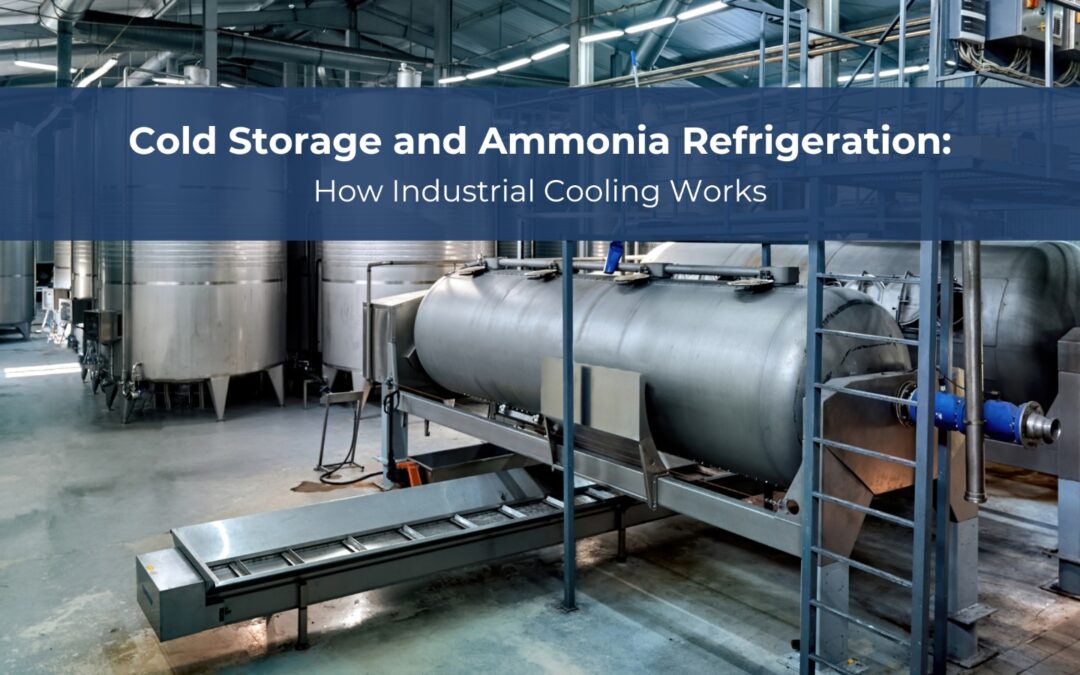

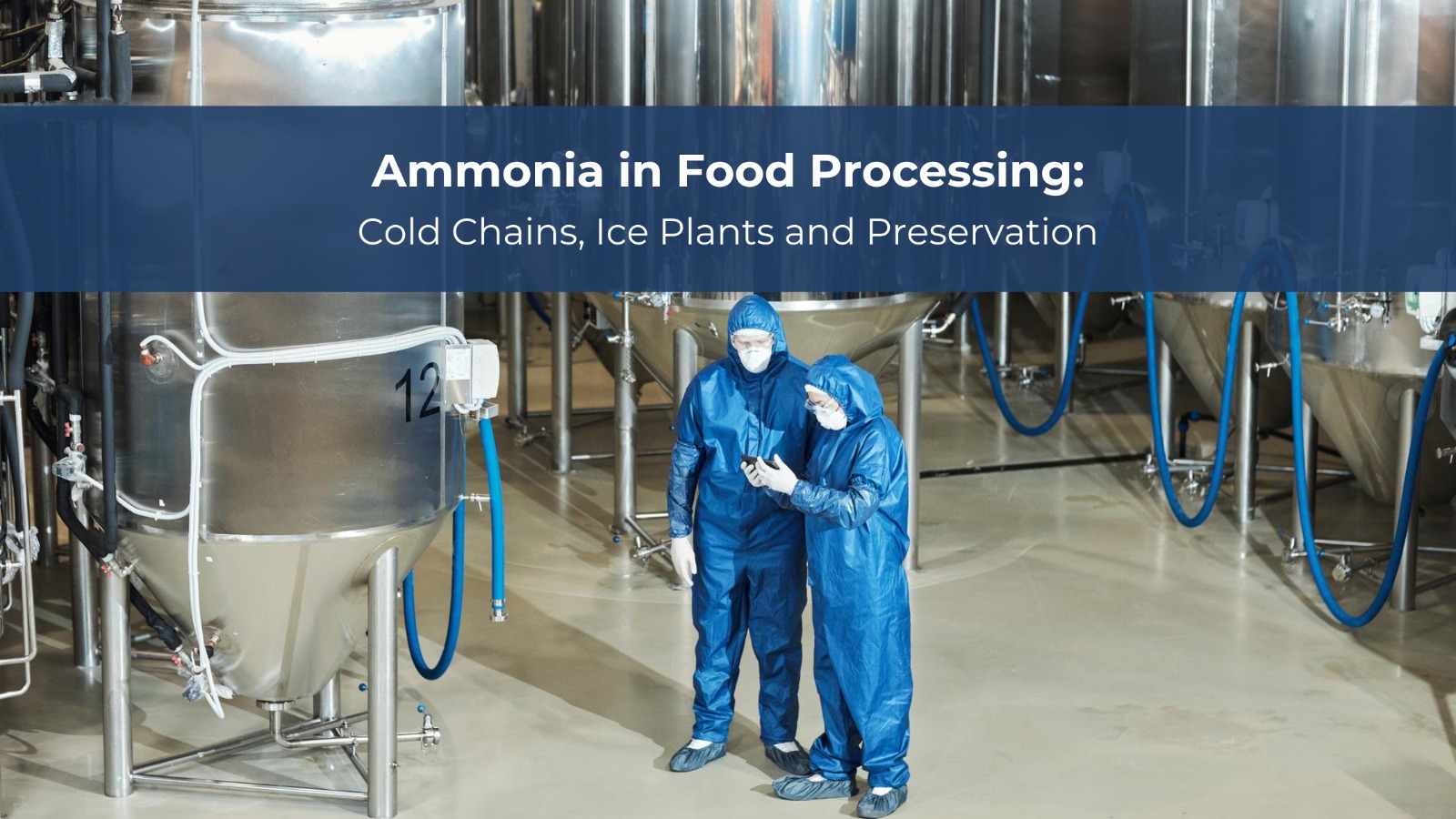
- Ammonia is the world’s most widely used industrial refrigerant in large-scale food processing, valued for its energy efficiency and zero global warming potential.
- India’s food processing sector including cold stores, ice plants, poultry, dairy, and seafood facilities depends on anhydrous ammonia refrigeration to prevent spoilage.
- Ammonia refrigeration systems achieve Coefficient of Performance (COP) values 10-20% higher than synthetic refrigerants, reducing energy costs significantly.
- Both direct and indirect ammonia refrigeration systems are used in food plants, with system design determined by food contact risk and facility layout.
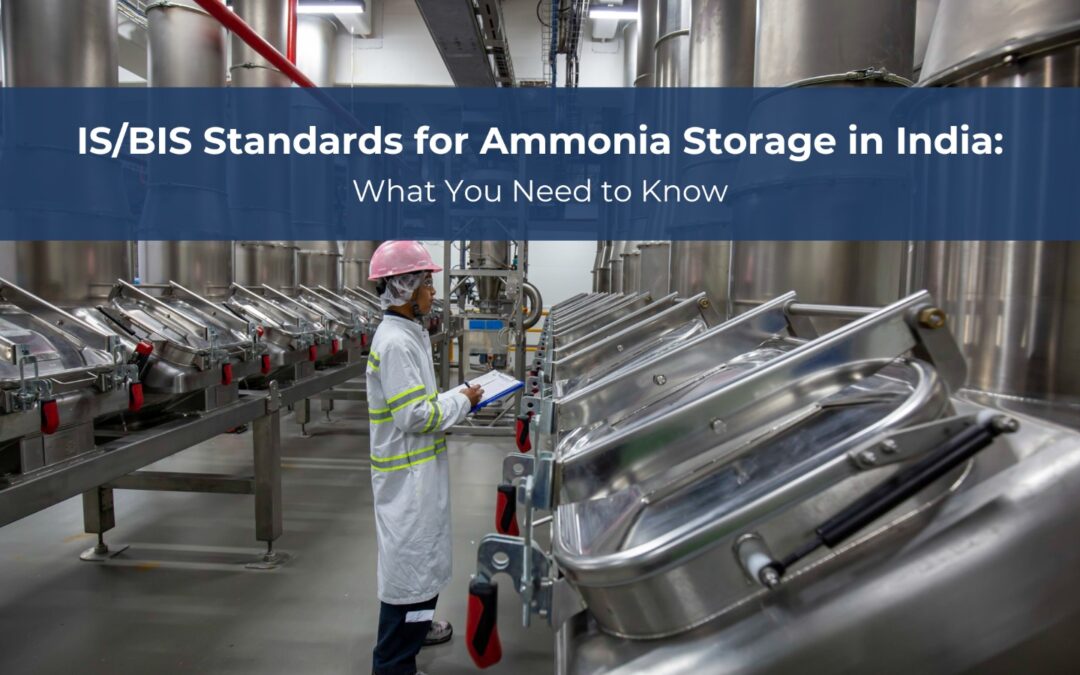
- All ammonia refrigeration systems in India require PESO licensing and must comply with IS 660, IS 5765, MSIHC Rules, and applicable Factories Act provisions.
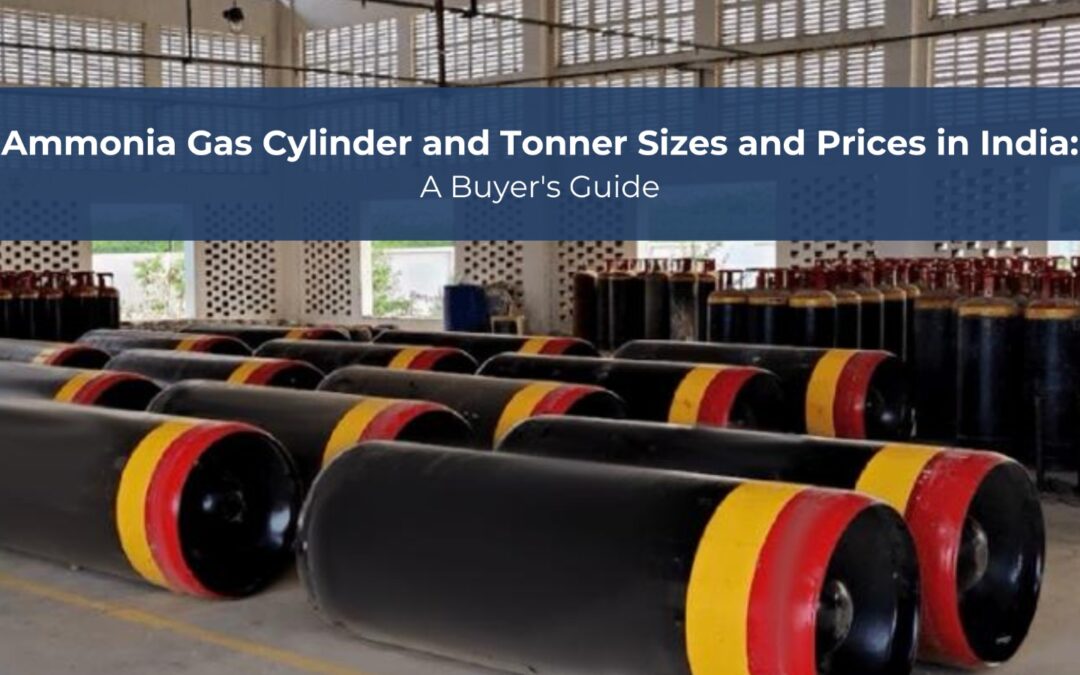
- Ammoniagas supplies high-purity anhydrous ammonia in cylinders and tonners sized for refrigeration system charges across India.
- What Is Ammonia Refrigeration in Food Processing?
- How Ammonia Refrigeration Works
- Types of Ammonia Refrigeration Systems
- Ammonia in Ice Plant Operations
- Ammonia and Cold Chain Logistics in India
- Key Food Processing Applications
- Ammonia vs HFC Refrigerants in Food Plants
- Safety Requirements in Food Processing Facilities
- Regulatory Compliance for Food Sector Operators
- Ammoniagas Serves the Food and Cold Chain Sector
- Related Reading
- Frequently Asked Questions
India wastes an estimated 40% of its food production due to inadequate cold chain infrastructure, according to the NITI Aayog. Behind every cold store, ice plant, and processing facility that prevents this loss is a single refrigerant that has dominated industrial cooling for over a century: anhydrous ammonia.
Ammonia is not new to food processing. It has been the backbone of large-scale refrigeration since the 19th century, and its combination of thermodynamic efficiency, low cost, and environmental neutrality has kept it firmly at the centre of the food cold chain. At Ammoniagas, we supply high-purity anhydrous ammonia to food processors, ice plant operators, cold store owners, and dairy facilities across India. This guide explains how ammonia refrigeration works, where it is used across the food value chain, and what operators need to know about safe and compliant operation.
1. What Is Ammonia Refrigeration in Food Processing?
Ammonia refrigeration refers to the use of anhydrous ammonia (NH3) as the working fluid in a vapour compression refrigeration cycle to produce and maintain low temperatures in food processing and storage environments. The refrigerant absorbs heat from the space or product being cooled as it evaporates, and releases that heat to the atmosphere as it condenses — creating a continuous cooling effect.
In the food processing industry, this technology is applied across the entire value chain: from the moment produce leaves the farm through washing, processing, packaging, storage, and distribution. Ammonia refrigeration systems range from compact ice-making units serving local fish markets to sprawling multi-thousand-tonne cold stores serving national distribution networks.
The fundamental reason for ammonia’s dominance in food refrigeration is thermodynamic performance. Ammonia has a latent heat of vaporisation approximately six times higher than common HFC refrigerants, meaning it can transfer far more heat energy per kilogram of refrigerant circulated. This directly translates into smaller system components, lower energy consumption, and reduced operating costs — all critical factors for food businesses operating on thin margins.
2. How Ammonia Refrigeration Works
The vapour compression cycle that underlies all ammonia refrigeration systems follows four stages:
The Four-Stage Vapour Compression Cycle
Compression: The compressor takes low-pressure ammonia vapour from the evaporator and compresses it to high pressure. Compression raises the temperature of the vapour significantly above ambient.
Condensation: The high-pressure, high-temperature vapour passes through the condenser, where it releases its heat to the cooling medium (typically air or water) and condenses back into a liquid state. Evaporative condensers are common in large food processing plants for energy efficiency.
Expansion: The liquid ammonia passes through an expansion valve, which drops the pressure rapidly. This pressure drop causes the temperature of the ammonia to fall to well below the target refrigeration temperature.
Evaporation: The cold, low-pressure ammonia enters the evaporator coils inside the refrigerated space. As it absorbs heat from the surrounding air or food product, it evaporates back into vapour — completing the cycle. The heat absorbed at this stage is what produces the cooling effect.
Ammonia’s boiling point at atmospheric pressure is -33 degrees C. This gives it a natural operating advantage for deep-freeze applications without requiring exotic compressor technology, unlike many synthetic refrigerants that require cascade systems to reach similar temperatures.
3. Types of Ammonia Refrigeration Systems
Food processing facilities select from several ammonia system configurations depending on their application, scale, and food safety requirements.
| System Type | How It Works | Best For | Key Advantage |
|---|---|---|---|
| Direct Expansion (DX) | Ammonia evaporates directly inside coils in the refrigerated space | Blast freezers, cold rooms, ice plants | Highest efficiency, simple design |
| Flooded System | Evaporator always partially flooded with liquid ammonia for continuous wetted surface | Large cold stores, plate freezers | Better heat transfer, consistent temperatures |
| Indirect (Secondary Coolant) | Ammonia chills a secondary fluid (brine/glycol) which circulates to the food zone | Open-food processing lines, bakeries | Eliminates ammonia exposure risk in food zones |
| Cascade System | Ammonia high-stage linked to CO2 low-stage for ultra-low temperatures | Deep freeze, ice cream, tuna freezing | Achieves -50 to -60 degrees C safely |
| Absorption Refrigeration | Heat-driven cycle using ammonia-water solution; no compressor | Waste heat recovery applications | Can use waste heat from food processing operations |
The trend in modern food processing plant design is toward NH3/CO2 cascade or secondary coolant systems, which retain ammonia’s efficiency benefits while keeping the refrigerant contained in the machine room away from food production areas.
4. Ammonia in Ice Plant Operations
Ice plants represent one of the oldest and most widespread applications of ammonia refrigeration in India. From fishing harbours in Kerala and Tamil Nadu to wholesale vegetable markets in Maharashtra and Uttar Pradesh, ammonia-based ice plants provide the foundational cooling layer that keeps perishables viable before and during distribution.
How Ammonia Ice Plants Work
In a plate ice or block ice plant, refrigerated ammonia circulates through hollow plates or around cylindrical moulds submerged in water. The water freezes in contact with the cold ammonia-chilled surface, forming ice blocks or flakes that are then harvested and stored. The efficiency of ammonia in this application is exceptional: large plants producing 50 tonnes of ice per day can operate at a fraction of the energy cost of equivalent HFC-based systems.
Types of Ice Produced
Ammonia refrigeration systems produce four main types of ice used across India’s food supply chain: block ice (used in fish transport and direct cooling), flake ice (food-contact safe for fish display and seafood processing), tube ice (beverages, packaged cooling), and plate ice (poultry chilling and meat processing). Each requires a slightly different evaporator design but all use the same fundamental ammonia refrigeration cycle.
Ammoniagas supplies anhydrous ammonia in cylinders and tonners to ice plant operators. Our ancillary equipment range includes pressure regulators, valves, and safety accessories suited to ice plant refrigeration circuits. Operators requiring cylinder and tonner maintenance services can contact our technical team.
5. Ammonia and Cold Chain Logistics in India
India’s cold chain infrastructure connects producers to consumers across vast distances and diverse climate zones. Ammonia refrigeration forms the backbone of this network at every stationary node: pre-cooling centres, packing houses, cold storage warehouses, and processing hubs.
The Cold Chain Journey
Farm-level pre-cooling: Immediately after harvest, produce enters a pre-cooling facility where room temperature is rapidly reduced to inhibit enzymatic activity and microbial growth. Forced-air and hydrocooling systems using ammonia refrigeration accomplish this in minutes for sensitive products like berries, flowers, and leafy vegetables.
Cold storage warehousing: Bulk produce, processed food, and frozen products are held in temperature-controlled warehouses at temperatures ranging from +13 degrees C (tropical fruits) down to -25 degrees C (frozen meat and seafood). Ammonia systems at this scale — often 1,000 to 10,000 tonne capacity — require sustained, reliable operation and benefit from ammonia’s low refrigerant cost relative to the large charge volumes required.
Processing plant refrigeration: At food processing plants, ammonia provides refrigeration for ingredient chilling, process cooling, product freezing, and packaged product storage before dispatch.
India’s National Action Plan on Cold-chain Connectivity, supported by PM Kisan Sampada Yojana, has allocated significant funding for expanding cold storage capacity — creating strong demand for anhydrous ammonia supply to new and expanded refrigeration facilities across the country.
6. Key Food Processing Applications
Across India’s diverse food processing sector, ammonia refrigeration serves distinct functions in each industry segment.
Poultry Processing
Modern poultry processing plants use ammonia refrigeration at multiple stages: chill tanks where carcasses are rapidly cooled after slaughter (typically to below 4 degrees C within 60 minutes as required by FSSAI), blast freezing tunnels for IQF (individually quick frozen) products, and cold room storage for packaged retail and export product. Indirect ammonia systems using glycol as the secondary coolant are common where food-contact risk must be minimised.
Seafood and Fish Processing
India is among the world’s top seafood exporters, and virtually all export-grade seafood processing facilities operate ammonia refrigeration systems. Marine products require rapid chilling from catch temperature to below 2 degrees C, and deep freezing to -18 degrees C or lower for export. Large shrimp processing plants in Andhra Pradesh, Kerala, Gujarat, and Tamil Nadu rely on high-capacity ammonia systems meeting MPEDA and international food safety standards.
Dairy and Milk Processing
Milk must be chilled from cow temperature (approximately 38 degrees C) to below 4 degrees C within hours of collection to prevent spoilage. Bulk milk coolers and dairy processing plants across India’s major producing states use ammonia refrigeration for this rapid chilling. Ice cream manufacturing requires additional blast freezing capacity at -30 to -40 degrees C, again served by ammonia cascade systems.
Fruit and Vegetable Cold Stores
Controlled atmosphere (CA) cold stores for apples, grapes, pomegranates, and other horticultural crops maintain precise temperature and gas composition using ammonia refrigeration. Large CA stores in Himachal Pradesh, Kashmir, and Maharashtra can hold thousands of tonnes of fruit across entire seasons, directly reducing post-harvest losses.
Supplying India’s Food Cold Chain
Ammoniagas delivers high-purity anhydrous ammonia in cylinders and tonners to ice plants, cold stores, poultry processors, and seafood exporters across India. PESO-compliant supply with nationwide logistics.
Beverages and Breweries
Large beverage manufacturing facilities — including breweries, soft drink plants, and bottled water operations — use ammonia refrigeration for process chilling, syrup cooling, and product storage. Brewery fermentation temperature control is particularly demanding, requiring consistent temperatures of 8 to 15 degrees C maintained over weeks-long fermentation cycles.
Grain and Seed Storage
While not as temperature-sensitive as fresh produce, grains and seeds benefit from refrigerated storage at 10 to 15 degrees C to suppress insect activity and prevent mycotoxin development. Large grain silos and seed processing facilities increasingly adopt ammonia refrigeration as an alternative to chemical fumigation.
7. Ammonia vs HFC Refrigerants in Food Plants
Food processing operators evaluating refrigeration systems frequently face the choice between ammonia and HFC (hydrofluorocarbon) refrigerants. The comparison is not close on most parameters that matter to large-scale operators.
| Parameter | Ammonia (NH3) | HFC Refrigerants (R-404A, R-507) |
|---|---|---|
| Global Warming Potential (GWP) | 0 (zero) | 3,000 to 4,000 |
| Ozone Depletion Potential (ODP) | 0 (zero) | 0 (HFCs) to 0.05+ (HCFCs) |
| Refrigerant Cost | Very low (Rs 80-120/kg) | High (Rs 500-1,500/kg) |
| System Efficiency (COP) | 3.5 to 5.0 typical | 2.5 to 3.5 typical |
| Charge Volume Required | Low (due to high latent heat) | High (low latent heat) |
| Regulatory Trend | Favoured under Kigali Amendment | Phase-down under Kigali Amendment |
| Leak Detection | Easily detected by smell at 5 ppm | Odourless; requires electronic detectors |
| Toxicity Risk | Toxic in high concentrations; IDLH 300 ppm | Asphyxiation risk only at very high concentrations |
| Best Scale | Large industrial systems (50 kW+) | Small commercial and retail systems |
For food processing plants operating at industrial scale, ammonia wins decisively on cost, efficiency, and environmental compliance. The Kigali Amendment to the Montreal Protocol, ratified by India, mandates a phased reduction of HFCs — making ammonia an increasingly future-proof choice for new plant investments.
8. Safety Requirements in Food Processing Facilities
Ammonia refrigeration systems in food plants must be designed, operated, and maintained to industry safety standards. The key risks — ammonia release in enclosed spaces — are manageable with correct engineering controls and operating procedures.
Engineering Controls
Machinery room design: Compressors, condensers, and pressure vessels are housed in dedicated, ventilated machinery rooms separated from food handling areas. Ventilation rates are specified by ASHRAE Standard 15 and Indian standards to ensure that any ammonia release is rapidly diluted below hazardous concentrations.
Automatic gas detection: Ammonia detectors set to alarm at 25 ppm (10% of OSHA PEL) and trigger emergency ventilation at 150 ppm are mandatory in modern food processing installations. Detectors in food handling areas provide early warning before any ammonia could contact food products.
Emergency isolation valves: Remotely operated emergency shutoff valves allow operators to isolate refrigerant circuits from a safe location in case of a leak. These are required by OISD standards and good engineering practice.
FSSAI requires that food processing facilities using ammonia refrigeration demonstrate that ammonia cannot contact food or food-contact surfaces under any foreseeable failure scenario. Indirect refrigeration systems using a secondary coolant barrier are the most straightforward means of satisfying this requirement in open-food processing zones.
Operational Safety Practices
Trained and certified refrigeration engineers must operate and maintain ammonia systems. Personal protective equipment including self-contained breathing apparatus (SCBA), chemical splash goggles, and acid-resistant gloves must be available and regularly tested. All personnel working near ammonia refrigeration systems require basic ammonia awareness training covering detection, evacuation, and emergency response procedures.
9. Regulatory Compliance for Food Sector Operators
Food processing facilities using ammonia refrigeration in India face a layered regulatory environment. Understanding each requirement prevents operational disruptions and protects worker and food safety.
| Regulation / Authority | What It Covers | Key Requirement for Food Plants |
|---|---|---|
| PESO (Gas Cylinders Rules 2016) | Storage and handling of compressed ammonia in cylinders and tonners | PESO licence for storage above threshold quantities; approved vessels only |
| SMPV Rules 2020 | Static and mobile pressure vessels including refrigeration receivers | Vessel design, testing, and periodic inspection certification |
| MSIHC Rules 1989 | Manufacture, storage, import of hazardous chemicals | Ammonia above 10 tonnes triggers Site Accident/Emergency Plan obligations |
| Factories Act 1948 | Worker safety in factory premises | Hazardous process notification, safety officer requirement above 500 workers |
| FSSAI (Food Safety and Standards) | Food safety in processing and storage | Refrigerant must not contact food; facility must demonstrate food safety controls |
| State PCB Clearances | Environmental compliance | Ammonia storage above thresholds may require environmental clearance |
| BIS Standards (IS 660, IS 5765) | Ammonia cylinder and refrigeration equipment standards | All cylinders, tonners, and equipment must carry valid BIS certification |
Ammoniagas supplies ammonia that is fully compliant with IS standards and PESO requirements. Our services include technical guidance on storage and handling requirements. For detailed regulatory compliance information, refer to our dedicated guide on ammonia storage licensing processes.
10. Ammoniagas Serves the Food and Cold Chain Sector Across India
Ammoniagas supplies high-purity anhydrous ammonia to food processing operators, cold store owners, and ice plant manufacturers across India. Our supply infrastructure supports operations from small regional ice plants to large integrated food processing complexes.
Beyond refrigerant supply, Ammoniagas offers specialist transportation for ammonia cylinders and tonners, and our team can advise on cylinder and tonner maintenance schedules to keep refrigeration systems operating without interruption. View our customer portfolio to understand the breadth of food sector operations we support.
11. Related Reading
- Top Industrial Applications of Anhydrous Ammonia in India
- How Ammonia Gas Is Manufactured: The Industrial Process Explained
- Handling Liquor Ammonia Safely: A Practical Operator’s Guide
- Storage Procedures for Liquor Ammonia: Best Practices and Standards
- Ammonia Transport and Packaging: Regulations and Requirements
- Industries and Markets Served by Ammoniagas
12. Frequently Asked Questions
Is ammonia safe to use in food processing facilities?
Yes, anhydrous ammonia is widely used in food processing refrigeration systems where it is contained within sealed piping and never contacts food directly. Facilities must follow ASHRAE Standard 15, IS 660, and PESO licensing requirements. Trained operators, gas detection systems, and emergency protocols make ammonia refrigeration systems safe and reliable. Indirect refrigeration systems using a secondary coolant provide an additional barrier in open-food handling zones.
Why do ice plants use ammonia instead of other refrigerants?
Ammonia offers a higher coefficient of performance (COP) than synthetic refrigerants, meaning it produces more cooling per unit of energy consumed. It is also significantly cheaper, has zero global warming potential, and does not deplete the ozone layer. These advantages make ammonia the preferred refrigerant for large-scale ice production across India. At high capacity, ammonia ice plants can save lakhs of rupees annually compared to equivalent HFC systems.
What food sectors use ammonia refrigeration in India?
In India, ammonia refrigeration is used across cold storage warehouses, poultry and meat processing plants, fish and seafood processing and export facilities, dairy and milk processing units, fruit and vegetable pre-cooling centres, beverage and brewery manufacturing, and large-scale ice manufacturing plants. The cold storage sector alone operates over 7,500 facilities relying primarily on ammonia.
What is the difference between direct and indirect ammonia refrigeration in food plants?
In direct systems, ammonia circulates through evaporator coils inside the refrigerated space itself, offering maximum efficiency. In indirect systems, ammonia chills a secondary fluid such as brine or glycol, which then circulates through the food processing area. Indirect systems are preferred where ammonia exposure risk must be minimised, such as in open-food handling zones, even though they are slightly less efficient than direct systems.
How much anhydrous ammonia does a typical ice plant require?
The ammonia charge in an ice plant depends on production capacity and system design. A small 5-tonne-per-day ice plant may require 50 to 100 kg of ammonia charge, while large industrial plants producing 50 tonnes per day or more may hold several hundred kilograms in the system. Ammoniagas supplies anhydrous ammonia in standard cylinders and tonners sized to match plant requirements and can advise on top-up supply schedules.
Can ammonia refrigerant be used in frozen food storage at -18 degrees C?
Yes, ammonia refrigeration systems are fully capable of achieving and maintaining frozen storage temperatures of -18 degrees C and below. Ammonia remains effective as a refrigerant down to approximately -33 degrees C at atmospheric pressure, making it suitable for blast freezing and deep-freeze cold stores used in meat, seafood, and frozen food industries. Cascade systems extend this capability further for ultra-low-temperature applications.
What licences are required to operate an ammonia refrigeration system in a food plant in India?
Food processing facilities operating ammonia refrigeration systems in India must comply with PESO licensing under the Gas Cylinders Rules and SMPV Rules for pressure vessels, the Factories Act for plant safety, MSIHC Rules if ammonia quantities exceed threshold limits, FSSAI requirements for food safety, and State Pollution Control Board clearances where applicable. Ammoniagas can connect operators with compliance advisors during the licensing process.
How does ammonia refrigeration support India’s cold chain infrastructure?
India’s cold chain network relies heavily on ammonia refrigeration at the warehouse and processing plant level. Large cold stores serving agricultural produce, meat, dairy, and frozen food sectors use ammonia systems for their energy efficiency and low operating costs. Government schemes such as PM Kisan Sampada Yojana have further expanded ammonia-based cold storage capacity across the country, directly reducing India’s estimated 40% post-harvest food loss.
Where can I source anhydrous ammonia for my food processing or ice plant in India?
Ammoniagas is a leading supplier of high-purity anhydrous ammonia for refrigeration applications across India. We supply in cylinders and tonners, with nationwide logistics and full compliance with PESO and BIS standards. Visit our Get a Quote page or contact our team to discuss your plant’s capacity and supply requirements.