
- Primary standard: IS 5116 specifies the quality requirements for anhydrous ammonia; IS 6099 covers liquor ammonia (aqueous solution) grades used in industry.
- Regulatory authority: PESO (Petroleum and Explosives Safety Organisation) issues and enforces storage licences for ammonia pressure vessels under the Gas Cylinders Rules 2016.
- MSIHC threshold: On-site storage of 150 MT or more of ammonia triggers Major Accident Hazard (MAH) unit designation under MSIHC Rules 1989, requiring emergency planning and public disclosure.
- Testing intervals: Ammonia cylinders and tonners require hydrostatic testing every 5 years; failure to test is a regulatory violation and a serious safety risk.
- Key standards: IS 7285 (cylinders), IS 5765 (valves), IS 660 (refrigeration), IS 3196 (welded vessels), IS 7895 (transport tankers) are the core technical references.
- Ammoniagas compliance: All ammonia supplied by Ammoniagas meets applicable IS specifications with batch-specific Certificates of Analysis, and all vessels are maintained under current PESO certification.
- India’s Regulatory Framework for Ammonia Storage
- Key IS/BIS Standards for Ammonia
- PESO Licensing Requirements
- MSIHC Rules and Major Accident Hazard Units
- Standards for Cylinders and Tonners
- Standards for Bulk Ammonia Storage
- Transport and Tanker Standards
- Safety System Requirements
- Inspection, Testing, and Certification
- Practical Compliance Checklist
- Who Must Comply: Sector Breakdown
- Frequently Asked Questions
India’s industrial chemical sector operates under one of the most comprehensive hazardous chemical regulatory frameworks in Asia. For ammonia — a chemical stored and used by thousands of industries across cold storage, textiles, water treatment, fertiliser, and refrigeration sectors — compliance with the applicable IS (Indian Standards), BIS certification requirements, and PESO licensing is not optional. It is a legal obligation that carries serious consequences for non-compliance, ranging from licence cancellation to criminal prosecution under the Environment Protection Act and Explosives Act.
This guide is intended as a practical compliance reference for plant managers, EHS (Environment, Health, and Safety) officers, procurement teams, and facility engineers at industrial sites that store or use ammonia in any form. Ammoniagas supplies ammonia to hundreds of such facilities across India and has deep operational experience navigating this regulatory landscape. All products supplied by Ammoniagas meet applicable IS specifications.
1. India’s Regulatory Framework for Ammonia Storage
Ammonia storage in India is governed by a layered regulatory system involving multiple acts, rules, and standards from different ministries and bodies. Understanding how these layers interact is essential for compliance planning.
| Regulatory Layer | Instrument | Governing Body | Primary Scope |
|---|---|---|---|
| Compressed Gas Safety | Gas Cylinders Rules 2016 (under Explosives Act 1884) | PESO / Ministry of Commerce | Cylinder and tonner design, testing, filling, storage, transport |
| Major Hazard Control | MSIHC Rules 1989 (under Environment Protection Act 1986) | MoEF / State PCBs | Large-quantity storage, emergency planning, public disclosure |
| Product Quality | IS Standards via BIS | Bureau of Indian Standards | Chemical purity, vessel design, material specifications |
| Industrial Safety | Factories Act 1948 / State Factory Rules | State Factory Inspectorates | Worker safety, hazardous process designation, PPE requirements |
| Environmental Discharge | Environment Protection Rules 1986 / CPCB Effluent Standards | CPCB / SPCBs | Effluent limits for ammonia in wastewater discharges |
| Road Transport | Central Motor Vehicles Rules 1989 / Hazmat Rules | MoRTH | Tanker design, driver certification, vehicle marking |
Non-compliance with the Gas Cylinders Rules 2016 can result in cancellation of the storage licence, seizure of vessels by PESO inspectors, and prosecution under Section 9 of the Explosives Act 1884, which carries penalties including fines and imprisonment. Environmental violations under MSIHC Rules can attract additional penalties under the Environment Protection Act.
2. Key IS/BIS Standards for Ammonia
The Bureau of Indian Standards (BIS) publishes the IS standards that specify design, material, testing, and quality requirements for ammonia and its storage vessels. These standards are referenced in the Gas Cylinders Rules 2016 and must be met for any vessel used in ammonia storage to be PESO-licensable.
| IS Standard | Title | Relevance to Ammonia |
|---|---|---|
| IS 5116 | Anhydrous Ammonia | Quality specification: purity, water content, oil content, residue requirements for industrial-grade anhydrous ammonia |
| IS 6099 | Ammonia Solution (Liquor Ammonia) | Quality specification for aqueous ammonia at various concentration grades (10%, 20%, 25%, 28%) |
| IS 7285 (Part 1 and 2) | Gas Cylinders for Permanent and Liquefied Gases | Design, fabrication, inspection, and testing requirements for seamless and welded steel cylinders for ammonia |
| IS 5765 | Valves for Gas Cylinders | Design, materials, testing, and marking requirements for valves used on ammonia cylinders and tonners |
| IS 3196 (Part 2) | Specification for Welded Mild Steel Cylinders | Applicable to welded cylinder designs used for ammonia; covers material, welding, and test procedures |
| IS 660 | Safety Code for Mechanical Refrigeration | Safety requirements for ammonia refrigeration systems including pipe sizing, pressure relief, machine room design, and ventilation |
| IS 7895 | Road Tankers for Liquefied Hazardous Gases | Design, fabrication, and marking requirements for road tankers carrying liquid anhydrous ammonia |
| IS 2062 | Hot Rolled Medium and High Tensile Structural Steel | Material specification for pressure vessel construction applicable to ammonia storage vessels |
3. PESO Licensing Requirements
PESO (Petroleum and Explosives Safety Organisation), headquartered in Nagpur with regional offices across India, is the statutory authority responsible for the administration of the Gas Cylinders Rules 2016 and the licensing of ammonia storage facilities. Every facility storing ammonia above the exempt quantity must hold a valid PESO licence.
Licence Categories for Ammonia Storage
The Gas Cylinders Rules 2016 provide for different forms of licence depending on the nature and scale of ammonia storage. Form VIII covers the import, transport, storage, and sale of cylinders of compressed gas. Form X covers the manufacture, repair, and testing of gas cylinders. Retailers and distributors of filled cylinders require a Form II licence (for the sale of compressed gas). Facilities filling cylinders require a separate filling licence, which includes requirements for calibrated filling equipment and safety distances.
The Licence Application Process
A PESO storage licence application must include a detailed site plan showing the location of the storage area relative to neighbouring buildings, roads, and services; a description of the storage layout including number and type of vessels; a description of the safety measures in place; identification of the responsible persons (Competent Persons) for storage operations; and evidence that the proposed storage complies with all applicable IS standards and the Gas Cylinders Rules requirements. First-time applications typically involve a site inspection by a PESO officer before the licence is granted.
4. MSIHC Rules and Major Accident Hazard Units
The Manufacture, Storage, and Import of Hazardous Chemicals Rules 1989 (MSIHC Rules), made under the Environment Protection Act 1986, apply to sites that handle hazardous chemicals above specified threshold quantities. Ammonia is listed as a hazardous chemical in Schedule 2 (Major Hazard Installations) of the MSIHC Rules.
Threshold Quantities for Ammonia
The MSIHC Rules specify two threshold quantities for ammonia. Any site storing 150 MT or more of ammonia is designated as a Major Accident Hazard (MAH) unit, also known as a Major Hazard Installation. Sites storing 500 MT or more must additionally submit an off-site emergency plan to the District Emergency Authority. Below 150 MT, standard Gas Cylinders Rules 2016 licensing under PESO applies, but basic MSIHC notification may still apply if other hazardous chemicals at the site collectively meet threshold criteria.
MAH Unit Requirements
Sites designated as MAH units under MSIHC Rules must meet additional obligations beyond basic PESO licensing. These include preparing and updating a Safety Report (equivalent to a Process Safety Management document) covering the chemical properties, quantities, storage conditions, and potential accident scenarios; preparing an On-Site Emergency Plan for internal incident management; coordinating with local authorities on an Off-Site Emergency Plan for community emergency response; conducting formal safety audits at least every 3 years; and reporting any major accidents or near-misses to the authorities within 24 hours.
5. Standards for Cylinders and Tonners
Cylinders and tonners used for ammonia storage must be manufactured, tested, and marked in accordance with the applicable IS standards. Buyers and users should verify these markings before accepting a vessel for service.
Required Markings on Ammonia Cylinders
Every ammonia cylinder in India must bear the following markings on its neck ring: the BIS certification mark with IS number and BIS licence number; the cylinder serial number; the water capacity in litres; the tare weight in kg; the maximum fill weight in kg (for ammonia); the design pressure in bar; the test pressure in bar; the date of manufacture; and the date of the most recent hydrostatic test (month and year) with the testing station identifier. Any cylinder lacking any of these markings or with an expired test date should not be put into service.
Colour Coding
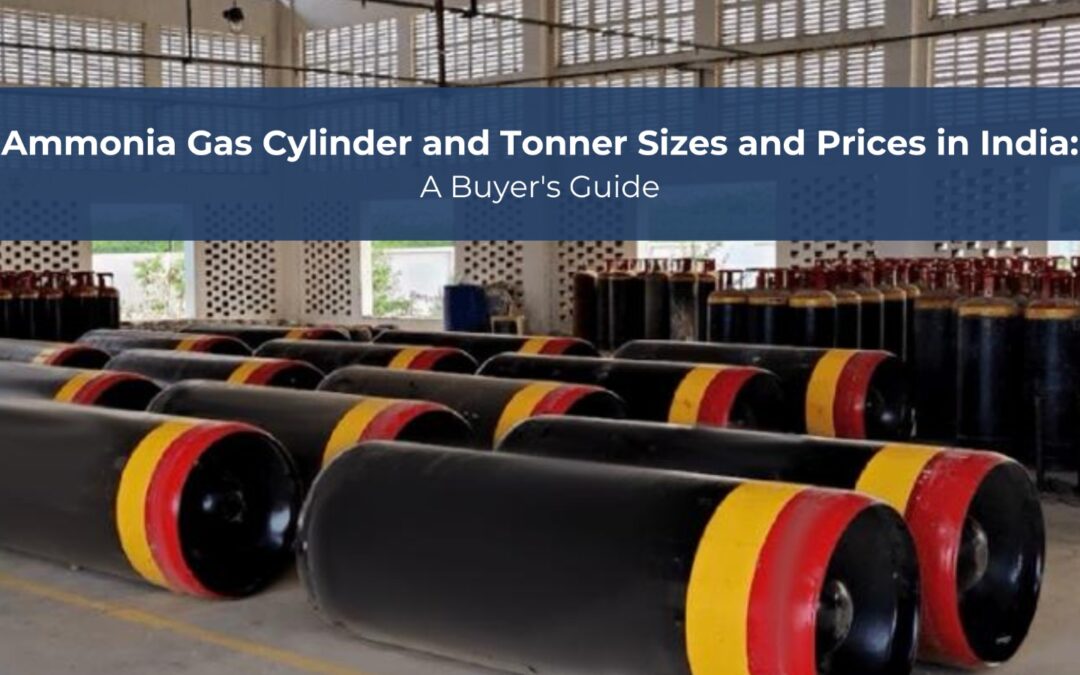
Under IS 4379, cylinders containing toxic gases including ammonia must have their top painted yellow (the body colour may vary by the supplier’s convention, but the top is standardised). This colour coding is a critical safety feature that allows quick identification of toxic gas cylinders in storage areas and during emergency response.
Compliant Ammonia Supply for Indian Industry
All Ammoniagas cylinders and tonners are PESO-licensed, BIS-certified, and maintained to current hydrostatic test schedules. Full documentation with every supply.
6. Standards for Bulk Ammonia Storage
Facilities storing ammonia in quantities above tonner capacity — in fixed-mounted pressure vessels or low-temperature atmospheric tanks — face additional standards and engineering requirements.
Pressure Vessels (Bullet Tanks)
Fixed-mounted pressure vessels for anhydrous ammonia storage, commonly known as bullet tanks, must be designed and fabricated in accordance with IS 2825 (Code for Unfired Pressure Vessels) or equivalent ASME Section VIII Division 1. The vessels must be registered with the PESO and subject to periodic inspection by a PESO-approved inspection authority. Safety relief valves, pressure gauges, level indicators, and high-level/high-pressure cutoff interlocks are mandatory equipment on all storage vessels.
Low-Temperature Refrigerated Storage
Very large ammonia storage installations (above 1,000 MT) may use refrigerated storage at atmospheric pressure, storing liquid ammonia at -33°C (its boiling point at 1 bar). These atmospheric-pressure refrigerated storage tanks are subject to different design standards (typically IS 803, code for the design, fabrication, and erection of vertical mild steel cylindrical welded oil storage tanks, applied with modifications for low-temperature service) and require an outer berm or dyke capable of containing the full tank volume in the event of catastrophic failure. These systems are typically found only at large fertiliser plants and major ammonia import terminals.
7. Transport and Tanker Standards
The transport of liquid anhydrous ammonia on Indian roads is governed by IS 7895 for tanker design and by the Central Motor Vehicles Rules 1989 for transport operations. All tankers must carry the PESO-issued tanker certificate confirming that the vessel meets IS 7895 requirements and has been hydrostatically tested within the required interval.
Tanker Design Requirements Under IS 7895
Road tankers for liquefied ammonia must be fabricated from carbon steel meeting IS 2062 specifications, designed for a minimum working pressure of 16 bar (to accommodate ammonia vapour pressure at maximum anticipated ambient temperature), equipped with an excess flow valve on the liquid outlet to prevent catastrophic discharge in a pipe rupture incident, fitted with a safety relief valve sized per API 520 or equivalent, and equipped with pressure and temperature gauges accessible from ground level without climbing the vessel.
Driver and Vehicle Compliance
Drivers of ammonia tankers must hold a Hazardous Goods transport endorsement on their driving licence, issued after completion of an approved hazardous materials transport training course. The vehicle must carry a transport emergency card (TREM card) and the shipper’s written emergency response information in English, Hindi, and the state’s official language. Ammoniagas’s transport fleet and drivers are fully compliant with all these requirements. Learn more about our transportation services.
8. Safety System Requirements
IS standards and the Gas Cylinders Rules 2016 specify certain minimum safety systems that must be present at any ammonia storage facility above the exempt quantity. The following systems are either mandated or strongly implied by the applicable standards.
Gas Detection and Alarm
Continuous ammonia gas detection using electrochemical sensors is required in machine rooms (for refrigeration systems, per IS 660), in storage areas, and in any enclosed space where ammonia gas could accumulate. Detectors must be calibrated at intervals not exceeding 12 months, with records maintained. The alarm system must provide audible and visual alarms at warning level (25 ppm), evacuation level (50–150 ppm per site-specific assessment), and emergency shutdown level (300 ppm). Refer to our guide on ammonia gas leak detection systems for detailed specifications.
Emergency Shut-Off Systems
Bulk ammonia storage facilities must be equipped with remotely operated emergency shut-off valves on all liquid ammonia lines exiting the storage vessel. These valves must fail-safe in the closed position (close on loss of power or instrument signal) and must be operable from a safe location at least 15 metres from the storage vessel.
Personal Protective Equipment
PPE requirements under the Factories Act and IS standards for ammonia handling include chemical-splash goggles, face shield for higher-risk operations, nitrile or neoprene gloves, acid/alkali resistant coveralls, and chemical-resistant safety boots. For high-concentration exposure risk (vessel entry, tanker unloading, emergency response), a self-contained breathing apparatus (SCBA) or supplied air respirator is required. Full PPE requirements are detailed in our ammonia safety equipment guide.
9. Inspection, Testing, and Certification
The periodic inspection and testing regime for ammonia storage vessels is one of the most important elements of the regulatory framework. It ensures that pressure vessels remain fit for continued service and that dangerous defects are identified and addressed before they can cause incidents.
Hydrostatic Testing Schedule
Under the Gas Cylinders Rules 2016, ammonia cylinders and tonners must be hydrostatically tested at intervals not exceeding 5 years. The test involves filling the vessel with water and pressurising it to 1.5x the design pressure (for cylinders) or as specified in the vessel’s design documentation (for tonners). The vessel is inspected for leakage, visible deformation, and permanent volumetric expansion. Vessels that fail any criterion are condemned and must be de-commissioned.
Approved Testing Stations
Hydrostatic testing must be conducted at PESO-approved testing stations. A comprehensive list of approved testing stations is maintained on the PESO website. The testing station issues a Test Certificate bearing the test date, test pressure, expansion result, and the testing station’s PESO approval number. This certificate must be retained with the vessel’s records and is inspected during PESO licence renewals.
Ongoing Inspection Requirements
Between hydrostatic tests, ammonia vessels must be subject to external visual inspection at least annually. The inspection should check for corrosion, mechanical damage, valve condition, pressure gauge accuracy, and the condition of safety relief valves and their discharge lines. For refrigeration vessels, IS 660 specifies inspection requirements that should be incorporated into the facility’s preventive maintenance programme. Records of all inspections must be maintained and made available to PESO inspectors on request.
10. Practical Compliance Checklist
The following checklist summarises the key compliance requirements for an ammonia storage facility in India. It is intended as a practical self-assessment tool, not as a substitute for formal legal advice or a PESO-approved safety plan.
| Compliance Area | Requirement | Evidence Required |
|---|---|---|
| PESO Licence | Valid storage licence in current form; not expired | Current PESO licence certificate displayed at site |
| Vessel Certification | All cylinders/tonners bear valid BIS mark and current hydrostatic test date | Test certificates for each vessel on file |
| Gas Detection | Calibrated gas detectors operational in all relevant areas | Annual calibration certificates on file |
| MSIHC Assessment | Quantity stored confirmed below 150 MT threshold, or MAH status formally acknowledged and documented | Chemical inventory and MSIHC Rule 5 notification to authority |
| Emergency Response Plan | Written plan covering evacuation, first aid, spill response, contact list | Document signed by facility head, reviewed annually |
| PPE Availability | Appropriate PPE available for all workers in ammonia handling areas | PPE inspection and issue records |
| Training Records | All ammonia-handling personnel trained in chemical properties, emergency response, and PPE | Training records with dates and attendance |
| MSDS | Current Material Safety Data Sheet for ammonia posted in storage area | Current MSDS from supplier available on site |
11. Who Must Comply: Sector Breakdown
- Cold storage and ice plants — PESO licence for refrigerant charge; IS 660 compliance for the refrigeration system; gas detection mandatory. Ammonia refrigerant guide
- Textile and dyeing mills — PESO cylinder/tonner storage licence; handling compliance under Factories Act; regular hydrostatic test verification
- Water treatment plants — PESO licence for cylinder storage; IS 5116 compliance for ammonia quality; emergency shut-off systems. Ammonia in water treatment
- Fertiliser manufacturers — Full MSIHC Rules compliance (typically above 150 MT threshold); comprehensive Process Safety Management documentation
- Ammonia distributors and suppliers — PESO filling licence; tanker licence; driver certification; TREM card documentation. Jaysons Chemical Transportation
- Chemical processing plants — PESO storage licence; environmental compliance for effluent containing ammoniacal nitrogen
- Agricultural users — PESO licence for cylinder storage; restricted direct soil injection use in India
- Green ammonia producers and exporters — Export documentation per customs requirements; green ammonia export compliance
Ammoniagas supports its customers’ regulatory compliance through complete documentation with every supply — including batch Certificates of Analysis confirming IS 5116 or IS 6099 compliance, valid hydrostatic test certificates for all cylinders and tonners, MSDS documentation, and transport compliance records. Our customer service team can assist with compliance queries. For enquiries, contact us at ammoniagas.com/contact-us.
12. Related Reading
Frequently Asked Questions
Which BIS/IS standards govern ammonia storage in India?
The primary IS standards relevant to ammonia storage include IS 5116 (anhydrous ammonia quality), IS 6099 (liquor ammonia), IS 7285 (gas cylinders), IS 5765 (cylinder valves), IS 660 (mechanical refrigeration safety), IS 3196 (welded cylinders), and IS 7895 (road tankers). These are supplemented by the Gas Cylinders Rules 2016 and MSIHC Rules 1989 as the primary regulatory frameworks.
What is the threshold quantity for ammonia that requires MSIHC Rules compliance?
Under MSIHC Rules 1989, the threshold quantity is 150 MT of on-site ammonia storage for Major Accident Hazard (MAH) unit designation. Storage above 500 MT triggers additional notification requirements. Below 150 MT, the Gas Cylinders Rules 2016 and standard PESO licensing apply.
What is the PESO licence required for storing ammonia in India?
A Form VIII licence under the Gas Cylinders Rules 2016 covers storage of cylinders. Bulk storage (tonners and larger fixed tanks) requires a Form X licence. Applications must include site plans, safety documentation, and confirmation of IS standards compliance. Contact PESO or Ammoniagas’s compliance team for guidance.
What is the minimum separation distance required for ammonia storage in India?
Minimum separation distances are 3 metres for storage up to 125 kg, 7.5 metres for up to 500 kg, and 15 metres or more for storage above 500 kg, measured from occupied buildings. Site-specific risk assessments under MSIHC Rules may require greater distances based on dispersion modelling results.
Does IS 5116 apply to both anhydrous ammonia and liquor ammonia?
IS 5116 specifically covers anhydrous ammonia (the pure, pressurised form in cylinders and tonners). Liquor ammonia (aqueous solution) is covered by IS 6099. Both are supplied by Ammoniagas with batch-specific Certificates of Analysis confirming compliance with the respective IS standard. See our comparison of liquor vs liquid ammonia for more detail.
Are there IS standards specific to ammonia tankers and road transport in India?
Yes. IS 7895 covers road tanker design for liquefied hazardous gases including ammonia. The Central Motor Vehicles Rules 1989 mandate driver training, vehicle marking (Hazchem placard 1076), and TREM card documentation. Ammoniagas’s transport fleet is fully compliant with all IS and regulatory requirements.
What fire suppression system is required for an ammonia storage facility?
Ammonia is primarily a toxic hazard rather than a flammable one. The required safety system is a water spray deluge system capable of cooling vessels in a fire scenario and absorbing leaked ammonia gas. At least 10 L/min/m2 of vessel surface area must be achievable. Appropriate DCP fire extinguishers must also be provided.
What documentation must be maintained at an ammonia storage facility?
Required documentation includes the PESO storage licence, valid hydrostatic test certificates, current MSDS, emergency response plan, personnel training records, gas detector calibration records, and vessel inspection records. MAH units must additionally maintain an On-Site Emergency Plan. Ammoniagas provides all product-level documentation with each supply — request our compliance documentation package via the contact page.