

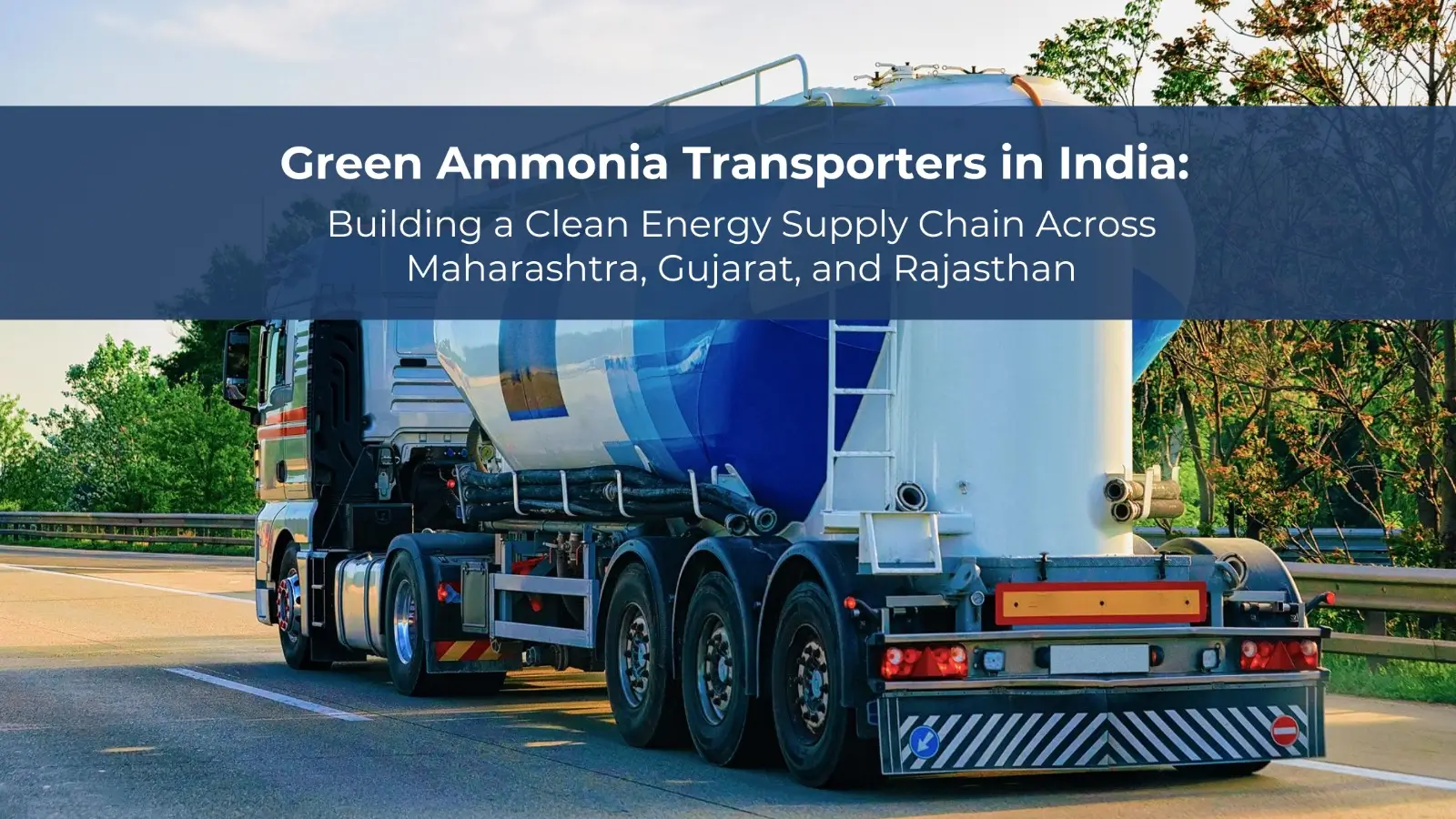
- Same physical handling as grey ammonia: Green ammonia is chemically identical to conventional ammonia — the same PESO regulations, UN numbers, tanker specifications, and safety protocols apply to both.
- Chain-of-custody certification is the difference: The critical distinction for green ammonia logistics is the documentation chain — verifying renewable origin from production through transport to end-user delivery to support sustainability claims.
- Gujarat leads export development: Gujarat’s combination of world-class solar and wind resources, active project development by major companies, and strategic port infrastructure at Kandla and Mundra makes it India’s most advanced green ammonia export state.
- Port infrastructure in development: Dedicated large-scale green ammonia export terminals with refrigerated storage and ammonia carrier loading are in planning and early construction across Gujarat, Tamil Nadu, and Andhra Pradesh.
- National Green Hydrogen Mission framework: The MNRE and BEE are developing the certification and regulatory framework that will govern green ammonia production verification and export documentation in India.
- Domestic demand also growing: Beyond export, growing domestic demand for certified green ammonia from industries with sustainability targets is creating a parallel domestic green ammonia supply chain requirement.
- Why Green Ammonia Logistics Are Critical
- Transport Modes for Green Ammonia in India
- Road Transport Requirements
- Rail Transport
- Coastal Shipping and ISO Tanks
- Green Ammonia Certification and Chain of Custody
- Port Infrastructure for Export
- State-Level Green Ammonia Developments
- Building the Domestic Green Ammonia Supply Chain
- Jaysons Chemical Industries Role in Green Ammonia Logistics
- Related Reading
- Frequently Asked Questions
The transition to a green ammonia economy is as much a logistics challenge as a production challenge. Even when green ammonia can be produced at competitive cost from renewable energy, it must be transported reliably and efficiently from production sites — often in remote high-solar or high-wind locations — to export ports or domestic end-users. The infrastructure, regulations, certification systems, and safety protocols that govern this movement are developing rapidly in India, driven by the National Green Hydrogen Mission and the growing commercial interest from both Indian producers and international buyers.
Jaysons Chemical Industries supplies green ammonia and is actively developing the logistics capabilities needed for certified green ammonia distribution in India. This guide covers the full logistics landscape for green ammonia transportation in the Indian context.
1. Why Green Ammonia Logistics Are Critical
The sites with the best renewable energy resources for green ammonia production — the desert solar regions of Rajasthan, the coastal wind corridors of Gujarat and Tamil Nadu, the offshore wind zones of the Gulf of Mannar — are rarely adjacent to the ports from which green ammonia will be exported, or to the industrial clusters where domestic customers are located. This geographic separation between production and consumption is a fundamental feature of the green ammonia economy, just as it is for oil and gas.
The logistics challenge has two distinct components. The first is physical: building the pipeline, road, or rail infrastructure to move ammonia from inland production sites to coastal terminals or industrial zones. The second is informational: building the certification and documentation systems that allow a tonne of green ammonia to be verified as genuinely green throughout its entire journey from renewable energy generation through electrolysis, synthesis, storage, transport, and final delivery. Without both components working reliably, the commercial premium that green ammonia commands cannot be credibly justified to buyers.
2. Transport Modes for Green Ammonia in India
Green ammonia in India can be transported by four modes, each with different economics, capacity, and regulatory frameworks:
| Mode | Best For | Capacity per Unit | Regulatory Framework |
|---|---|---|---|
| Road tanker | Medium distances, flexible routing, last-mile delivery | 10-25 tonnes per tanker | PESO (pressure tankers); CMV Rules DG; UN1005/UN2672 |
| Rail tank wagon | Long distances, high volumes on rail corridors | 40-60 tonnes per wagon | Railway Board DG rules; PESO pressure vessel registration |
| Pipeline | Fixed high-volume point-to-point (production to port) | Thousands of tonnes/day | PESO pipeline regulations; state permissions |
| Coastal/sea shipping | Port-to-port bulk movements; export loading | 500-80,000 tonnes per vessel | IMDG Code; DGMS; port authority DG regulations |
3. Road Transport Requirements
Road transport is the most flexible mode for green ammonia distribution within India, enabling delivery to any industrial customer reachable by road. For anhydrous green ammonia, road transport requires PESO-registered pressure tankers operating under the Static and Mobile Pressure Vessels (Unfired) Rules 1981. These tankers must carry current PESO inspection certificates, be fitted with emergency shut-off valves and pressure relief devices, and display UN1005 hazard identification panels on all four sides.
For liquor green ammonia, standard chemical tankers made from stainless steel or HDPE can be used, with UN2672 placards (ammonia solution 10-35%) for concentrations in that range. Drivers of both tanker types must hold a Dangerous Goods endorsement on their commercial vehicle licence and carry the TREMCARD (Transport Emergency Card) in the cab throughout the journey.
Route planning for ammonia road transport should account for: state or urban area restrictions on dangerous goods vehicle routing (particularly during peak hours in major cities); bridge weight limits for fully loaded tankers; distance from hospitals and emergency services for route risk assessment; and proximity to sensitive receptors (schools, hospitals, dense residential areas) along the preferred route. Ammonia transport and packaging guidance covers the full requirements in detail.
4. Rail Transport
Railway transport offers higher capacity per vehicle than road and is well-suited to long-distance movements of large volumes — relevant for connecting inland green ammonia production sites in Rajasthan or Gujarat to coastal export terminals. Indian Railways operates specialised pressure tank wagons approved for ammonia service, subject to Railway Board dangerous goods regulations and PESO pressure vessel registration of the tank wagons themselves.
The logistics of rail transport for green ammonia require: sidings or loading facilities at the production site capable of handling ammonia pressure tank wagon filling; terminal unloading facilities at the destination port or distribution hub; co-ordination of wagon scheduling with Indian Railways freight operations; and the same documentation chain for green certification as for other transport modes.
Rail transport is not yet widely used for ammonia in India compared to road transport, but it is expected to become increasingly important as green ammonia production scales to the volumes where rail economics become compelling — particularly for movements of 50,000 tonnes per year or more on fixed routes.
5. Coastal Shipping and ISO Tanks
Coastal shipping — moving cargo between Indian ports — offers an efficient option for connecting green ammonia production centres on one part of India’s coastline with industrial customers or export terminals on another. Ammonia-rated ISO tanks (pressure vessels in standard 20-foot or 40-foot container frames, capable of carrying approximately 15-20 tonnes of anhydrous ammonia) can be loaded at inland production sites, transported by road or rail to a port, loaded onto a coastal vessel, and discharged at the destination port for onward road distribution.
Coastal shipping is governed by the IMDG Code for the sea leg (treating the Indian coastal voyage as if it were international for dangerous goods purposes), along with Directorate General of Shipping (DGS) regulations for vessel safety. Not all Indian ports accept dangerous goods of all classes — ammonia’s Class 2.3 (toxic gas) classification means that port acceptance must be verified before booking any ammonia coastal shipping movement.
Green Ammonia Supply and Logistics Support
Jaysons Chemical Industries supplies certified green ammonia with the logistics, documentation, and chain-of-custody support needed for verified green supply chains. Contact us to discuss green ammonia supply arrangements for your facility.
6. Green Ammonia Certification and Chain of Custody
The commercial value of green ammonia — its price premium over grey ammonia — depends entirely on credible verification that the ammonia was indeed produced from renewable energy. Without a robust certification and chain-of-custody system, buyers cannot trust that what they are receiving is genuinely green rather than conventional grey ammonia relabelled for a premium price.
The certification framework for green ammonia is still developing globally and in India. Key elements required for a credible green ammonia certification system include:
- Production verification: Documentation that the electricity used for electrolysis was from renewable sources (solar, wind, hydro) — verified through renewable energy purchase agreements (PPAs), metering data, and potentially Guarantees of Origin (GOs) for the electricity.
- Electrolyser metering: Measurement of total electricity consumed by electrolysers per unit of hydrogen produced — the basis for calculating the carbon intensity of the green hydrogen, and by extension the green ammonia.
- Carbon intensity statement: A documented calculation of the lifecycle carbon intensity (in kg CO2-equivalent per kg NH3) of the specific batch of green ammonia, covering production, storage, and transport to the point of delivery.
- Chain-of-custody documentation: Records tracing each batch of certified green ammonia through every step of the supply chain — from production tank to transport vehicle to storage at hub to delivery to end user — with no co-mingling with uncertified product at any step.
- Third-party audit: Independent verification by an accredited auditor that the production and custody records are accurate and that the ammonia’s renewable origin claim is substantiated.
7. Port Infrastructure for Export
India’s green ammonia export ambitions require port infrastructure capable of receiving ammonia from inland production and storage sites, holding it in large refrigerated tanks, and loading it onto ocean-going ammonia carriers for export to Japan, South Korea, and European markets. This infrastructure does not yet exist at commercial scale for green ammonia in India, though planning and investment are advancing.
The required port infrastructure components include: large refrigerated atmospheric-pressure ammonia storage tanks (holding ammonia at -33 degrees C rather than under pressure, which is more practical at the scale of 10,000-100,000 tonnes of storage); ammonia loading arms connecting shore tanks to ship manifolds; continuous ammonia gas monitoring throughout the terminal; fire and emergency response systems scaled for the storage volume; and trained terminal operators with ammonia handling competence.
Kandla Port (Gujarat), Mundra Port (Gujarat), Tuticorin Port (Tamil Nadu), and Visakhapatnam Port (Andhra Pradesh) are the most commonly cited candidates for early green ammonia export terminal development, based on their proximity to planned production sites and their existing capacity to handle hazardous goods.
8. State-Level Green Ammonia Developments
India’s green ammonia development is advancing most rapidly in states with the strongest renewable energy resources and political commitment to the National Green Hydrogen Mission’s export ambitions:
Gujarat: Home to some of India’s largest renewable energy projects and the most advanced green ammonia development pipeline. Adani Green Energy, NTPC, Torrent Power, and several international joint ventures have announced large-scale green hydrogen and ammonia projects in the Kutch and Saurashtra regions. Kandla and Mundra ports are being evaluated for ammonia export terminal development. Green ammonia exporters in Gujarat represent the largest current pipeline in India.
Tamil Nadu: The Gulf of Mannar offshore wind corridor offers world-class wind resources for green hydrogen production. The state government has signed memoranda with multiple international companies to develop green ammonia projects for export through Tuticorin port. Green ammonia exporters in Tamil Nadu are advancing projects targeting Japanese and South Korean offtake buyers.
Andhra Pradesh: The state’s long coastline, existing industrial base, and active renewable energy development create conditions for green ammonia production for both domestic use and export through Visakhapatnam and Krishnapatnam ports. Green ammonia exporters in Andhra Pradesh are in early development stage.
Rajasthan: The Thar Desert’s exceptional solar irradiance makes it one of the world’s best locations for solar-powered green hydrogen and ammonia production. The primary logistics challenge is the distance from the coast — production would need to be moved by pipeline or rail to Gujarat ports for export. Green ammonia production in Rajasthan is advancing with multiple large-scale projects announced.
9. Building the Domestic Green Ammonia Supply Chain
Beyond the export market, there is growing domestic demand for certified green ammonia from Indian industries with sustainability commitments. Sectors driving domestic green ammonia demand include:
- Fertiliser manufacturers seeking to produce certified low-carbon fertilisers for premium agricultural markets and to satisfy corporate sustainability targets
- Chemical companies with Scope 3 emission reduction commitments that require decarbonising their ammonia-derived feedstocks
- Power sector customers developing ammonia co-firing or SCR applications where green ammonia supports their decarbonisation roadmap
- Export-oriented industries supplying European customers who must comply with the EU’s Carbon Border Adjustment Mechanism — which from 2026 will impose carbon costs on ammonia-derived products
Serving these domestic customers requires a domestic green ammonia distribution network — not just port-focused export infrastructure. This means developing certified green ammonia supply chains using existing road and rail transport modes with appropriate chain-of-custody documentation systems overlaid on the existing logistics infrastructure.
10. Jaysons Chemical Industries Role in Green Ammonia Logistics
Jaysons Chemical Industries is developing the capabilities to serve customers across the emerging green ammonia supply chain — both as a supplier of certified green ammonia and as a logistics partner for customers navigating the transition from conventional to green ammonia supply.
Our green ammonia offering includes: certified green ammonia supply with full chain-of-custody documentation; technical guidance on storage and handling requirements for customers transitioning from grey to green ammonia supply; connectivity to green ammonia production sources in India’s key production regions; and support for customers developing the documentation required for CBAM compliance, sustainability reporting, and green product certification.
Frequently Asked Questions
How is green ammonia transported within India?
Using the same modes as conventional ammonia — PESO-registered pressure tankers for anhydrous green ammonia; chemical tankers for liquor green ammonia; rail tank wagons for long-distance bulk movements; and coastal shipping with ammonia-rated ISO tanks or bulk vessels. The physical transport is identical to grey ammonia; the difference is the documentation and chain-of-custody certification required to verify renewable origin throughout the supply chain.
What certificates are needed to verify green ammonia’s renewable origin?
A credible certification system requires: renewable electricity Guarantees of Origin for the electrolysis input; electrolyser energy metering per unit of hydrogen produced; lifecycle carbon intensity statement (kg CO2e per kg NH3); chain-of-custody documentation from production through every transport and storage step to end-user delivery; and third-party audit verification. India’s MNRE and BEE are developing the national framework under the National Green Hydrogen Mission.
What road tanker specifications are required for transporting green ammonia?
For anhydrous green ammonia: PESO-registered pressure tankers (IS 2825, design pressure 25+ bar); current inspection certificate; emergency shut-off and excess flow valves; UN1005 placards on all four sides; TREMCARD in cab; driver DG endorsement. For liquor green ammonia: stainless steel or HDPE chemical tankers with UN2672 placards. Regulations are identical to those for conventional ammonia transport.
What port infrastructure exists for green ammonia export from India?
Purpose-built commercial-scale green ammonia export terminals are not yet operational in India. Planning is advanced for terminals at Kandla and Mundra (Gujarat), Tuticorin (Tamil Nadu), and Visakhapatnam (Andhra Pradesh). Required infrastructure includes large refrigerated ammonia storage tanks (-33 degrees C), ship loading arms for ammonia carriers, gas detection systems, and fire/emergency response scaled to the storage volume.
What is the difference between transporting green and conventional ammonia?
From physical and regulatory perspectives, they are identical — same UN numbers, PESO regulations, tanker specifications, and safety protocols. The difference is entirely in commercial documentation: green ammonia requires renewable energy production certificates, carbon intensity statements, and chain-of-custody documentation from production to delivery. Transporters must ensure no co-mingling with uncertified product and must maintain documentation integrity throughout transit.
Which states in India are developing green ammonia production for export?
Gujarat is most advanced — with major projects from Adani, NTPC, and others targeting Kutch and Saurashtra for production and Kandla/Mundra for export. Tamil Nadu is developing offshore wind-powered projects for export through Tuticorin. Andhra Pradesh has projects near its coastline targeting Visakhapatnam export. Rajasthan’s Thar Desert solar resources drive production planning for export via Gujarat ports.
What safety protocols are specific to green ammonia transport?
None that differ from conventional ammonia transport — green ammonia has identical physical hazard properties. Road: PESO tankers, emergency shut-offs, placards, DG driver licence, TREMCARD. Coastal shipping: IMDG Code compliance, ammonia-rated vessels, port acceptance verification. The only additional protocols for green ammonia relate to documentation — maintaining the renewable origin certification chain, not any physical handling difference.
How is green ammonia stored at distribution hubs?
Identical infrastructure to conventional ammonia: PESO-registered pressure vessels for anhydrous green ammonia at domestic distribution points; standard chemical tanks for liquor green ammonia. For large export hubs, refrigerated atmospheric-pressure tanks at -33 degrees C offer better economics than pressure vessels at large scale. Chain-of-custody documentation requires segregation from uncertified product and batch tracking throughout storage.