

Key Highlights
- Strategic position: India’s combination of low-cost renewable energy, existing ammonia logistics infrastructure, and coastal port access positions it as a potential leading green ammonia exporter to Japan, South Korea, and Europe.
- Domestic transport: India’s ammonia road transport operates under PESO licensing — tankers must comply with IS 7895, drivers must hold Hazardous Goods endorsements, and all movements require current PESO certification.
- Export markets: Japan (3 MT/year by 2030), South Korea (3.9 MT/year by 2030), Germany, and the Netherlands are the primary committed import markets for green ammonia from India.
- Port development: Kandla, Visakhapatnam, Krishnapatnam, and Kamarajar ports are being assessed and upgraded for large-scale green ammonia export loading.
- Policy support: India’s National Green Hydrogen Mission provides viability gap funding, production-linked incentives, and bilateral trade facilitation for green ammonia export development.
- Timeline: Commercial-scale green ammonia exports from India are projected to begin in 2027–2029, with significant volume growth through the 2030s.
In This Article
- Why Green Ammonia Transport Matters
- India’s Strategic Advantage
- Domestic Ammonia Transport in India
- Regulatory Framework for Ammonia Transport
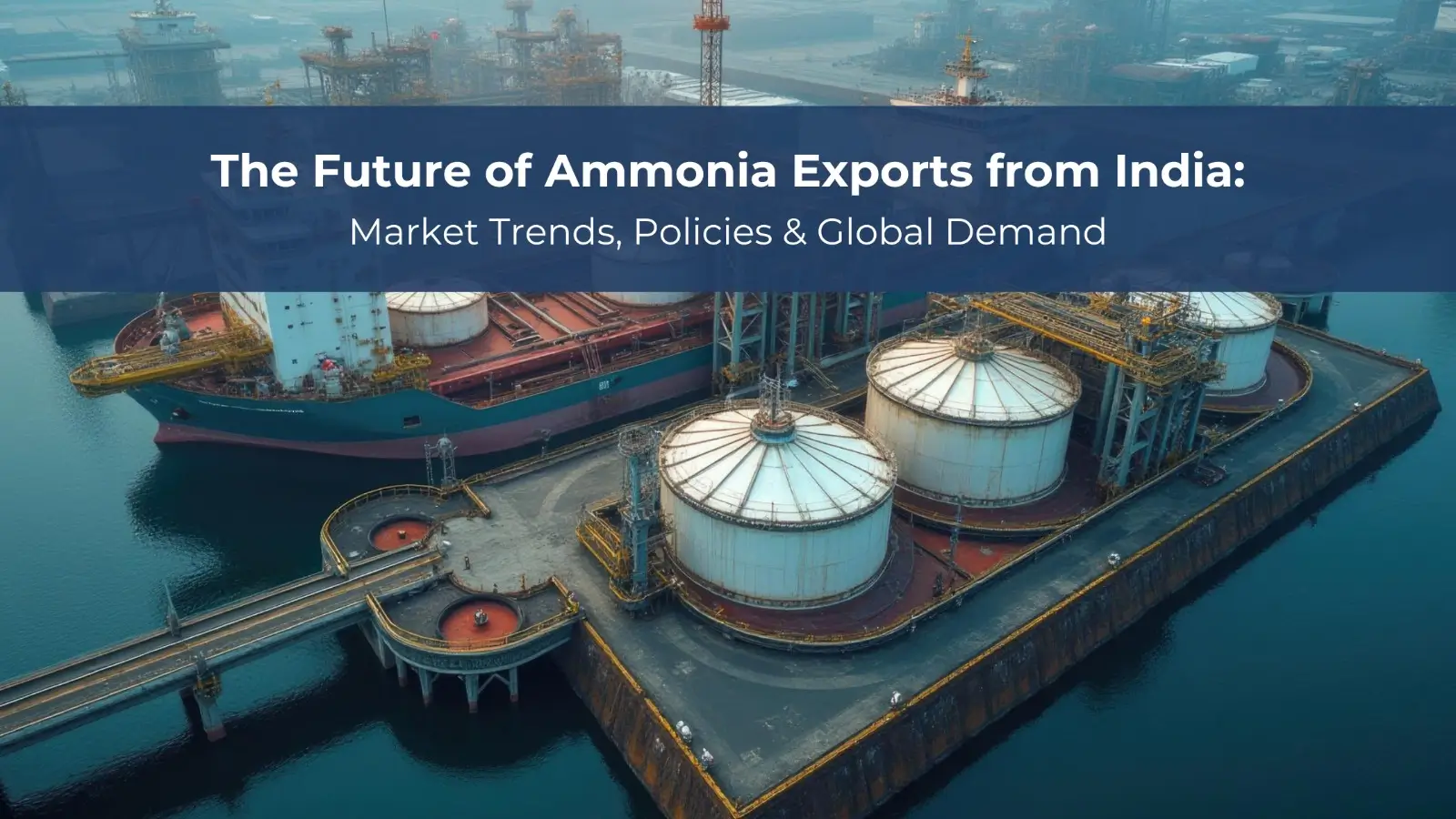
- Port Infrastructure for Green Ammonia Export
- Marine Transport: Ammonia Tanker Logistics
- Global Demand for Indian Green Ammonia
- Policy Support and Trade Agreements
- Challenges and How They Are Being Addressed
- Jaysons Chemical Industries’s Role in the Green Ammonia Supply Chain
- Who Benefits from Green Ammonia Transport Development?
- Related Reading
- Frequently Asked Questions
Green ammonia’s journey from renewable electricity to end use involves multiple transport stages — from the production site to domestic users or export staging terminals, then across oceans to importing countries, and finally to power plants, industrial facilities, or agricultural distributors at the destination. Each stage of this logistics chain requires specialised expertise, certified equipment, and regulatory compliance. For India, building the transport and export infrastructure for green ammonia is as strategically important as the production technology itself.
This guide covers how India’s green ammonia transport sector is developing — the domestic road logistics framework, the port terminal development underway, the marine transport requirements for export, the global demand landscape, and the policy environment. Jaysons Chemical Industries, a division of Jaysons Chemical Industries, operates PESO-licensed ammonia transport across India and is positioned to serve the growing green ammonia logistics market as India’s export capacity develops.
1. Why Green Ammonia Transport Matters
The economic case for green ammonia as a global energy commodity rests on the ability to produce it cost-effectively in renewable energy-rich locations and transport it reliably to energy-importing locations. Without an efficient, safe, and commercially viable transport supply chain, even the lowest-cost green ammonia production is commercially stranded.
India’s National Green Hydrogen Mission targets 5 MT per year of green hydrogen equivalent production by 2030 — a significant portion of which is expected to be in the form of green ammonia for export. Achieving this target requires not only the production plants but also the transport corridors, port terminals, marine fleet, and certification infrastructure that transform production into exported commodity. Transport infrastructure development is therefore on the critical path of India’s green ammonia export ambition.
One of ammonia’s most significant advantages over hydrogen as an energy export commodity is that the global logistics infrastructure for its transport largely already exists. The world currently ships approximately 20 million MT of ammonia per year in refrigerated and semi-refrigerated marine tankers, using established port terminals equipped for ammonia loading and unloading. Adapting this infrastructure for green ammonia export is an incremental upgrade rather than a greenfield build — a major competitive advantage versus building an entirely new liquid hydrogen export infrastructure from scratch.
2. India’s Strategic Advantage
India’s position in the emerging global green ammonia trade is shaped by four structural advantages that distinguish it from competing potential exporters.
Renewable Energy Abundance
India has some of the world’s highest solar irradiation values in Rajasthan, Gujarat, and parts of the Deccan plateau — equivalent to annual radiation of 5–6 kWh/m²/day, enabling utility-scale solar at costs below Rs 2/kWh in many recent auctions. India’s offshore wind potential — particularly along the coasts of Tamil Nadu, Andhra Pradesh, and Gujarat — is estimated at 70–100 GW of developable capacity. Low-cost renewable electricity is the primary input to green ammonia production; India’s cost position is among the most competitive globally.
Existing Ammonia Industry and Expertise
India operates approximately 30 ammonia plants with combined production capacity exceeding 12 million MT per year. The associated logistics infrastructure — road tanker fleets, storage facilities, handling expertise, and regulatory compliance frameworks — provides a ready foundation for scaling green ammonia production and transport. The workforce trained in ammonia handling, safety, and maintenance is a genuine human capital asset that new entrants to the green ammonia export market must build from scratch.
Coastal Geography and Port Access
India’s 7,500 km coastline with major deep-water ports on both the western coast (Kandla, Hazira, Mumbai, New Mangalore) and eastern coast (Visakhapatnam, Krishnapatnam, Kamarajar, Haldia) provides multiple export gateway options. Different production zones can be connected to appropriate ports depending on geography — Rajasthan solar projects to Kandla; Andhra Pradesh offshore wind projects to Visakhapatnam — minimising inland transport costs.
3. Domestic Ammonia Transport in India
India’s domestic ammonia transport infrastructure — built over decades to serve the fertiliser, refrigeration, textile, and chemical sectors — provides the logistics backbone for green ammonia distribution within the country and to export staging terminals.
Road Tanker Fleet
Ammonia road tankers in India typically carry 15–25 MT of anhydrous ammonia per trip in horizontal cylindrical pressure vessels designed to IS 7895. The tanker fleet is operated by industrial gas companies, chemical logistics specialists, and ammonia producers’ own transport divisions. Jaysons Chemical Industries transport services cover ammonia delivery from production facilities to end users across multiple states, with PESO-licensed vehicles and trained hazmat drivers.
Pipeline Infrastructure
India has limited dedicated ammonia pipeline infrastructure — unlike the USA, which operates thousands of kilometres of dedicated ammonia pipelines serving agricultural regions. A few short dedicated pipelines connect ammonia production plants to adjacent fertiliser factories or port terminals. The development of dedicated green ammonia pipelines connecting production zones to export ports is under evaluation — potentially reducing transport costs for large-scale export by 30–40% compared to road tanker logistics.
4. Regulatory Framework for Ammonia Transport
Ammonia transport regulation in India involves multiple overlapping frameworks that must all be satisfied simultaneously. Understanding this regulatory environment is essential for transport operators and ammonia buyers.
| Regulation | Authority | Primary Requirement |
|---|---|---|
| Central Motor Vehicles Rules 1989 | MoRTH / RTO | Vehicle fitness, driver licence, Hazardous Goods endorsement |
| Gas Cylinders Rules 2016 | PESO / MoCI | Tanker design, PESO transport permit, documentation |
| IS 7895 | BIS | Road tanker design and construction standards for liquefied gas |
| MSIHC Rules 1989 | MoEF / SPCBs | Hazardous chemical transport notification above thresholds |
| Environment Protection Act | CPCB / SPCBs | Spill prevention and response obligations |
All Jaysons Chemical Industries transport vehicles maintain current compliance with all applicable frameworks. Customers can request copies of vehicle PESO permits, driver training certificates, and vehicle fitness documentation as part of their supplier due diligence process.
5. Port Infrastructure for Green Ammonia Export
The port terminal is the critical interface between India’s domestic green ammonia production logistics and the international marine transport network. Current Indian port ammonia handling capacity is designed for import of conventional ammonia for fertiliser use — it must be significantly upgraded or supplemented to handle large-scale green ammonia export volumes.
Key Port Terminal Requirements
A green ammonia export terminal requires: dedicated berths capable of accommodating large refrigerated gas carriers (30,000–80,000 DWT); refrigerated storage tanks of 10,000–50,000 tonne capacity maintaining ammonia at -33°C; loading arms rated for cryogenic liquefied gas; metering and certification systems for green credential documentation; ammonia vapour recovery and control systems; IS 660-compliant safety systems including detection, ventilation, and emergency response; and environmental monitoring systems for CPCB and state PCB compliance.
Ports Under Evaluation
The following ports are under active evaluation or early-stage development for green ammonia export capability: Kandla and Hazira (Gujarat) — proximity to Rajasthan and Gujarat renewable energy zones; Visakhapatnam and Krishnapatnam (Andhra Pradesh) — access to offshore wind development areas and deep-water capacity; Kamarajar (Tamil Nadu) — Tamil Nadu offshore wind access and Chennai industrial connectivity; and New Mangalore (Karnataka) — west coast access for Karnataka renewable projects.
6. Marine Transport: Ammonia Tanker Logistics
Green ammonia exported from India to Japan, South Korea, or Europe travels in specialised marine vessels designed for liquefied gas carriage. Two main vessel types serve the ammonia trade.
Refrigerated Liquid Gas Carriers
Refrigerated carriers maintain liquid ammonia at -33°C and atmospheric pressure — the more economical storage condition for large volumes. These vessels typically range from 20,000 to 84,000 DWT and represent the majority of the global ammonia marine fleet. For India’s large-scale green ammonia export, refrigerated carriers of 40,000–84,000 DWT (Very Large Gas Carriers — VLGCs) would provide the most cost-effective transport economics at scale, similar to the economics of LPG trade.
Semi-Refrigerated/Pressurised Carriers
Smaller vessels (typically 3,000–15,000 DWT) may use semi-refrigerated (partial pressure + partial cooling) or fully pressurised designs for ammonia carriage. These are less efficient per tonne-km but serve smaller trade routes and terminal configurations where refrigerated storage is not available.
Marine Safety Requirements
Ammonia-carrying vessels must comply with the International Maritime Organization’s International Code of the Construction and Equipment of Ships Carrying Liquefied Gases in Bulk (IGC Code), which specifies design, construction, crew training, and operational requirements for liquefied gas carriers. For ammonia-fuelled vessels — ships that use ammonia as their own propulsion fuel — additional IGC amendments and the developing IMO framework for ammonia as marine fuel apply.
7. Global Demand for Indian Green Ammonia
The global demand for green ammonia — as a fertiliser input, energy carrier, marine fuel, and hydrogen vector — is growing rapidly, driven by national decarbonisation commitments and industrial net-zero targets. India’s potential role as a supplier is well-recognised by importing countries.
Japan
Japan’s Basic Hydrogen Strategy and associated Green Transformation (GX) implementation plan commit to importing 3 million MT of ammonia per year by 2030 for power plant co-firing as a bridge decarbonisation measure. Japan’s JERA, JBIC, and trading houses including Mitsubishi, Marubeni, and Itochu are all actively engaged in green ammonia supply negotiations with Indian project developers. India-Japan government-to-government cooperation on hydrogen and ammonia was formalised in the 2023 bilateral energy partnership.
South Korea
South Korea has committed to importing 3.9 million MT of low-carbon ammonia per year by 2030 for power generation co-firing. KEPCO and Korea’s major utilities are in early discussions with Indian project developers. Korea’s proximity and the existing ammonia trade route from the Middle East through Indian Ocean waters makes India a natural supplier.
Europe (Germany and Netherlands)
Germany’s National Hydrogen Strategy targets 10 MT of imported hydrogen equivalent by 2030, with green ammonia as a key carrier option. The Netherlands — through the Port of Rotterdam — is developing Europe’s largest green ammonia import terminal, targeting multiple supplier countries including India. EU-India trade discussions have included green hydrogen and ammonia as priority cooperation areas.
8. Policy Support and Trade Agreements
India’s policy framework for green ammonia export is developing across multiple ministries and bilateral channels.
The National Green Hydrogen Mission (NGHM) provides direct financial support through viability gap funding for pilot projects, production-linked incentives for green hydrogen and ammonia production, and infrastructure support for port terminal development. The Ministry of Ports, Shipping and Waterways is coordinating port terminal development and has issued expressions of interest for green ammonia export berth development at major ports. The Ministry of New and Renewable Energy (MNRE) serves as the nodal ministry for NGHM and bilateral cooperation on green hydrogen trade.
Bilateral agreements on green hydrogen and ammonia trade have been signed or are in negotiation with Japan, Germany, the European Union, Australia, and the UAE. These agreements provide frameworks for certification mutual recognition, trade facilitation, and joint project development — important enablers for large-scale commercial green ammonia trade.
Ammonia Transport and Logistics from Jaysons Chemical Industries
Jaysons Chemical Industries operates PESO-licensed ammonia transport across India — serving fertiliser producers, industrial chemical users, cold storage operators, and green ammonia project developers. Reliable delivery, full compliance documentation, and decades of ammonia logistics experience.
9. Challenges and How They Are Being Addressed
Port Terminal Investment Gap
Green ammonia export terminals require substantial capital investment — a dedicated VLGC-capable berth with refrigerated storage can cost USD 100–300 million depending on capacity. Private investment requires off-take agreements with importing buyers before terminal construction is committed. The NGHM’s viability gap funding and the Ministry of Ports’ terminal development programme are designed to bridge the initial investment gap while the commercial market develops.
Certification and Green Credential Verification
Importing countries require certified documentation that green ammonia was genuinely produced from renewable electricity. India’s Bureau of Energy Efficiency is developing a domestic Green Hydrogen Standard that will provide the certification framework for Indian producers. Bilateral recognition of India’s certification framework by importing countries’ regulatory bodies is a necessary precondition for large-scale commercial trade — negotiations are ongoing.
Ammonia Tanker Availability
The global fleet of large ammonia marine tankers (VLGCs above 40,000 DWT) is relatively small compared to the fleet sizes that would be needed to transport millions of tonnes per year of green ammonia. New vessel orders are being placed by major shipping companies, but vessel construction lead times of 2–3 years mean that adequate marine transport capacity for the 2030 targets must be ordered now. Vessel availability could constrain the initial ramp-up of Indian green ammonia exports in the 2027–2029 period.
10. Jaysons Chemical Industries Role in the Green Ammonia Supply Chain
Jaysons Chemical Industries — the parent company of Jaysons Chemical Industries — has been a trusted ammonia transporter and supplier to Indian industry for decades. Our PESO-licensed fleet, trained hazmat drivers, and compliance management expertise provide a foundation for participating in India’s developing green ammonia supply chain.
As green ammonia production scales in India — from pilot projects to commercial-scale facilities — Jaysons Chemical Industries is positioned to provide: domestic distribution from production sites to industrial users; logistics coordination between production facilities and export staging terminals; supply of conventional high-purity ammonia to industries transitioning toward green supply; and technical advisory services for customers evaluating ammonia storage, handling, and compliance requirements as they engage with green ammonia supply chains.
11. Who Benefits from Green Ammonia Transport Development?
Stakeholder Groups
- Green Ammonia Producers — need reliable domestic and export logistics
- Industrial Exporters — diversifying export portfolio with green commodities
- Fertiliser Industry — transition from grey to green ammonia nitrogen supply
- Shipping Sector — ammonia-fuelled vessels and cargo trade growth
- Power Sector — green ammonia for co-firing and SCR systems
- Climate Goals — decarbonisation of global fertiliser and energy systems
Indian States with Green Ammonia Export Potential
- Gujarat — Kandla and Hazira port access, solar and wind resources
- Andhra Pradesh — Visakhapatnam and Krishnapatnam, offshore wind
- Rajasthan — world-class solar, pipeline to Kandla export route
- Tamil Nadu — Kamarajar Port, offshore wind resources
- Karnataka — New Mangalore Port, renewable energy cluster
- Odisha — Paradip Port, eastern coast industrial access
- Maharashtra — Mumbai and JNPT, industrial hub access
12. Related Reading
Articles
Services and Products
Frequently Asked Questions
What makes India a strategic location for green ammonia export?
India’s strategic advantage derives from: abundant low-cost renewable energy (solar below Rs 2/kWh in many auctions); a large experienced domestic ammonia industry; deep-water port access on both coasts; and government policy support through the National Green Hydrogen Mission. These factors position India as a potentially lowest-cost green ammonia supplier to Japan, South Korea, and Europe by the late 2020s.
What are the regulatory requirements for ammonia road transport in India?
Requirements include: PESO-approved transport vehicles certified for ammonia; IS 7895-compliant tanker construction with pressure relief valves and emergency isolation; drivers with Hazardous Goods endorsement and current training certification; vehicles carrying MSDS, emergency response cards, hazard diamond placards, fire extinguisher, and spill response kit; and compliance with state-specific route restrictions on hazardous material vehicles.
Which Indian ports are best positioned for green ammonia export?
Best-positioned ports include: Kandla and Hazira (Gujarat) — proximity to solar and wind zones; Visakhapatnam and Krishnapatnam (Andhra Pradesh) — offshore wind access and deep water; Kamarajar (Tamil Nadu) — offshore wind and Chennai connectivity; and New Mangalore (Karnataka) — west coast access. All require terminal upgrades for large-scale green ammonia handling.
Who are the major markets for Indian green ammonia exports?
The four primary import markets are Japan (committed to 3 MT/year by 2030 for coal co-firing), South Korea (3.9 MT/year by 2030), Germany, and the Netherlands. All four have formal or informal government-to-government dialogues with India on green ammonia supply arrangements.
What is the difference between domestic and export ammonia transport?
Domestic transport uses PESO-licensed road tankers (15–25 MT) under Central Motor Vehicles Rules. Export transport uses international marine tankers — refrigerated liquid gas carriers (at -33°C) or pressure carriers (at 8–10 bar) — with capacities from 3,000 to 84,000 DWT. Export additionally requires port terminal handling, customs documentation, and compliance with IMDG/IGC maritime dangerous goods codes.
What safety systems are required for green ammonia transport in India?
Required safety systems include: PESO-certified vehicle with fitness certificate; IS 7895-compliant tanker with pressure relief valves, emergency isolation, and earthing cables; ammonia-rated hose assemblies with breakaway couplings; onboard fire suppression; driver PPE (SCBA, gloves, goggles); emergency response card and MSDS. Marine export additionally requires gas-tight cargo spaces, inert gas systems, water curtain systems, and certified cargo operations personnel under IGC Code.
What policy support is available for green ammonia transport and export from India?
India’s National Green Hydrogen Mission provides viability gap funding, production-linked incentives, and infrastructure support for port terminal development. The Ministry of Ports is coordinating port terminal development. MNRE is the nodal ministry for NGHM policy. Bilateral agreements with Japan, Germany, EU, Australia, and UAE provide frameworks for certification mutual recognition and trade facilitation.
What challenges face India’s green ammonia export development?
Key challenges include: port terminal investment gap (requiring off-take agreements before capital commitment); certification framework development and bilateral regulatory recognition; and ammonia marine tanker availability (vessel construction lead times of 2–3 years mean orders must be placed now for 2027–2029 delivery). All are being actively addressed through policy measures and commercial negotiations.