

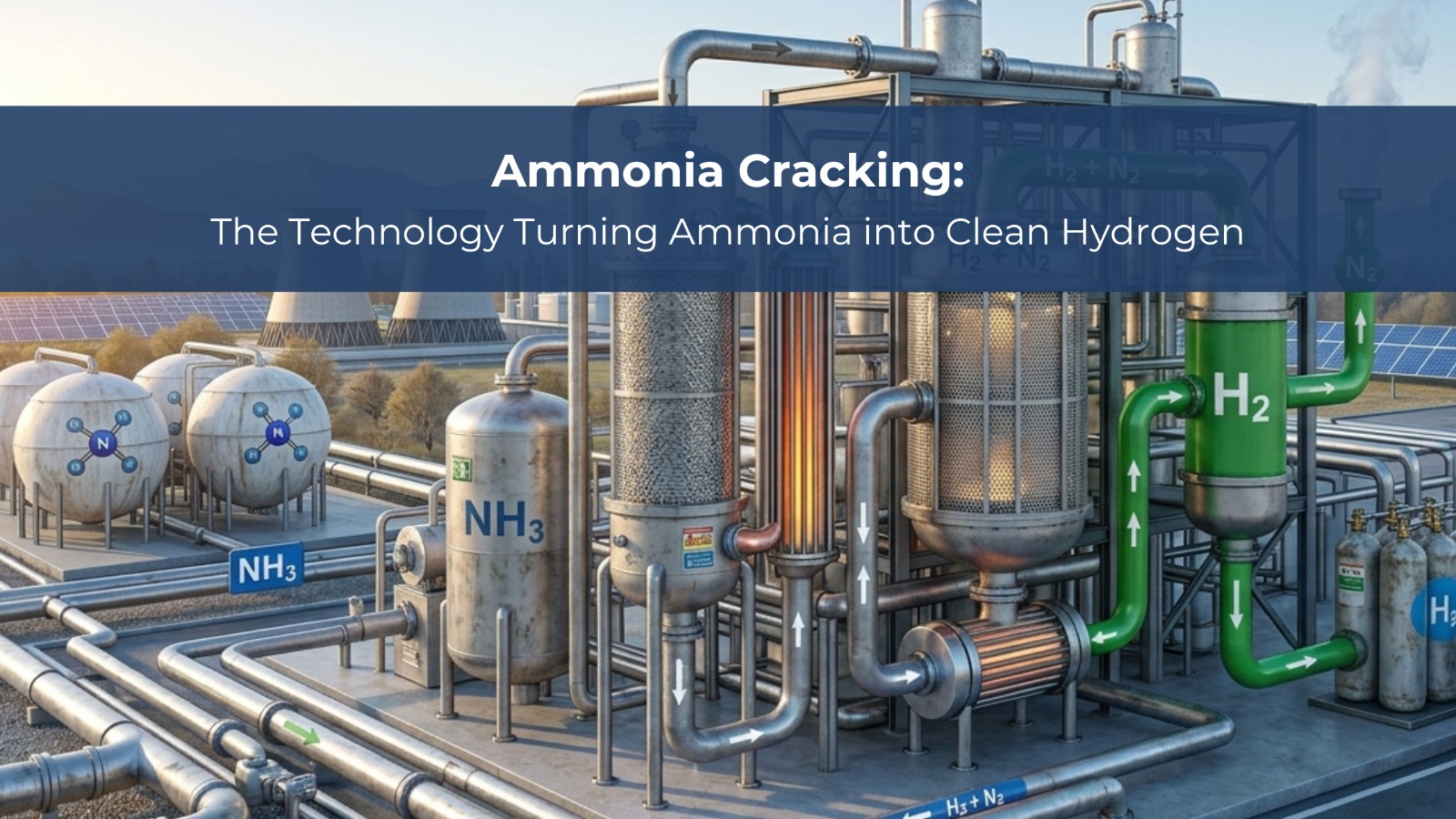
- Core reaction: Ammonia cracking (2NH3 → N2 + 3H2) splits ammonia into nitrogen and hydrogen using heat and a catalyst, producing zero carbon emissions when green ammonia is the feedstock.
- Hydrogen content: Ammonia contains 17.6% hydrogen by weight — more than most hydrogen carrier candidates — and is vastly easier and cheaper to store and transport than compressed or liquid hydrogen.
- Technology readiness: Ammonia cracking is commercially proven at industrial scale for hydrogen supply; scale-up for energy applications is advancing rapidly globally and in India.
- Catalyst options: Ruthenium (most active, lower operating temperature), nickel (most widely deployed, lower cost), and iron (developmental, lowest cost) are the primary catalyst systems.
- India’s opportunity: India’s National Green Hydrogen Mission targets 5 MT/year of green hydrogen by 2030, with green ammonia as the primary export vehicle — making ammonia cracking the critical final step.
- Feedstock connection: Green ammonia produced via water electrolysis and Haber-Bosch synthesis is the zero-carbon feedstock for carbon-free hydrogen cracking — positioning Jaysons Chemical Industries at the centre of this supply chain.
- What Is Ammonia Cracking?
- The Chemistry and Mechanism of Cracking
- Catalyst Technology and Selection
- Ammonia Cracker System Types
- Why Ammonia Is the Leading Hydrogen Carrier
- Energy Applications of Cracked Hydrogen
- Industrial Applications of Ammonia Cracking
- The Green Ammonia Connection
- India’s Hydrogen Mission and Ammonia’s Role
- Challenges and Commercial Outlook
- Who Benefits from Ammonia Cracking Technology?
- Related Reading
- Frequently Asked Questions
Hydrogen is the clean fuel the world needs. Ammonia is how we move it there. This fundamental insight is driving one of the most consequential developments in the global energy transition: the use of ammonia as a hydrogen carrier, with ammonia cracking technology providing the bridge between storage and use. Anhydrous ammonia — the same compound that has powered industrial refrigeration and agricultural fertiliser systems for over a century — is emerging as the most practical, scalable, and cost-effective medium for storing and transporting hydrogen across continents.
Jaysons Chemical Industries, a division of Jaysons Chemical Industries, has served India’s industrial ammonia sector for decades. As ammonia’s role expands from industrial chemical to global energy carrier, understanding ammonia cracking technology is essential for energy developers, industrial engineers, project finance teams, and policy stakeholders. This guide provides a comprehensive technical and commercial overview of the full ammonia cracking landscape.
1. What Is Ammonia Cracking?
Ammonia cracking — also referred to as ammonia decomposition or thermolysis — is the catalytic process by which ammonia molecules are split into their constituent elements: nitrogen gas (N2) and hydrogen gas (H2). It is the reverse of the Haber-Bosch process that synthesised the ammonia in the first place, and it regenerates hydrogen on demand at the point of use without any carbon emissions.
The reaction equation is: 2NH3 → N2 + 3H2. The reaction is endothermic, meaning it requires heat input, and requires a catalyst to proceed at economically useful rates at acceptable temperatures. Without a catalyst, meaningful ammonia decomposition requires temperatures above 900°C. With an appropriate catalyst, conversion rates above 99% are achievable at 500–650°C, enabling compact reactor designs with manageable heat input requirements.
2. The Chemistry and Mechanism of Cracking
Ammonia decomposition on a catalyst surface proceeds through a sequence of elementary surface reactions. The overall mechanism involves: (1) adsorption of ammonia molecules onto active sites on the catalyst surface; (2) sequential dehydrogenation steps in which ammonia loses hydrogen atoms progressively (NH3 → NH2 → NH → N); (3) recombination of nitrogen atoms to form molecular nitrogen gas (N2) that desorbs from the surface; and (4) simultaneous recombination of hydrogen atoms to form H2 gas that also desorbs.
The Rate-Limiting Step
The slowest step in the overall mechanism — and therefore the step that controls the overall reaction rate — is the recombination and desorption of nitrogen atoms from the catalyst surface. This is the critical insight driving catalyst design: an optimal cracking catalyst must have sufficient affinity for nitrogen to hold the N atoms long enough to undergo dehydrogenation from the ammonia, but not so strong an affinity that nitrogen atoms are held too tightly on the surface to combine and desorb as N2. Catalysts at the optimum point of this “nitrogen binding energy” volcano plot achieve the highest turnover frequencies.
Thermodynamic Considerations
Ammonia cracking is thermodynamically spontaneous at all temperatures above approximately 200°C — meaning the equilibrium always favours decomposition products — but the rate is temperature-dependent. At 400°C, conversion rates with the most active ruthenium catalysts approach 90–95%. At 500°C, conversion exceeds 99% with commercial nickel catalysts. The approximately 46 kJ/mol of heat energy required per mole of NH3 decomposed must be supplied externally — this is a critical system design consideration that influences the choice between electric heating, combustion heating, and waste heat recovery as the energy source.
3. Catalyst Technology and Selection
The catalyst is the heart of any ammonia cracker. Catalyst selection determines the operating temperature, the conversion efficiency, the reactor size and cost, the catalyst lifetime, and ultimately the economics of the entire cracking system. Three catalyst classes currently dominate commercial and developmental systems.
Ruthenium Catalysts
Ruthenium (Ru) sits at the optimal point of the nitrogen binding energy volcano — it achieves the highest catalytic activity for ammonia decomposition among all tested metals. Ruthenium catalysts supported on carbon nanotubes, activated carbon, or magnesium oxide achieve conversion rates above 90% at operating temperatures as low as 400–450°C, enabling more compact reactor designs with lower heat input requirements. The significant disadvantage is cost: ruthenium is a platinum-group metal priced at approximately USD 14,000–18,000 per kg, making catalyst loading costs substantial for large-scale systems.
Nickel Catalysts
Nickel-based catalysts are the current industrial standard for ammonia cracking at commercial scale. They require higher operating temperatures (600–700°C) than ruthenium but are dramatically cheaper — nickel costs approximately USD 15–20 per kg. The temperature penalty is manageable in most applications because the required heat can be sourced from combustion gases or industrial waste heat. Nickel catalysts are commercially available from multiple suppliers, well-characterised in terms of deactivation mechanisms, and have established regeneration protocols. These factors make nickel the pragmatic choice for initial commercial deployments.
Iron Catalysts
Iron is the catalyst used in the Haber-Bosch synthesis process (running in the forward direction), and it shows activity for the reverse reaction as well. Iron catalysts have the lowest raw material cost of any candidate system, but they currently require higher operating temperatures (700–800°C) and higher pressures than nickel to achieve acceptable conversion rates. Active research programmes in India, Japan, and Europe are developing promoted iron formulations that could make this system competitive with nickel at lower temperatures.
| Catalyst | Operating Temp | Conversion at Temp | Cost Level | TRL |
|---|---|---|---|---|
| Ruthenium (Ru) | 400–500°C | 90–99% | Very High | 7–8 |
| Nickel (Ni) | 600–700°C | 95–99% | Low | 8–9 |
| Iron (Fe) | 700–800°C | 80–95% | Very Low | 4–5 |
| Ru-Ni Bimetallic | 450–550°C | 95–99% | Moderate | 5–6 |
4. Ammonia Cracker System Types
Ammonia cracker reactor designs vary significantly depending on scale, feed purity requirements, heat source, and downstream application. Understanding the system landscape helps developers and engineers select the right architecture for each specific deployment.
Tubular Fixed-Bed Reactors
The most common commercial cracker design uses tubes packed with catalyst pellets, heated externally by combustion gases or electric resistance heaters. Ammonia vapour flows through the catalyst bed, decomposing progressively as it travels along the tube length. This design is well-understood, easily scaleable by increasing the number of parallel tubes, and compatible with both nickel and ruthenium catalysts. Heat input is straightforward to control, and catalyst replacement is relatively simple. Tubular fixed-bed crackers are the design of choice for industrial-scale hydrogen supply and most early-stage energy applications.
Membrane Reactors
Membrane reactors integrate a hydrogen-permeable membrane (typically palladium or palladium-alloy) within the reactor itself. As hydrogen is produced, it permeates through the membrane and is removed continuously from the reaction zone. This removal of product gas shifts the equilibrium toward higher conversion, enabling near-complete ammonia decomposition at lower temperatures than fixed-bed systems require. Membrane reactors produce hydrogen already partially purified on the permeate side, reducing downstream purification requirements. The challenge is membrane cost and durability, but this design pathway is attracting significant research investment globally.
Catalytic Combustion Crackers
Some cracker designs use a portion of the ammonia feedstock as fuel for catalytic combustion to supply the endothermic heat of cracking. The combustion catalyst oxidises ammonia to nitrogen and water (not to NOx in well-designed systems), providing heat to the cracking reactor. This autothermal approach eliminates the need for an external heat source but reduces the net hydrogen yield by the fraction of ammonia used as fuel — typically 15–20%.
Green Ammonia for Clean Hydrogen Production
Jaysons Chemical Industries supplies high-purity anhydrous ammonia suitable as feedstock for ammonia cracking systems — from pilot-scale crackers to industrial hydrogen production facilities. Ask us about supply continuity and purity specifications for your project.
5. Why Ammonia Is the Leading Hydrogen Carrier
Hydrogen’s fundamental challenge as an energy carrier is its low volumetric energy density in gaseous form and the extreme conditions required to store it in liquid form (-253°C). Ammonia elegantly solves both problems. Understanding why ammonia has emerged as the leading hydrogen carrier candidate requires comparing it directly with the alternatives.
Energy Density Comparison
Liquid ammonia at ambient temperature (stored at modest pressure of approximately 8.6 bar) contains 108 kg of hydrogen per cubic metre — compared to 71 kg/m³ for liquid hydrogen (which requires storage at -253°C) and just 39 kg/m³ for compressed hydrogen at 700 bar. Ammonia stores more hydrogen per unit volume than liquid hydrogen, using equipment that is orders of magnitude cheaper and safer to operate.
Infrastructure Compatibility
Global ammonia production currently stands at approximately 185 million MT per year, supported by an established worldwide network of production plants, storage terminals, tankers, and pipelines. This infrastructure exists today and can be adapted for hydrogen carrier service with modest modifications — providing a ready-made global distribution network for hydrogen that would cost trillions of dollars to replicate from scratch for compressed or liquid hydrogen.
6. Energy Applications of Cracked Hydrogen
The hydrogen produced by ammonia cracking can be used across a growing range of energy applications, each with specific purity requirements and system design implications.
Fuel Cell Power Generation
Proton exchange membrane (PEM) fuel cells, alkaline fuel cells (AFC), and solid oxide fuel cells (SOFC) can all use hydrogen from ammonia cracking as fuel for electricity generation. PEM fuel cells are the most demanding in terms of purity — requiring less than 0.1 ppm residual ammonia to prevent platinum catalyst poisoning. This typically requires a pressure swing adsorption (PSA) purification stage after the cracker. SOFC systems are more tolerant of ammonia contamination and can in some designs operate directly on partially cracked ammonia, simplifying system architecture.
Gas Turbine and Power Plant Fuel
Gas turbines can be adapted to combust hydrogen-nitrogen mixtures produced by partial or complete ammonia cracking. The nitrogen dilution reduces flame temperature and NOx formation, which is a benefit in gas turbine applications. Japan’s ammonia co-firing programme — using ammonia mixed with coal in thermal power plants — has demonstrated this pathway at commercial scale, with several utilities now targeting 20% ammonia co-firing ratios.
Shipping Fuel
The maritime sector’s decarbonisation challenge is driving intense interest in ammonia as a zero-carbon ship fuel. Some ship engine designs combust ammonia directly; others crack a portion of the ammonia to hydrogen and use the hydrogen-ammonia mixture to improve combustion characteristics. The International Maritime Organization’s 2050 decarbonisation targets are accelerating the adoption of ammonia fuel technology in shipping.
7. Industrial Applications of Ammonia Cracking
Beyond the energy sector, ammonia cracking has well-established industrial hydrogen supply applications where it has been in use for decades. These applications provide proven commercial reference points for the technology and demonstrate the reliability of the process in demanding industrial environments.
Metal Heat Treatment
Cracked ammonia — a mixture of approximately 75% hydrogen and 25% nitrogen — has been used as a protective atmosphere in metal heat treatment furnaces for over 60 years. The hydrogen component prevents oxidation of metal parts during annealing, brazing, and sintering operations, while the nitrogen provides an inert carrier. Ammonia crackers serving heat treatment furnaces are typically small to medium scale (1–50 Nm³/h hydrogen), making them the most mature and commercially widespread form of ammonia cracking technology in India today.
Electronics Manufacturing
The electronics industry uses high-purity hydrogen from cracked ammonia in semiconductor fabrication, LED manufacturing, and photovoltaic cell production. The consistent, on-demand hydrogen supply available from ammonia cracking is preferred over bulk hydrogen cylinder delivery for process reliability and safety reasons. Purification to semiconductor grade (99.9999% H2) requires additional processing beyond standard PSA units.
Float Glass Production
The float glass process — in which molten glass floats on a bath of liquid tin to produce flat glass — requires a reducing atmosphere of nitrogen and hydrogen above the tin bath to prevent tin oxidation. Ammonia crackers provide the hydrogen component of this atmosphere reliably and cost-effectively. Indian glass manufacturers represent a significant installed base of ammonia cracking capacity.
8. The Green Ammonia Connection
The true transformative potential of ammonia cracking lies not in its existing industrial applications but in its role as the delivery mechanism for green hydrogen produced from renewable energy. The pathway is: renewable electricity → water electrolysis → green hydrogen → Haber-Bosch synthesis with green hydrogen and atmospheric nitrogen → green ammonia → export by sea → ammonia cracking at destination → green hydrogen for end use.
This pathway allows renewable energy resources in sunbelt or windrich regions — including India’s Rajasthan desert and Gujarat coastline — to be converted into a globally tradeable energy commodity using proven, existing technology. The energy content of the original renewable generation is recovered at the destination as clean hydrogen, with the only emissions being water vapour from the electrolysis and the nitrogen returned to atmosphere from cracking.
9. India’s Hydrogen Mission and Ammonia’s Role
India’s National Green Hydrogen Mission (NGHM), launched in January 2023 with an initial outlay of Rs 19,744 crore, sets a target of producing 5 MT of green hydrogen per year by 2030 and reducing hydrogen production costs to USD 1 per kg. The mission explicitly identifies green ammonia as a primary route for green hydrogen export and as a near-term decarbonisation option for the fertiliser sector.
Strategic Export Opportunities
Japan, South Korea, Germany, and the Netherlands have all identified green ammonia imports as a critical pathway for achieving their own decarbonisation targets. Japan alone has committed to importing 3 MT of ammonia per year by 2030 as a co-firing fuel for thermal power plants. This demand creates a concrete, near-term commercial opportunity for Indian green ammonia producers — and for the ammonia cracking facilities at the receiving end of these trade flows.
Domestic Decarbonisation Applications
Within India, the NGHM envisions green hydrogen produced by cracking green ammonia being used to decarbonise hard-to-abate sectors including steel manufacturing, oil refining, and heavy road transport. Hydrogen-powered fuel cell trucks and trains are identified as priority applications where cracked ammonia could serve as the on-board hydrogen source, avoiding the compressed hydrogen storage infrastructure challenges that have slowed hydrogen mobility globally.
Fertiliser Sector Integration
India’s fertiliser industry is the world’s second-largest consumer of ammonia, almost entirely using grey ammonia synthesised from natural gas. The transition from grey to green ammonia in fertiliser production is a massive decarbonisation opportunity. While this does not directly involve cracking — the ammonia is used directly as fertiliser rather than cracked to hydrogen — it creates the green ammonia production scale that will drive down costs for the hydrogen carrier pathway as well. Ammonia as fertiliser and ammonia as a hydrogen carrier are complementary rather than competing applications.
10. Challenges and Commercial Outlook
Ammonia cracking for large-scale energy applications faces several challenges that are actively being addressed by industry, research institutions, and governments globally. Understanding these challenges provides a realistic picture of the technology’s commercial timeline.
Scale-Up Cost
Current ammonia cracking costs for energy-scale hydrogen production are estimated at USD 0.5–1.5 per kg of hydrogen, depending on the heat source, scale, and ammonia feedstock cost. This is competitive with electrolysis-produced green hydrogen but must be considered alongside the upstream cost of producing and transporting the green ammonia feedstock. As green ammonia production costs decline with renewable electricity cost reductions, the overall green hydrogen-via-cracking cost is expected to fall substantially toward the NGHM target of USD 1/kg by 2030.
Ammonia Slip in Fuel Cell Applications
Even parts-per-million levels of residual ammonia in hydrogen from a cracker will poison platinum catalysts in PEM fuel cells, requiring post-cracking purification that adds cost and complexity. This challenge is driving research into novel cracking catalysts that achieve conversion rates above 99.99%, advanced membrane separation technologies, and alternative fuel cell types (particularly SOFC) that are tolerant of ammonia-containing hydrogen streams.
Energy System Integration
Integrating ammonia crackers with renewable energy sources, heat recovery systems, fuel cells, and grid-connection infrastructure requires sophisticated engineering and control systems. The intermittent nature of renewable electricity generation creates operational challenges for processes that benefit from steady-state operation. Thermal energy storage systems integrated with crackers, and the use of variable-capacity cracker designs, are being developed to address this intermittency challenge.
11. Who Benefits from Ammonia Cracking Technology?
- Power Generation — gas turbine co-firing and fuel cell power plants
- Maritime Shipping — ammonia-fuelled and cracked-hydrogen ships
- Fertiliser and Agriculture — green ammonia transition reducing Scope 1 emissions
- Heavy Industry — steel, glass, and chemicals decarbonisation
- Ammonia Exporters — new markets in green hydrogen carrier trade
- Sustainability Leaders — organisations targeting Scope 3 hydrogen decarbonisation
- Gujarat — coastal export terminals and existing ammonia infrastructure
- Andhra Pradesh — offshore wind resources and deep-water port access
- Rajasthan — solar renewable energy resources for electrolysis
- Tamil Nadu — offshore wind and southern port connectivity
- Odisha — industrial clusters and eastern port infrastructure
- Karnataka — technology and industrial hub connectivity
12. Related Reading
Frequently Asked Questions
What is ammonia cracking and why is it important?
Ammonia cracking is the catalytic decomposition of ammonia into nitrogen and hydrogen gas (2NH3 → N2 + 3H2). It is important because ammonia is an efficient hydrogen carrier — far easier to store and transport than compressed or liquid hydrogen — and cracking recovers the hydrogen at the point of use for fuel cells, industrial processes, or power generation. The process produces zero carbon emissions when the feedstock is green ammonia produced from renewable energy.
What temperature is required for ammonia cracking?
Without a catalyst, meaningful ammonia decomposition requires temperatures above 900°C. With an appropriate catalyst, useful conversion rates are achievable at 400–650°C. Ruthenium-based catalysts can achieve 90%+ conversion at the lower end of this range (400–500°C), while nickel-based catalysts require 600–700°C for comparable conversion efficiency. Reactor operating temperature selection depends on the balance between catalyst cost and heat energy cost.
What catalysts are used in ammonia cracking reactors?
The three primary catalyst systems are ruthenium (most active, achieves high conversion at 400–500°C, high cost), nickel (most widely deployed commercially, requires 600–700°C, significantly lower cost), and iron (lowest cost, developmental stage, requires high temperatures). Bimetallic catalysts combining ruthenium or nickel with promoter metals are an active area of research aimed at improving activity while reducing catalyst cost.
What is the hydrogen yield from ammonia cracking?
Ammonia contains 17.6% hydrogen by weight. Stoichiometrically, cracking 1 kg of ammonia produces approximately 178 g of hydrogen and 822 g of nitrogen. At conversion efficiencies of 99%+ achievable with modern catalysts at operating temperature, the practical hydrogen yield closely approaches this theoretical maximum. The nitrogen byproduct is harmless and is simply returned to the atmosphere.
How does ammonia cracking fit into India’s National Hydrogen Mission?
India’s National Green Hydrogen Mission targets 5 MT/year of green hydrogen production by 2030. Green ammonia is identified as the primary export vehicle — green hydrogen is synthesised into ammonia in India, shipped to importing countries, and cracked back to hydrogen at the destination. Ammonia cracking technology is therefore the critical final step in India’s green hydrogen export value chain, and its commercial development is central to India’s clean energy trade ambitions.
What is the difference between cracking for fuel cells versus industrial hydrogen?
Fuel cell applications — particularly PEM fuel cells — require very high hydrogen purity with ammonia slip below 0.1 ppm, as even trace ammonia poisons the platinum catalyst. This requires downstream purification using PSA or selective catalytic membranes. Industrial hydrogen for processes such as metal heat treatment or float glass production can tolerate higher nitrogen content and trace ammonia levels, simplifying system design and reducing purification costs.
Can existing industrial ammonia infrastructure be used for hydrogen carrier applications?
Existing ammonia storage and distribution infrastructure — including storage tanks, pipelines, and port terminals — can be adapted for use as hydrogen carrier infrastructure with relatively modest modifications. This is a significant strategic advantage of the ammonia-to-hydrogen pathway: it builds on decades of ammonia handling experience and existing global ammonia logistics networks rather than requiring entirely new hydrogen transport infrastructure.
What ammonia purity is required for cracking feedstock?
Requirements depend on the downstream application. For industrial hydrogen applications such as heat treatment, standard anhydrous ammonia (99.5%+ NH3) is typically suitable. For fuel cell hydrogen where downstream PSA purification is used, refrigerant-grade anhydrous ammonia (99.95%+ NH3) is preferred to minimise catalyst-poisoning contaminants entering the cracker. Oil content should be below 5 ppm in all cases to protect catalyst performance and longevity.