
- Standard sizes: Indian market ammonia cylinders are available in 47 kg, 100 kg, and 150 kg net fill capacities, all manufactured to IS 7285 / IS 5765 BIS specifications.
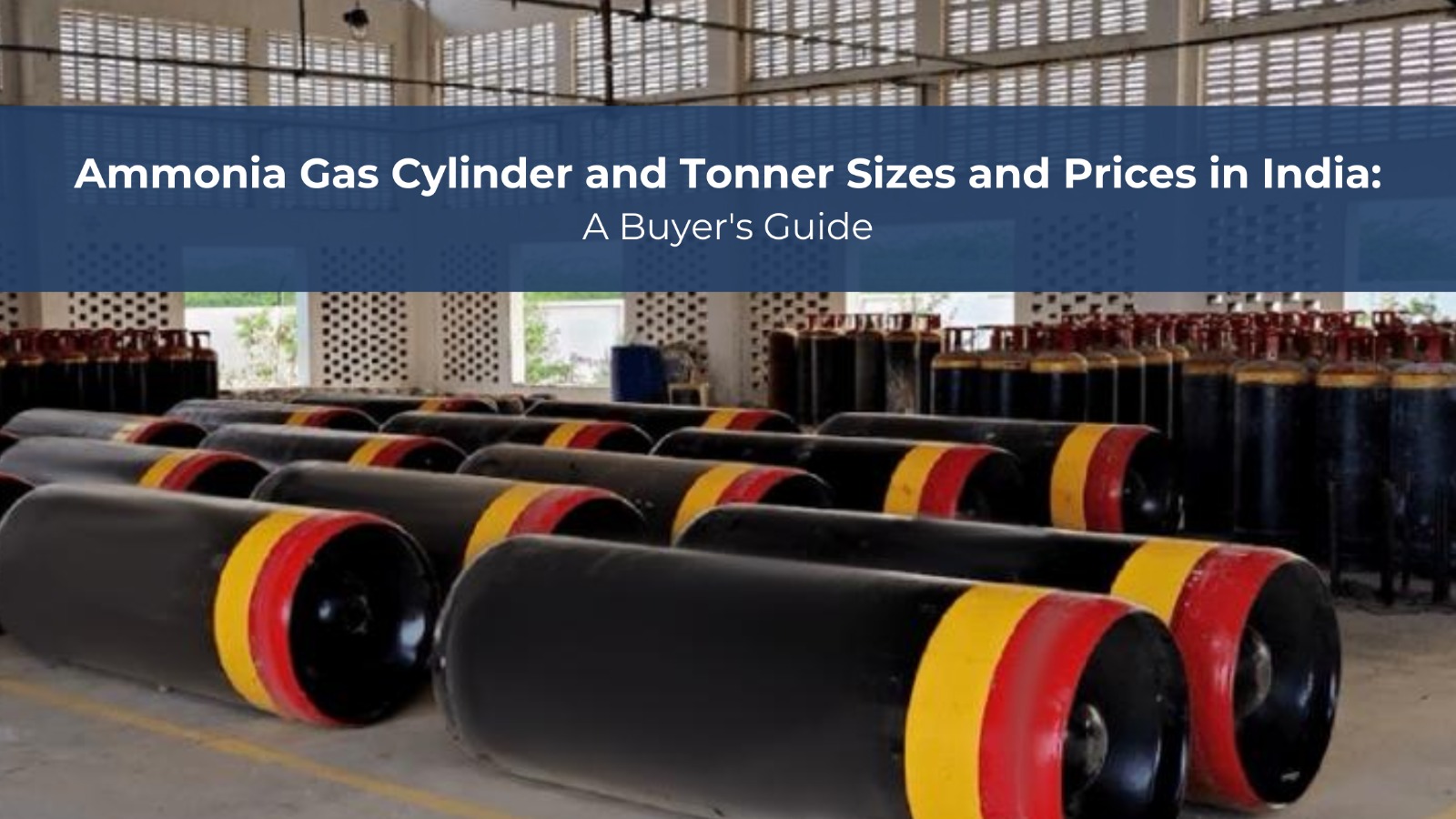
- Tonner capacity: Ammonia tonners hold 900–1,000 kg of anhydrous ammonia and are the economical choice for industrial users consuming more than 200 kg per month.
- Regulatory body: All ammonia pressure vessels are regulated by PESO under the Gas Cylinders Rules 2016 — storage above threshold quantities requires a valid licence.
- Testing interval: Ammonia cylinders must undergo hydrostatic testing every 5 years at a PESO-approved station. Expired cylinders cannot legally be filled or transported.
- Price drivers: Ammonia prices track natural gas feedstock costs, purity grade, order quantity, and delivery logistics. Prices fluctuate with global ammonia market movements.
- Jaysons Chemical Industries offering: Jaysons Chemical Industries supplies all standard cylinder sizes, tonners, and bulk tanker delivery across India with certified purity documentation for every consignment.
- Standard Ammonia Cylinder Sizes in India
- Ammonia Tonner Sizes and Specifications
- Cylinder vs Tonner: Which Is Right for You?
- Ammonia Grades and Purity Levels
- Ammonia Pricing Guide for Indian Buyers
- BIS and PESO Specifications for Ammonia Vessels
- Hydrostatic Testing and Cylinder Maintenance
- Storage Requirements and PESO Licensing
- Buyer’s Selection Guide
- Transport and Delivery Compliance
- Who Uses Ammonia Cylinders and Tonners?
- Related Reading
- Frequently Asked Questions
Whether you are a refrigeration engineer sourcing ammonia for a cold storage plant, a textile mill procuring liquefied ammonia for dyeing operations, or a metal heat treatment facility requiring a continuous hydrogen-nitrogen atmosphere, understanding ammonia cylinder and tonner sizes, specifications, and pricing in India is essential. The Indian ammonia cylinder market is governed by multiple regulatory standards, and buyers who understand this system can source more efficiently, comply more confidently, and manage their supply chain without disruption.
Jaysons Chemical Industries, a division of Jaysons Chemical Industries, has supplied ammonia cylinders, tonners, and bulk quantities to industrial customers across India for decades. This guide draws on that experience to provide a practical, accurate buyer’s reference for 2026. For current pricing or to place an order, visit our quote request page.
1. Standard Ammonia Cylinder Sizes in India
Ammonia cylinders in India are available in three standard net fill sizes — the weight of ammonia the cylinder contains when full. These sizes are standardised under BIS specifications and represent the forms in which anhydrous ammonia is distributed to industrial users who do not have permanent bulk storage facilities.
| Cylinder Type | Net Fill Weight | Water Capacity (approx.) | Tare Weight (approx.) | Gross Weight (approx.) |
|---|---|---|---|---|
| Small Cylinder | 47 kg NH3 | 72 litres | 55–65 kg | ~110 kg |
| Medium Cylinder | 100 kg NH3 | 150 litres | 90–110 kg | ~200 kg |
| Large Cylinder | 150 kg NH3 | 230 litres | 130–150 kg | ~290 kg |
All cylinders are stored and used in the vertical upright position. The fill ratio — the ratio of liquid ammonia volume to the cylinder’s total water capacity — is controlled to 85–90% to allow for liquid expansion with temperature changes. Never attempt to fill a cylinder beyond the stamped tare weight plus the specified net fill weight. Overfilling creates a serious hydraulic pressure hazard as liquid ammonia has very low compressibility.
2. Ammonia Tonner Sizes and Specifications
An ammonia tonner — also known as a ton container or TC — is a large horizontal cylindrical pressure vessel designed for high-volume industrial ammonia users who need substantially more capacity than cylinders can economically provide but have not yet invested in permanent bulk storage tanks. Tonners are the preferred format for cold storage plants, large textile mills, water treatment facilities, and fertiliser blending units.
| Parameter | Standard Tonner Specification |
|---|---|
| Net NH3 Fill Weight | 900–1,000 kg |
| Water Capacity | 1,400–1,500 litres |
| Vessel Orientation | Horizontal (on cradles) |
| Design Pressure | 25–30 bar (design) |
| Valve Arrangement | Two valves — gas phase and liquid phase withdrawal |
| BIS Standard | IS 3196 (welded pressure vessels) |
| Testing Interval | 5 years (hydrostatic test, PESO-approved station) |
| Tare Weight | 500–700 kg (varies by manufacturer) |
Tonners are supplied as either gas-phase withdrawal (vapour drawn from the top connection) or liquid-phase withdrawal (liquid drawn from the bottom connection). The correct withdrawal mode depends on the downstream equipment — refrigeration systems typically use liquid-phase withdrawal, while gas-phase withdrawal is used for applications such as water treatment dosing where gaseous ammonia is metered into a water stream.
3. Cylinder vs Tonner: Which Is Right for Your Operation?
Selecting between cylinders and tonners is primarily a question of monthly consumption volume, available storage infrastructure, and operational convenience. The following framework helps buyers make the right decision.
| Factor | Cylinders (47/100/150 kg) | Tonners (900–1,000 kg) |
|---|---|---|
| Monthly consumption threshold | Below 200 kg/month | Above 200 kg/month |
| Storage infrastructure needed | Cylinder cage or rack, ventilated area | Dedicated tonner bay with cradles, PESO licence |
| Delivery method | Exchange cylinders via truck | Tonner exchange via specialised vehicle |
| Per-kg cost | Higher (packaging, handling premium) | Lower (bulk discount) |
| Change frequency | Frequent — multiple changes per week for high users | Less frequent — typically monthly or bi-monthly |
| Ideal for | Labs, small heat treatment, small dyeing units | Cold storage, large textile mills, water treatment |
Users consuming more than 300–400 kg per month should seriously evaluate whether investment in a dedicated tonner bay offers a better total cost of ownership than continued cylinder purchasing. The cost premium of tonner infrastructure is typically recovered within 12–18 months through lower per-kg ammonia cost and reduced handling labour.
4. Ammonia Grades and Purity Levels
Not all ammonia is the same. The purity grade specified at purchase directly determines suitability for different applications — and purchasing the wrong grade can damage equipment, compromise product quality, and create compliance issues. The following grades are available in the Indian market.
Industrial Grade (99.5% NH3 minimum)
Standard industrial grade anhydrous ammonia is suitable for general chemical process applications, agricultural use, and non-critical industrial uses. This grade is the most widely available and the lowest cost option. It is not recommended for refrigeration systems, semiconductor manufacturing, or food-adjacent applications where trace impurities could cause equipment damage or contamination.
Refrigerant Grade / IS 5116 Grade (99.95% NH3 minimum)
Refrigerant grade ammonia meets IS 5116 specifications — 99.95% minimum purity, moisture below 0.2%, oil below 5 ppm. This grade is mandatory for all industrial refrigeration applications including cold storage, ice plants, and dairy processing. Anhydrous ammonia from Jaysons Chemical Industries for refrigeration applications is supplied with batch certificates of analysis confirming IS 5116 compliance.
Electronic Grade (99.999% NH3)
Ultra-high purity electronic grade ammonia is used in semiconductor fabrication and advanced materials processing. This grade is supplied in specially cleaned cylinders with extremely low moisture, oxygen, and metallic impurity levels. It commands a significant price premium over industrial and refrigerant grades and is available through specialist suppliers with appropriate gas handling capability.
5. Ammonia Pricing Guide for Indian Buyers
Ammonia prices in India are not fixed — they fluctuate with global feedstock markets, domestic demand cycles, seasonal patterns, and logistics costs. The following framework helps buyers understand the factors that determine what they will pay.
Feedstock Cost Driver
Anhydrous ammonia in India is primarily produced from natural gas (in plants using the Haber-Bosch process) or naphtha (in older plants). Natural gas prices — which track international LNG and domestic gas allocation prices — are the single largest driver of ammonia production costs. When gas prices rise, ammonia prices follow with a typical lag of 30–60 days. Monitoring India’s city gate gas prices and international ammonia spot prices (typically quoted from Middle Eastern hubs and Black Sea ports) provides advance warning of domestic price movements.
Grade Premium
Refrigerant grade ammonia (IS 5116) typically commands a 5–10% price premium over standard industrial grade due to additional purification, testing, and documentation requirements. Electronic grade commands a premium of 30–50% or more over refrigerant grade.
Quantity Discounts
Cylinder purchases are priced per cylinder based on the fill weight. Tonner purchases typically offer a 8–15% per-kg saving versus cylinder pricing for equivalent purity grade. Bulk tanker deliveries (road tankers of 15–25 MT) offer further savings of 10–20% versus tonner pricing for users with bulk storage infrastructure.
6. BIS and PESO Specifications for Ammonia Vessels
Every ammonia cylinder and tonner in India must conform to specific Bureau of Indian Standards (BIS) specifications and must be inspected and certified by PESO. Buying from a supplier whose vessels meet these requirements is not just good practice — it is a legal obligation for end users.
| Standard | What It Covers | Applies To |
|---|---|---|
| IS 7285 | Specification for gas cylinders — seamless steel | Ammonia cylinders (47, 100, 150 kg) |
| IS 5765 | Specification for cylinder valves — ammonia and chlorine | All ammonia cylinder and tonner valves |
| IS 3196 | Welded pressure vessels for liquefied gases | Ammonia tonners and bulk storage tanks |
| IS 5116 | Specification for anhydrous ammonia quality | Refrigerant-grade product purity |
| IS 660 | Code of practice for safety in refrigeration systems | Cold storage and process refrigeration systems |
| Gas Cylinders Rules 2016 | Regulatory framework for gas cylinder filling, storage, transport | All operators storing or filling ammonia cylinders |
Certified Ammonia Cylinders and Tonners Delivered Across India
Jaysons Chemical Industries supplies BIS-certified, PESO-compliant ammonia cylinders and tonners in all standard sizes. Every delivery includes purity certification, current test date verification, and full regulatory documentation.
7. Hydrostatic Testing and Cylinder Maintenance
Hydrostatic testing is the mandatory periodic safety verification for all ammonia pressure vessels — cylinders and tonners alike. Under the Gas Cylinders Rules 2016, the testing interval for ammonia cylinders is five years. A cylinder that has not been tested within this period cannot legally be filled, transported, or put into service.
What the Test Involves
In a hydrostatic test, the cylinder is filled with water and subjected to a pressure significantly above its working pressure — typically 1.5 times the design pressure. The cylinder is inspected for any permanent deformation, swelling, or leakage. Cylinders that fail the test are condemned and must be taken out of service. Those that pass are stamped with the test date and returned to service.
Visual Inspection Requirements
In addition to the five-year hydrostatic test, cylinders should be visually inspected at every filling for external corrosion, paint condition, valve integrity, and legibility of markings. Any cylinder with deep pitting corrosion, weld cracks, significant denting, or damaged valve threads should be set aside for assessment — not refilled. Jaysons Chemical Industries cylinder and tonner maintenance services include full inspection, testing, and certification management.
Reading Cylinder Markings
Every ammonia cylinder carries mandatory markings stamped into the metal at the neck or shoulder: the BIS certification mark, the cylinder serial number, the water capacity (WC) in litres, the tare weight (TW) in kg, the design pressure, the date of manufacture, and the date of the last hydrostatic test. Buyers should check the test date before accepting any cylinder — the test date is typically shown as a quarter-year format (e.g., “3/21” meaning third quarter of 2021, due for retest by third quarter 2026).
8. Storage Requirements and PESO Licensing
Storage of ammonia cylinders and tonners in India requires compliance with both the Gas Cylinders Rules 2016 and applicable PESO licensing thresholds. Understanding these requirements before commissioning a storage area prevents costly retrofits and regulatory delays.
Physical Storage Requirements
- Cylinders must be stored vertically in purpose-built cages or racks with restraint chains or straps to prevent toppling.
- Storage areas must be well-ventilated — minimum natural ventilation or forced extraction at low level where ammonia may accumulate.
- Ammonia cylinders must be segregated from oxidisers, acids, and flammable materials by at least 3 metres or a fire wall.
- Ammonia gas detectors calibrated to alarm at 25 ppm must be installed in and around cylinder storage areas.
- Emergency shower and eyewash equipment must be located within 10 seconds walking distance of the storage area.
PESO Licensing Thresholds
The Gas Cylinders Rules 2016 specify minimum storage quantities above which a PESO licence is required. For ammonia, the thresholds are relatively low — typically a few hundred kilograms of stored NH3 triggers licensing. Jaysons Chemical Industries can advise on the specific thresholds applicable to your state and facility type. PESO licence support is part of our service offering for customers setting up new ammonia storage facilities.
9. Buyer’s Selection Guide
Use this decision framework to identify the right product format, grade, and supply arrangement for your operation.
Step 1: Estimate Monthly Consumption
Calculate your average monthly ammonia consumption in kg. If below 100 kg, cylinders are the practical choice. Between 100–500 kg, compare cylinder and tonner total costs. Above 500 kg, tonners or bulk supply will almost certainly offer a better economics profile.
Step 2: Confirm the Required Grade
Identify your application and match it to the appropriate purity specification: industrial grade for chemical processes and agricultural use; IS 5116 refrigerant grade for cold storage, ice plants, and refrigeration; electronic grade only for semiconductor and advanced materials applications. Never downgrade specification to save cost — the equipment damage risk outweighs any procurement saving.
Step 3: Assess Storage Infrastructure
Evaluate your existing storage: do you have a PESO-compliant cylinder cage? A tonner bay with cradles and manifold connection? Bulk storage tanks? Match the supply format to your available infrastructure or budget for necessary upgrades.
Step 4: Evaluate Supply Continuity
Assess the reliability of your current or prospective supplier’s delivery schedule, vehicle fleet, and backup supply arrangements. Interruption to ammonia supply can shut down cold storage operations within hours. Jaysons Chemical Industries maintains dedicated vehicle fleets and regional stocking arrangements to ensure supply continuity for contracted customers.
10. Transport and Delivery Compliance
Ammonia is classified as a Hazardous Material under the Central Motor Vehicles Rules 1989 and must be transported in PESO-approved vehicles by trained drivers carrying appropriate documentation. When accepting ammonia deliveries, buyers should verify the following.
- The transport vehicle carries a valid PESO permit for ammonia transport.
- The driver holds a valid Hazardous Goods driving licence endorsement.
- The vehicle carries a Material Safety Data Sheet (MSDS) for ammonia and an emergency response card.
- Cylinders are secured during transport — they must not be able to roll or topple.
- The vehicle carries fire extinguisher, emergency spill kit, and first aid equipment.
All ammonia transport by Jaysons Chemical Industries is conducted in PESO-approved vehicles with trained drivers, full hazmat documentation, and GPS tracking for safety monitoring during transit.
11. Who Uses Ammonia Cylinders and Tonners?
- Cold Storage Plants — system charging and top-up for refrigeration systems
- Textile and Dyeing Units — process ammonia for dyeing and finishing
- Ice Plants and Food Processors — refrigerant charge for ice-making systems
- Water Treatment Plants — chloramination dosing for disinfection
- Metal Heat Treatment Furnaces — cracked ammonia as protective atmosphere
- Fertiliser and Agricultural Units — direct application or blending
- Gujarat — chemicals, dairy, pharmaceuticals
- Maharashtra — cold storage, textiles, food processing
- Tamil Nadu — knitting, garments, food processing
- Karnataka — engineering, food manufacturing, refrigeration
- Rajasthan — textiles, mining, cold chain
- Uttar Pradesh — potato cold stores, fertiliser, sugar mills
- Andhra Pradesh — aquaculture, seafood processing
12. Related Reading
Frequently Asked Questions
What are the standard ammonia cylinder sizes available in India?
The three standard ammonia cylinder sizes in the Indian market are 47 kg, 100 kg, and 150 kg net fill weight. All are manufactured to IS 7285 specifications with BIS certification, and all valves comply with IS 5765. These cylinders are used for anhydrous ammonia distribution to industrial users without bulk storage facilities.
How much ammonia does an ammonia tonner hold?
An ammonia tonner holds approximately 900–1,000 kg of anhydrous ammonia net fill weight, in a horizontal cylindrical pressure vessel with a water capacity of approximately 1,400–1,500 litres. Tonners sit on cradles in a dedicated storage bay and are connected to process equipment through a pressure manifold. They are the economical format for industrial users consuming 200–2,000 kg per month.
How often must ammonia cylinders be hydrostatically tested in India?
Under Gas Cylinders Rules 2016, ammonia cylinders must undergo hydrostatic testing every 5 years. Testing must be conducted at a PESO-approved testing station. Cylinders not tested within this interval cannot legally be filled or transported. The test date is stamped on the cylinder neck ring or shoulder.
Do I need a PESO licence to store ammonia cylinders?
Storage of ammonia above threshold quantities requires a valid PESO licence under Gas Cylinders Rules 2016. The thresholds are relatively low — typically a few hundred kilograms of total NH3 stored on-site triggers licensing. All tonner storage requires a PESO licence. Contact your regional PESO office or Jaysons Chemical Industries for guidance on the specific threshold applicable to your facility and state.
What factors affect ammonia cylinder prices in India?
Ammonia cylinder prices are influenced by: spot price of anhydrous ammonia (which tracks natural gas and naphtha feedstock costs), purity grade ordered, quantity ordered, delivery distance from filling station, cylinder rental or ownership arrangement, and applicable GST. Prices fluctuate seasonally and with global ammonia market movements. Contact Jaysons Chemical Industries for current pricing.
What is the difference between a cylinder and a tonner?
An ammonia cylinder is a vertical pressure vessel holding 47, 100, or 150 kg of anhydrous ammonia, portable and used individually or in manifold banks. An ammonia tonner is a larger horizontal vessel holding 900–1,000 kg, designed for high-consumption industrial users. Tonners sit in a fixed bay on cradles and are exchanged as complete units when empty.
What markings should I check on an ammonia cylinder before use?
Before accepting an ammonia cylinder, verify: the BIS certification mark on the cylinder body; the last hydrostatic test date stamped on the neck ring (must be within the past 5 years); the tare weight (TW) matches the actual empty weight; the valve is IS 5765 compliant and undamaged; and the cylinder body is free from visible corrosion, dents, or weld damage. Never accept an expired or unmarked cylinder.
Can ammonia cylinders be stored horizontally?
No. Ammonia cylinders must always be stored and used in the vertical upright position. Horizontal storage risks liquid ammonia covering the valve outlet, causing liquid delivery instead of gas — a serious hazard in most applications. Tonners, by contrast, are specifically designed as horizontal vessels and are always used in that orientation on their purpose-built cradles.