

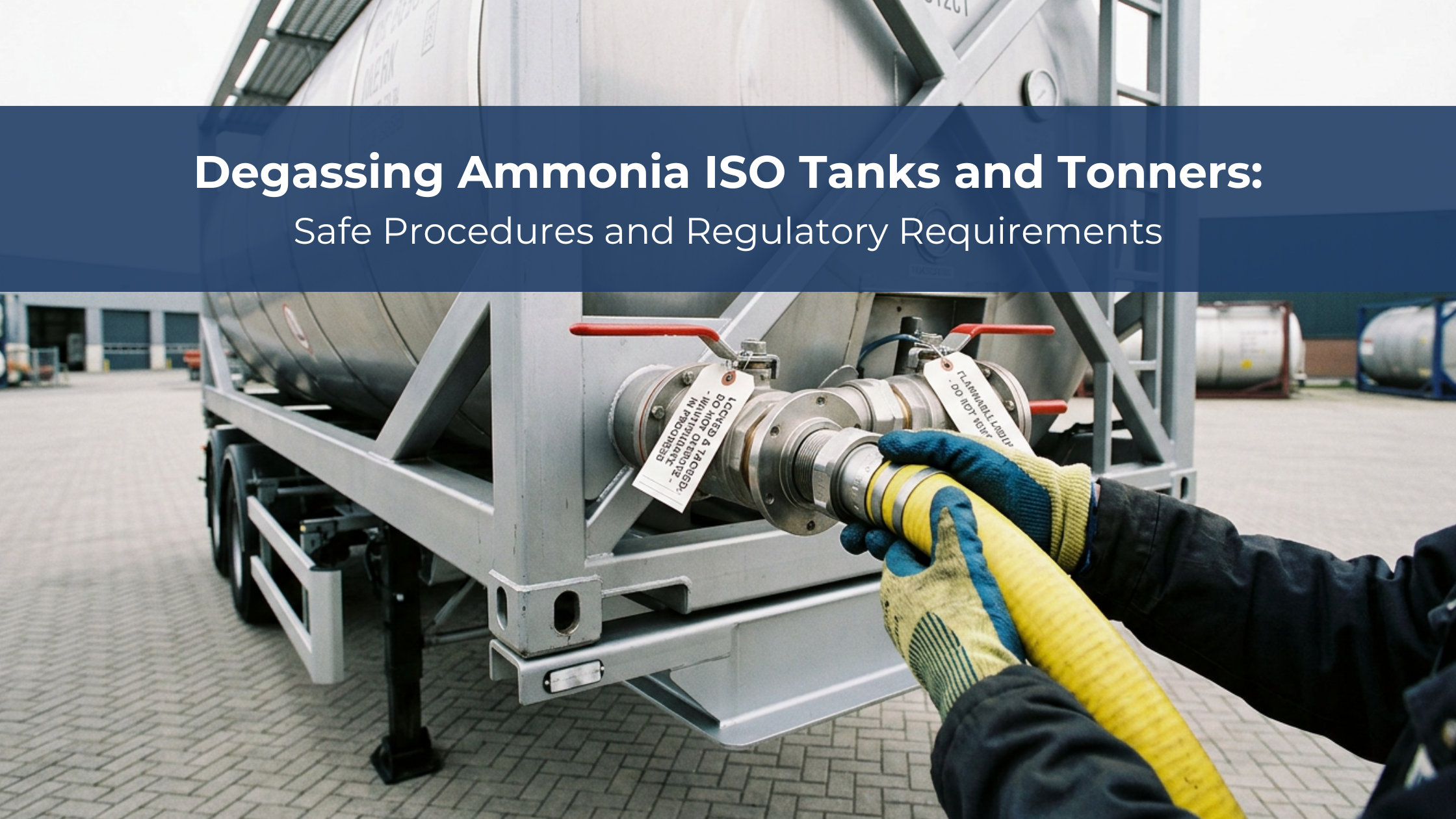
- Definition: Degassing removes all residual ammonia from cylinders, tonners, and ISO tanks before maintenance, inspection, hot work, or disposal as empty vessels.
- Primary methods: Water scrubbing, nitrogen purging, and caustic scrubbing — water scrubbing is most common for field degassing of large containers.
- Safe entry threshold: Internal atmosphere must read below 50 ppm ammonia and between 19.5 and 23.5 percent oxygen before any confined space entry is permitted.
- PPE is non-negotiable: Full-face APR or SCBA, butyl rubber gloves, chemical-resistant coveralls, and chemical splash goggles are required throughout active degassing.
- Waste management: Ammonia water generated during scrubbing must be collected and disposed of in compliance with local environmental regulations — no discharge to drains or waterways.
- Regulatory compliance: Degassing procedures must comply with OSHA confined space entry standards, ADR/IMDG transport regulations for empty containers, and local environmental discharge rules.
- What Is Degassing of Ammonia Containers?
- Why Degassing Is Critical for Safety and Compliance
- Ammonia Containers Requiring Degassing
- Degassing Methods Explained
- Step-by-Step Degassing Procedure for Tonners and ISO Tanks
- Equipment Required for Degassing Operations
- PPE Requirements During Degassing
- Ammonia Waste Management and Disposal
- Regulatory Requirements
- Who Performs Ammonia Tank Degassing?
- Related Reading
- Frequently Asked Questions
An ammonia tonner or ISO tank returned from service, decommissioned from a refrigeration system, or retired from a fertiliser operation may appear empty but can contain enough residual ammonia to create a life-threatening hazard for maintenance personnel, inspectors, and transport drivers. A thorough degassing procedure removes all residual ammonia from the vessel, verifies the internal atmosphere is safe, and prepares the container for inspection, repair, or transport as an empty unit. This is one of the most technically demanding and hazard-intensive operations in ammonia handling, requiring careful planning, trained personnel, and appropriate equipment. At Jaysons Chemical Industries, we manage the full lifecycle of anhydrous ammonia cylinders, tonners, and ISO tanks, including cylinder and tonner maintenance and compliant refilling and transport through our materials transportation service. This guide provides a comprehensive technical reference for safe degassing operations.
1. What Is Degassing of Ammonia Containers?
Degassing, also referred to as purging, decommissioning, or making safe, is the controlled process of removing all residual ammonia from inside a pressurised container or pipeline until the internal atmosphere is free of hazardous ammonia concentrations. The process addresses both the vapour phase (ammonia gas in the headspace) and the liquid phase (residual liquid ammonia that has not fully evaporated).
A container that appears to be empty by weight may still contain significant residual liquid ammonia, especially in cold conditions where vapour pressure is reduced and liquid evaporation is slower. Even a few kilograms of residual liquid ammonia in a 900 kg tonner can produce concentrations of thousands of parts per million when vaporised into the confined headspace, immediately creating IDLH conditions for any person entering or working in close proximity.
Never assume an ammonia container is safe based on a nominal weight check or pressure gauge reading alone. Residual liquid can remain at the bottom of a tank with the gauge reading near zero pressure at low ambient temperatures. Always verify with atmospheric monitoring equipment before opening or entering any vessel.
2. Why Degassing Is Critical for Safety and Compliance
The requirement to degas ammonia containers before certain activities is driven by overlapping safety and regulatory imperatives that apply across the container’s operational lifecycle.
Confined Space Entry Requirements
OSHA 29 CFR 1910.146 requires that the atmosphere inside a permit-required confined space, such as the interior of an ammonia vessel, be tested and verified to be below hazardous thresholds before entry. Entry into a container with residual ammonia above 50 ppm is prohibited without SCBA respiratory protection and a full confined space entry programme. Degassing is therefore the prerequisite for safe no-PPE inspection and maintenance.
Hot Work Permits
Welding, cutting, grinding, and other hot work on or near an ammonia container requires that the vessel be verified free of flammable concentrations (below 10 percent of the Lower Explosive Limit, or approximately 15,000 ppm NH3 in air). Even if the ammonia concentration is below the flammable range, hot work on a vessel containing residual ammonia will generate toxic fumes and potentially heat the residual liquid to the point of rapid vaporisation and pressure build-up. Complete degassing is the only safe approach before any hot work on ammonia containers.
Transport of Empty Containers
Containers classified as containing residual hazardous materials require hazmat placarding and handling during transport. Properly degassed containers that are certified clean may be transported as empty containers with simplified regulatory requirements. This has significant logistical and cost implications for facilities managing large fleets of cylinders and tonners.
3. Ammonia Containers Requiring Degassing
| Container Type | Typical Capacity | Material | Degassing Frequency |
|---|---|---|---|
| Ammonia Cylinder | 30 to 100 kg | Carbon steel, seamless | Before hydrostatic testing (every 5 years) |
| Ammonia Tonner | 500 to 1,000 kg | Carbon steel, welded | Before inspection, repair, or decommissioning |
| ISO Tank Container | 14,000 to 26,000 litres | Stainless steel or carbon steel | Before maintenance, requalification, or mode change |
| Road Tanker | 10,000 to 30,000 litres | Carbon steel | Before entry, welding repairs, or decommissioning |
| Fixed Storage Vessel | Varies (up to 500+ tonnes) | Carbon steel, pressure rated | Before confined space entry, inspection, or decommissioning |
Container sizes and specifications for our supplied products are detailed on our ammonia cylinder and tonner sizes and prices page.
4. Degassing Methods Explained
The choice of degassing method depends on the size of the container, the quantity of residual ammonia, the available equipment, the environmental discharge constraints, and whether the facility has a scrubbing system installed.
Water Scrubbing
Water scrubbing is the most widely used field degassing method for tonners and ISO tanks. Clean water is introduced into the container through the liquid valve, absorbing residual ammonia gas and dissolving residual liquid ammonia. The resulting dilute ammonia solution (typically 1 to 5 percent aqueous ammonia) is then withdrawn and collected for disposal. Multiple water charges may be required until atmospheric monitoring confirms the internal concentration is below the safe entry threshold.
Nitrogen Purging
Nitrogen purging displaces residual ammonia vapour with inert nitrogen gas, which is then vented to a scrubber or safe discharge point. Nitrogen purging is faster than water scrubbing for vapour-phase residuals but does not address liquid-phase residuals, making it most effective after initial water scrubbing has removed the bulk of residual liquid. The process requires a nitrogen supply at sufficient pressure to adequately purge the container volume.
Caustic Scrubbing
Dilute sodium hydroxide (caustic soda) solution is used in some facility-based scrubbing systems to neutralise residual ammonia, forming sodium ammonium hydroxide solution. This method is more common in fixed scrubber systems attached to storage areas than in field degassing of individual containers. The neutralised solution must still be disposed of as alkaline chemical waste.
Full Lifecycle Ammonia Container Management
Jaysons Chemical Industries offers professional cylinder and tonner maintenance, degassing coordination, and compliant transport for ammonia containers across India.
5. Step-by-Step Degassing Procedure for Tonners and ISO Tanks
The following procedure outlines the general steps for water scrubbing degassing of an ammonia tonner or ISO tank. Site-specific conditions, equipment configurations, and regulatory requirements may modify individual steps. A documented safe work procedure specific to the container type and site conditions must be prepared before commencing operations.
Pre-Work Phase
Verify the residual ammonia quantity by weight (tare the container on a calibrated scale). Confirm all isolation valves on connected pipework are closed and locked out. Set up atmospheric monitoring at the work location using calibrated ammonia gas detectors. Ensure all required PPE is available and inspect it before donning. Confirm wastewater containment is in place to capture all ammonia water generated during the process. Brief all personnel involved in the operation on the procedure and emergency actions.
Initial Vapour Recovery
If the container still has significant residual pressure, connect the vapour valve to a recovery system or wet scrubber to capture the remaining ammonia vapour before opening the vessel. Allow the container to depressurise to near atmospheric pressure through the recovery system. Do not vent directly to atmosphere unless a properly designed open-air dispersion system with appropriate atmospheric monitoring and exclusion zones is in place.
Water Charging and Purging
Connect a clean water supply to the liquid valve of the container using appropriate pressure-rated fittings and flexible hose. Introduce water in controlled quantities, allowing the ammonia to dissolve into the water. Monitor the pressure build-up (water charging of a warm container with residual ammonia can temporarily increase internal pressure as the ammonia dissolves exothermically). Collect and remove the ammonia water via the drain valve into a containment vessel. Repeat the water charge and drain cycle until the atmospheric monitoring at the open valve shows less than 50 ppm ammonia.
Verification and Certification
Open the appropriate valve on the container and use a calibrated gas detector to measure the internal atmosphere at the valve opening. If the reading is below 50 ppm ammonia and the oxygen content is between 19.5 and 23.5 percent, the container may be considered degassed for the purposes of the planned work. Document the final atmospheric readings, the date, the name of the competent person who performed the measurement, and the instrument used. Retain this record as the degassing certificate for the container.
6. Equipment Required for Degassing Operations
| Equipment Item | Specification | Purpose |
|---|---|---|
| Ammonia gas detector | Calibrated 0-1000 ppm range, electrochemical sensor | Continuous atmospheric monitoring |
| Oxygen meter | Calibrated 0-25% O2 range | Confined space atmosphere verification |
| Pressure-rated flexible hose | Compatible with liquid ammonia and water; pressure rated to container MAWP | Water introduction and drainage |
| Containment vessel / IBC | Polyethylene or stainless steel; capacity matched to expected ammonia water volume | Ammonia water collection |
| SCBA units | Positive pressure, 30 or 60 min cylinder | Respiratory protection for active work phases |
| Wet scrubber (if available) | Packed column scrubber with recirculated water or caustic solution | Vapour recovery during depressurisation |
| Calibrated platform scale | Capacity exceeding container tare + residual weight | Residual ammonia quantity assessment |
7. PPE Requirements During Degassing
PPE requirements for degassing operations are determined by the phase of the operation and the anticipated ammonia concentrations at each worker’s location. Refer to our dedicated guide on ammonia safety equipment and the broader article on safe handling of ammonia for full PPE selection guidance.
During active valve operation and water charging, full-face APR with ammonia cartridges minimum, preferably SCBA; chemical splash goggles integral to full-face respirator; butyl rubber gloves; chemical-resistant coveralls; and chemical-resistant safety boots are required. During atmospheric monitoring at a safe distance from the active operation, a half-face APR with ammonia cartridges, chemical splash goggles, neoprene gloves, and standard work clothing may be adequate depending on monitor readings. Emergency standby personnel must have SCBA immediately available and donnable within 30 seconds.
8. Ammonia Waste Management and Disposal
The dilute ammonia water generated during water scrubbing is a liquid waste that contains ammonia at concentrations typically ranging from 0.5 to 5 percent, depending on the quantity of residual ammonia and the volume of water used. This material cannot be discharged directly to drains, surface water, or ground without treatment or regulatory approval.
Disposal Options
For small quantities of very dilute ammonia water, dilution to below the applicable discharge standard (typically 30 to 50 mg/L ammonia as nitrogen for industrial discharge to sewer, depending on local limits) before controlled release to a permitted wastewater treatment system may be acceptable with prior notification to the relevant authority. For larger quantities or higher concentration ammonia water, collection in sealed containment vessels and disposal by a licensed hazardous waste contractor is the appropriate pathway. Some facilities with ammonia-using processes use the collected ammonia water directly as a process input, effectively recovering the ammonia value.
9. Regulatory Requirements
Degassing operations at ammonia facilities must comply with a layered set of regulations covering worker safety, environmental protection, and container transport. Key applicable frameworks include OSHA 29 CFR 1910.146 for confined space entry, OSHA 29 CFR 1910.119 for PSM-covered facilities, EPA regulations for environmental discharge, and DOT/ADR/IMDG requirements for transport of empty containers. In India, the MSIHC Rules 1989, Factory Act 1948 provisions for hazardous chemical handling, and Central Pollution Control Board guidelines for liquid effluent discharge all apply. Review our guide to simplifying ammonia storage licensing for the broader regulatory context in India.
10. Who Performs Ammonia Tank Degassing?
- Cold Storage and Refrigeration Plants – Degassing required before system maintenance, compressor overhaul, and vessel requalification
- Food Processing and Ice Plants – Degassing before vessel entry for cleaning and inspection
- Ammonia Transport and Logistics Operators – Degassing of ISO tanks before maintenance and requalification
- Industrial Chemical Facilities – Degassing as part of permit-to-work system for pressure vessel inspection
- Agriculture and Fertiliser Operations – Degassing of anhydrous ammonia applicator tanks during seasonal decommissioning
- Cylinder and Tonner Maintenance Facilities – Systematic degassing before hydrostatic testing and valve replacement
Key Takeaways
- Degassing removes residual ammonia from containers before maintenance, hot work, confined space entry, or transport as an empty vessel.
- Water scrubbing is the most common field degassing method; nitrogen purging is effective for vapour-phase residuals after initial water washing.
- The safe entry threshold is less than 50 ppm ammonia and between 19.5 and 23.5 percent oxygen, verified by calibrated atmospheric monitoring immediately before entry.
- Full-face APR or SCBA is required throughout active degassing; SCBA is mandatory for confined space entry during any phase of the process.
- Ammonia water from scrubbing must be collected and disposed of as liquid chemical waste; direct drain discharge is prohibited without regulatory approval.
- Degassing must be documented with a signed certificate recording the final atmospheric readings, the competent person responsible, and the monitoring equipment used.
- Regulatory compliance spans OSHA confined space entry, environmental discharge, and transport regulations for emptied containers.
Frequently Asked Questions
What is degassing of ammonia tanks?
Degassing (also called purging or decommissioning) of ammonia tanks is the process of safely removing all residual ammonia gas and liquid from a container before it is sent for maintenance, inspection, repair, or disposal. The goal is to reduce the ammonia concentration inside the tank to a level safe for confined space entry, hot work, or transport as an empty vessel without hazmat placarding requirements.
Why is degassing ammonia ISO tanks and tonners important?
Residual ammonia in a supposedly empty tank creates life-threatening hazards for maintenance technicians, inspectors, and transport personnel. Even small quantities of residual liquid ammonia can vaporise to produce dangerous concentrations within the tank headspace. Degassing ensures the vessel is safe for confined space entry, hot work such as welding, and transport as an empty container under simplified regulatory requirements.
What are the main methods for degassing ammonia containers?
The primary degassing methods include water scrubbing (absorbing residual ammonia with water to produce dilute ammonia solution), nitrogen purging (displacing residual ammonia with inert nitrogen gas followed by controlled venting), and caustic scrubbing (neutralising ammonia using dilute sodium hydroxide solution). Water scrubbing is the most common method for field degassing of ISO tanks and tonners due to its simplicity and the wide availability of clean water at industrial sites.
What concentration must an ammonia tank reach before it is considered safe for confined space entry?
Before confined space entry, the internal atmosphere must be verified to contain less than 50 ppm of ammonia (the OSHA PEL), and the oxygen content must be between 19.5 and 23.5 percent. Verification must be performed using calibrated atmospheric monitoring equipment by a competent person immediately before entry and continuously during the confined space activity, not just at the entry point.
What PPE is required during ammonia tank degassing?
During active degassing operations, workers in the immediate vicinity must wear chemical splash goggles, a full-face APR with ammonia cartridges or SCBA, neoprene or butyl rubber gloves, chemical-resistant coveralls, and safety boots. Personnel monitoring or controlling the process from a safe distance upwind may require only a half-face APR with ammonia cartridges, depending on the atmospheric monitoring results at their specific location.
Does the ammonia water from degassing require special disposal?
Yes. The dilute ammonia water generated during water scrubbing degassing must be collected and disposed of in accordance with applicable environmental regulations. Direct discharge to storm drains, surface water, or unlined areas is prohibited. Options include dilution to below applicable discharge standards before controlled release to a wastewater treatment system, or collection and disposal by a licensed hazardous waste contractor.
Can ammonia ISO tanks be degassed at the customer site or must they be returned to the supplier?
Ammonia ISO tanks and large tonners are typically degassed at dedicated facilities equipped with scrubbing systems, waste collection infrastructure, and trained personnel. Customer-site degassing is possible for smaller tonners and cylinders if the site has adequate ventilation, gas detection, PPE, and wastewater containment, and must be performed by trained and competent personnel following a documented safe work procedure. Regulatory requirements vary by jurisdiction.
How long does the degassing process take for an ammonia tonner?
The duration depends on the residual ammonia quantity, the degassing method used, the ambient temperature, and the equipment capacity. Water scrubbing of a standard 900 kg ammonia tonner with minor residual typically takes 4 to 8 hours. Nitrogen purging may be faster but requires greater volumes of inert gas. In cold weather, residual liquid ammonia vaporises more slowly, significantly extending the total degassing time required.