

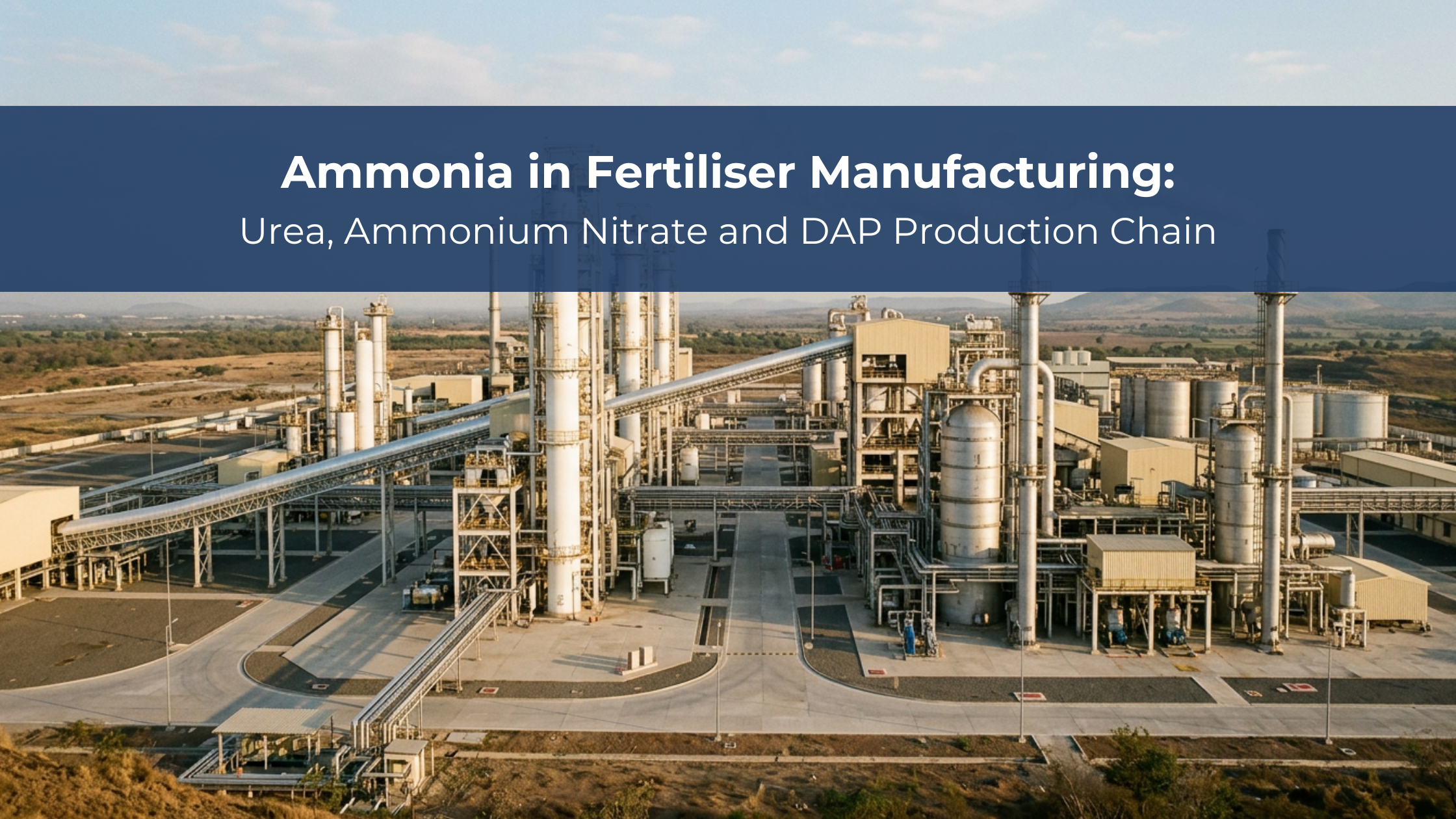
- Ammonia is the foundation: All major nitrogen fertilisers including urea, ammonium nitrate, and DAP are produced from ammonia as the primary nitrogen source.
- Scale of impact: Approximately 80 percent of globally produced ammonia is used for fertiliser manufacture, supporting food production for roughly half the world’s population.
- Urea efficiency: One tonne of urea requires approximately 567 kg of ammonia input and contains 46.3 percent nitrogen by weight.
- DAP dual nutrient: DAP (18-46-0) provides both nitrogen and phosphorus in a single granule, produced by reacting ammonia with phosphoric acid.
- Direct application: Anhydrous ammonia is also used directly as a soil-injected fertiliser, particularly for cereal crops, providing 82 percent nitrogen by weight.
- India context: India is the world’s second-largest fertiliser consumer and depends on both domestic Haber-Bosch production and imported ammonia and finished fertilisers to meet agricultural demand.
- The Ammonia-Fertiliser Connection
- Ammonia Production: The Haber-Bosch Process
- Urea Production from Ammonia
- Ammonium Nitrate Production Chain
- DAP Fertiliser Production Chain
- Other Ammonia-Based Fertilisers
- Direct Application of Anhydrous Ammonia
- Fertiliser Comparison Table
- Safety and Storage in Fertiliser Manufacturing
- Ammonia and Fertiliser Manufacturing in India
- Related Reading
- Frequently Asked Questions
Ammonia is the molecular bridge between atmospheric nitrogen and the food on your plate. Without ammonia-based fertilisers, global crop yields would collapse to a fraction of their current levels, and the world could not sustain its present population. Approximately 80 percent of all ammonia produced globally flows into the fertiliser industry, where it is either applied directly to soil or converted into the major nitrogen fertiliser products that reach farmers around the world. At Jaysons Chemical Industries, we supply high-purity anhydrous ammonia and liquor ammonia to fertiliser manufacturers and agricultural customers across India and internationally. This article explores the complete ammonia in fertiliser manufacturing value chain, from the Haber-Bosch synthesis plant to the urea granule, the ammonium nitrate prill, and the DAP granule that ultimately delivers nitrogen to the soil. Explore our resources on ammonia in agriculture and anhydrous ammonia uses in agriculture for the full agronomic context.
1. The Ammonia-Fertiliser Connection
Nitrogen is the most growth-limiting nutrient in most agricultural soils. While nitrogen makes up approximately 78 percent of the atmosphere, it exists as diatomic nitrogen gas (N2), which plants cannot directly absorb. Biological nitrogen fixation by soil bacteria provides some plant-available nitrogen, but not enough to support the intensive crop yields required by modern agriculture.
The Haber-Bosch process, developed in the early twentieth century, made it possible to convert atmospheric nitrogen to ammonia on an industrial scale. Ammonia (NH3) contains nitrogen in a form that can be directly utilised by plants as a soil amendment, or converted to a range of solid and liquid nitrogen fertilisers that are stable, concentrated, and suited to global trade. The world produces approximately 185 million tonnes of ammonia annually, of which around 150 million tonnes is used for fertiliser applications.
2. Ammonia Production: The Haber-Bosch Process
All fertiliser-grade ammonia begins with the Haber-Bosch synthesis process, in which atmospheric nitrogen (N2) and hydrogen (H2) are reacted at high temperature and pressure over an iron catalyst to produce ammonia. The reaction is: N2 + 3H2 yields 2NH3 (with a standard enthalpy change of -92 kJ/mol, making it an exothermic reaction).
Industrial ammonia plants operate at pressures of 150 to 300 bar and temperatures of 400 to 500 degrees Celsius, achieving single-pass conversions of 15 to 25 percent with unreacted gases recycled to improve overall conversion to 95 percent or higher. The hydrogen feedstock is produced primarily by steam methane reforming (SMR) of natural gas, making natural gas both the energy source and the hydrogen source for conventional ammonia production. Green ammonia plants use electrolytic hydrogen from renewable electricity, as described in our article on green ammonia production science.
3. Urea Production from Ammonia
Urea (CO(NH2)2) is the world’s most widely traded nitrogen fertiliser, accounting for approximately 50 percent of global nitrogen fertiliser consumption. With a nitrogen content of 46.3 percent by weight, it is the most nitrogen-dense solid fertiliser and is economical to transport and store.
The Urea Synthesis Reaction
Urea is produced by reacting ammonia with carbon dioxide in two sequential steps. First, ammonia and CO2 combine to form ammonium carbamate: 2NH3 + CO2 yields NH2COONH4. This reaction is fast and essentially complete. Second, ammonium carbamate dehydrates at elevated temperature to form urea and water: NH2COONH4 yields CO(NH2)2 + H2O. The second reaction is slower and does not reach completion at typical reactor conditions, requiring separation and recycling of unconverted carbamate.
Urea Plant Operations
Industrial urea plants operate at temperatures of 160 to 200 degrees Celsius and pressures of 140 to 200 bar. The urea melt leaving the reactor typically contains 70 to 80 percent urea, which is concentrated to 99.7 percent by multi-stage evaporation under vacuum. The molten urea is then converted to solid product by prilling (spraying through a prilling tower to form spherical droplets that solidify as they fall) or granulation (coating growing granule seeds with urea melt in a rotating drum or fluidised bed). For every tonne of urea produced, approximately 567 kg of ammonia and 733 kg of CO2 are consumed.
Reliable Ammonia Supply for Fertiliser Manufacturing
Jaysons Chemical Industries supplies high-purity anhydrous ammonia for fertiliser manufacturing with BIS-certified containers, complete SDS documentation, and nationwide delivery.
4. Ammonium Nitrate Production Chain
Ammonium nitrate (AN) provides two forms of nitrogen — ammonium nitrogen and nitrate nitrogen — that are taken up by plants through different mechanisms, offering agronomic flexibility. It contains 33 to 35 percent nitrogen and is used both as a direct fertiliser and as a component of compound fertiliser formulations such as calcium ammonium nitrate (CAN) and ammonium nitrate phosphate (ANP).
Step 1: Nitric Acid Production
The ammonium nitrate production chain begins with the Ostwald process for nitric acid synthesis. In the Ostwald process, ammonia is catalytically oxidised over platinum-rhodium gauze catalysts at 850 to 950 degrees Celsius to produce nitric oxide (NO): 4NH3 + 5O2 yields 4NO + 6H2O. The NO is further oxidised to nitrogen dioxide (NO2) and absorbed in water to produce nitric acid (HNO3): 3NO2 + H2O yields 2HNO3 + NO. This means that ammonia is the feedstock for both sides of the ammonium nitrate synthesis reaction.
Step 2: Neutralisation
Gaseous ammonia is neutralised with dilute nitric acid (50 to 65 percent concentration) in a neutralisation reactor, producing an ammonium nitrate solution and releasing considerable heat: NH3 + HNO3 yields NH4NO3. The neutralisation heat is used to concentrate the solution by evaporation. The process typically produces a 70 to 95 percent ammonium nitrate solution.
Step 3: Solidification
The concentrated ammonium nitrate solution is further concentrated to melt purity (99.7 percent) and then prilled or granulated as per the urea process. Ammonium nitrate products are coated with anti-caking agents and conditioned to maintain granule integrity during storage. Given ammonium nitrate’s oxidising properties and potential for detonation at high temperatures or under confinement, its storage and transport are subject to strict regulatory controls distinct from those applicable to urea.
5. DAP Fertiliser Production Chain
Di-ammonium phosphate, universally known as DAP, is the world’s most widely used phosphate fertiliser, with a standard analysis of 18-46-0 (18 percent nitrogen, 46 percent P2O5). Its dual nutrient content makes it particularly valuable for cereal crops that require both nitrogen and phosphorus at planting.
Phosphoric Acid Production
DAP production begins with phosphoric acid, produced by digesting phosphate rock (primarily fluorapatite) with sulphuric acid in the wet process: Ca10(PO4)6F2 + 10H2SO4 yields 6H3PO4 + 10CaSO4 + 2HF. The resulting phosphoric acid solution (28 to 32 percent P2O5) is purified and concentrated for use in DAP synthesis.
Ammonia-Phosphoric Acid Reaction
DAP is produced in two stages. In the first stage, ammonia is reacted with phosphoric acid in a pre-neutralisation reactor at a mole ratio of approximately 1.4 ammonia to 1 phosphoric acid, producing a MAP-rich slurry. In the second stage, additional ammonia is added to bring the ratio to 2:1, producing the DAP product slurry: 2NH3 + H3PO4 yields (NH4)2HPO4. The slurry is then granulated, dried, and screened to produce the finished DAP granule.
6. Other Ammonia-Based Fertilisers
Beyond urea, ammonium nitrate, and DAP, ammonia is the nitrogen source for a wide range of additional fertiliser products serving specific soil conditions and crop requirements.
Ammonium Sulphate
Ammonium sulphate (21-0-0-24S) is produced by reacting ammonia with sulphuric acid. It is valued for supplying both nitrogen and sulphur, making it particularly effective on sulphur-deficient soils. It is a byproduct of caprolactam (nylon intermediate) production and coke-oven operations, as well as a direct synthesis product for markets requiring its acidifying soil effect.
Mono-Ammonium Phosphate (MAP)
MAP (11-52-0) is produced using the same phosphoric acid neutralisation process as DAP but at a lower ammonia-to-acid ratio of 1:1. It provides a highly concentrated phosphate nutrient with a moderate nitrogen contribution and is widely used as a starter fertiliser and in compound fertiliser blends.
Calcium Ammonium Nitrate (CAN)
CAN is produced by blending ammonium nitrate with calcium carbonate or dolomite. It contains 26 to 27 percent nitrogen and is a preferred nitrogen fertiliser in Europe due to its lower explosive risk compared to pure ammonium nitrate and its neutral-to-basic soil pH effect.
7. Direct Application of Anhydrous Ammonia
Anhydrous ammonia with a nitrogen content of 82 percent by weight is the most nitrogen-concentrated fertiliser in existence. In North America and parts of Europe, it is injected directly into the soil at depths of 15 to 20 cm as a pre-plant or side-dress nitrogen application for cereal crops including corn, wheat, and sorghum. The injected ammonia dissolves in soil moisture and is converted to ammonium, which is retained by soil particles and subsequently nitrified to nitrate for plant uptake.
Direct application of anhydrous ammonia requires specialised nurse tanks, high-pressure applicator equipment, and significant safety infrastructure including SCBA on every operator unit. The economics are favourable due to the high nitrogen concentration and lower cost per unit of nitrogen compared to solid fertilisers, but the safety requirements and infrastructure investment limit its adoption primarily to large-scale commercial farming operations. Our page on anhydrous ammonia uses in agriculture explores these applications in detail.
8. Fertiliser Comparison Table
| Fertiliser | N Content | P2O5 | NH3 Input per Tonne | Primary Application | Key Regulatory Notes |
|---|---|---|---|---|---|
| Anhydrous Ammonia | 82% | 0% | 1,000 kg (itself) | Direct soil injection; industrial feedstock | Hazmat; SCBA required for handling |
| Urea | 46.3% | 0% | 567 kg | Broadcast, fertigation, foliar | Standard solid fertiliser regulations |
| Ammonium Nitrate | 33-35% | 0% | ~212 kg | Top-dressing cereals and pasture | Oxidiser; strict storage and transport controls |
| DAP | 18% | 46% | ~219 kg | Starter and pre-plant for most crops | Standard solid fertiliser regulations |
| MAP | 11% | 52% | ~134 kg | Starter fertiliser; compound blends | Standard solid fertiliser regulations |
| Ammonium Sulphate | 21% | 0% | ~257 kg | Sulphur-deficient soils; acidifying agent | Standard solid fertiliser regulations |
9. Safety and Storage in Fertiliser Manufacturing
The production chain for ammonia-based fertilisers involves multiple hazardous chemical streams requiring robust safety management systems. Ammonia itself, at the head of the process chain, is the most acute inhalation hazard. Nitric acid in the ammonium nitrate chain is a strong oxidising acid. Solid ammonium nitrate presents unique storage and fire risks due to its oxidising properties and susceptibility to detonation under specific conditions.
Ammonia Storage at Fertiliser Plants
Large-scale fertiliser manufacturing facilities typically store ammonia in refrigerated atmospheric tanks (at -33 degrees Celsius) or pressurised tanks at ambient temperature, often in quantities of thousands of tonnes. These quantities place the facilities firmly within OSHA PSM and EPA RMP coverage, requiring comprehensive process safety management programmes. Gas detection, emergency response planning, and regular safety audits are non-negotiable requirements. Our resources on safe ammonia handling and storage and ammonia gas leak detection are directly applicable to fertiliser plant operations.
10. Ammonia and Fertiliser Manufacturing in India
India is the world’s second-largest producer and consumer of fertilisers, with agricultural demand supported by a combination of domestic production capacity and significant imports. The Indian government provides substantial fertiliser subsidies that make nitrogen fertilisers, particularly urea, accessible to smallholder farmers, driving demand that in turn supports the ammonia supply chain.
- Gujarat – Home to several major integrated ammonia-urea complexes and chemical port infrastructure
- Uttar Pradesh – Significant urea and NPK manufacturing capacity serving the northern agricultural belt
- Maharashtra – Chemical manufacturing hub with ammonia-based fertiliser downstream operations
- Andhra Pradesh – DAP and NPK manufacturing serving southern agricultural markets
- Rajasthan – Emerging phosphate-based fertiliser manufacturing leveraging regional phosphate rock deposits
- Tamil Nadu – Chemical port facilities and fertiliser trading and distribution infrastructure
Key Takeaways
- Approximately 80 percent of globally produced ammonia is consumed by the fertiliser industry, feeding roughly half the world’s population.
- Urea production consumes approximately 567 kg of ammonia per tonne of product and delivers 46.3 percent nitrogen by weight.
- Ammonium nitrate production uses ammonia both directly (neutralisation) and indirectly (via nitric acid production through the Ostwald process).
- DAP production combines ammonia and phosphoric acid in a 2:1 molar ratio, delivering 18 percent nitrogen and 46 percent P2O5 per granule.
- Anhydrous ammonia is the most nitrogen-dense fertiliser (82 percent N) and can be applied directly via soil injection for cereal crops.
- Fertiliser manufacturing facilities using ammonia above PSM threshold quantities require comprehensive process safety management programmes.
- India’s fertiliser industry depends on both domestic Haber-Bosch production and imported ammonia and finished products to meet agricultural demand.
Frequently Asked Questions
Why is ammonia essential for fertiliser manufacturing?
Ammonia is the primary source of reactive nitrogen in all nitrogen-based fertilisers. It is used directly as anhydrous ammonia fertiliser or as the feedstock for manufacturing urea, ammonium nitrate, ammonium sulphate, DAP, and MAP. Without ammonia, the large-scale nitrogen fertiliser industry that sustains food production for approximately half the world’s population would not exist.
How is ammonia converted to urea?
Urea is produced by reacting ammonia with carbon dioxide at high temperature (160 to 200 degrees Celsius) and pressure (140 to 200 bar) in a urea reactor. The reaction first forms ammonium carbamate, which then dehydrates to urea and water. The product stream is concentrated by evaporation and the urea melt is prilled or granulated into the solid product sold as fertiliser.
What is the role of ammonia in ammonium nitrate production?
Ammonium nitrate is produced by neutralising ammonia gas with dilute nitric acid in a neutralisation reactor. The reaction is highly exothermic and produces an ammonium nitrate solution that is concentrated by evaporation and solidified by prilling or granulating. The nitric acid used in the process is itself produced from ammonia through the Ostwald catalytic oxidation process, meaning ammonia serves as the feedstock for both reactants.
How is DAP fertiliser made from ammonia?
Di-ammonium phosphate is produced by reacting ammonia with phosphoric acid in a two-stage neutralisation process. In the first stage, MAP is formed with a lower ammonia-to-acid ratio. In the second stage, additional ammonia is added to achieve the 2:1 ammonia-to-phosphoric acid molar ratio characteristic of DAP. The resulting slurry is granulated and dried to produce the solid DAP fertiliser product with an analysis of 18-46-0.
What is the ammonia consumption rate for producing one tonne of urea?
Producing one tonne of urea requires approximately 567 kg of ammonia (0.567 tonnes NH3) and 733 kg of CO2. Urea contains 46.3 percent nitrogen by weight, making it the most nitrogen-dense solid fertiliser and the preferred product for long-distance trade due to its favourable nitrogen-to-weight and nitrogen-to-cost ratios.
Is it safe to use anhydrous ammonia directly as a fertiliser?
Yes, anhydrous ammonia is used directly as a fertiliser through subsurface injection into soil, primarily for cereal crops. The ammonia is injected at a depth of at least 15 cm to prevent volatilisation loss. This application method requires specialised injection equipment, trained operators, and full anhydrous ammonia PPE including SCBA on standby. It is most widely used in North America and parts of Europe for large-scale corn and wheat production.
What is the difference between urea and ammonium nitrate as nitrogen fertilisers?
Urea contains 46 percent nitrogen and is the most concentrated solid nitrogen fertiliser, making it cost-effective for transport and storage. Ammonium nitrate contains 33 to 35 percent nitrogen and provides two nitrogen forms (ammonium and nitrate) for different plant uptake pathways. Ammonium nitrate is faster-acting but subject to stricter storage and transport regulations due to its oxidising and potentially explosive properties at certain concentrations and contamination conditions.
How does India source the ammonia for its fertiliser industry?
India is the world’s second-largest consumer of fertilisers. The Indian fertiliser industry sources ammonia from domestic production using natural gas through the Haber-Bosch process at integrated ammonia-urea plants, and from imports of anhydrous ammonia from producers in the Middle East, Russia, and Southeast Asia. India also imports significant quantities of finished urea, DAP, and other fertilisers to supplement domestic production capacity and meet seasonal agricultural demand.