

- Two system types: Fixed detectors provide continuous area monitoring; portable detectors protect individual workers and support maintenance inspections.
- Sensor choice matters: Electrochemical sensors offer the best low-level sensitivity (0-500 ppm); photoacoustic IR sensors provide superior long-term stability.
- Placement is critical: Because ammonia is lighter than air, sensors must be mounted correctly relative to likely leak sources and ceiling-level accumulation zones.
- Alarm set-points: Three-tier alarm configuration at 25, 50, and 300 ppm aligns with NIOSH and OSHA regulatory thresholds.
- Calibration schedule: IEC 60079-29-1 mandates calibration at minimum every 6 months for fixed systems; portable units require monthly calibration and pre-shift bump testing.
- Indian regulations: MSIHC Rules 1989 and BIS IS 5572 require fixed gas detection in facilities handling hazardous quantities of ammonia.
- Why Ammonia Gas Detection Matters
- Fixed Ammonia Gas Detectors
- Portable Ammonia Gas Detectors
- Sensor Technology Comparison
- Placement Standards and Location Planning
- Alarm Set-Point Configuration
- Calibration and Maintenance Schedules
- Fixed vs Portable: Direct Comparison
- How to Choose the Right Detection System
- Who Uses Ammonia Gas Detection Systems?
- Related Reading
- Frequently Asked Questions
An undetected ammonia leak is one of the most dangerous scenarios in any industrial facility. With a sharp pungent odour detectable by humans at just 1 to 5 ppm and an OSHA IDLH threshold of 300 ppm, the window between early detection and life-threatening exposure is narrow. A properly designed ammonia gas detection system, combining both fixed and portable technologies, is the first line of defence against that risk. At Jaysons Chemical Industries, we work with facilities across India and internationally to supply ammonia alongside technical guidance on detection, storage, and safe handling. This guide breaks down everything you need to know about fixed versus portable ammonia gas detectors, from sensor technology to placement standards and long-term maintenance. Visit our ammonia ancillary equipment page for products that complement your detection infrastructure.
1. Why Ammonia Gas Detection Matters
Ammonia’s distinctive odour is often considered a natural warning mechanism, but relying on human senses alone is dangerously insufficient in industrial settings. At low concentrations, olfactory fatigue occurs within minutes, causing workers to stop perceiving the odour even as levels continue to rise. Workers who have been continuously exposed to low background levels may also have a blunted odour response. An engineered gas detection system removes this variable entirely and provides objective, continuous measurement with documented alarm records.
Beyond worker safety, gas detection is essential for regulatory compliance. In India, the BIS standards for ammonia storage and the MSIHC Rules 1989 both require detection systems at facilities storing hazardous quantities of ammonia. Internationally, OSHA PSM (Process Safety Management) regulations and EPA RMP programmes mandate continuous monitoring for covered ammonia facilities.
Industry data from the US Chemical Safety Board shows that a significant proportion of ammonia incidents occur during maintenance activities when pressurised components are disturbed. Portable detectors worn by maintenance teams during these tasks are a critical safeguard.
2. Fixed Ammonia Gas Detectors
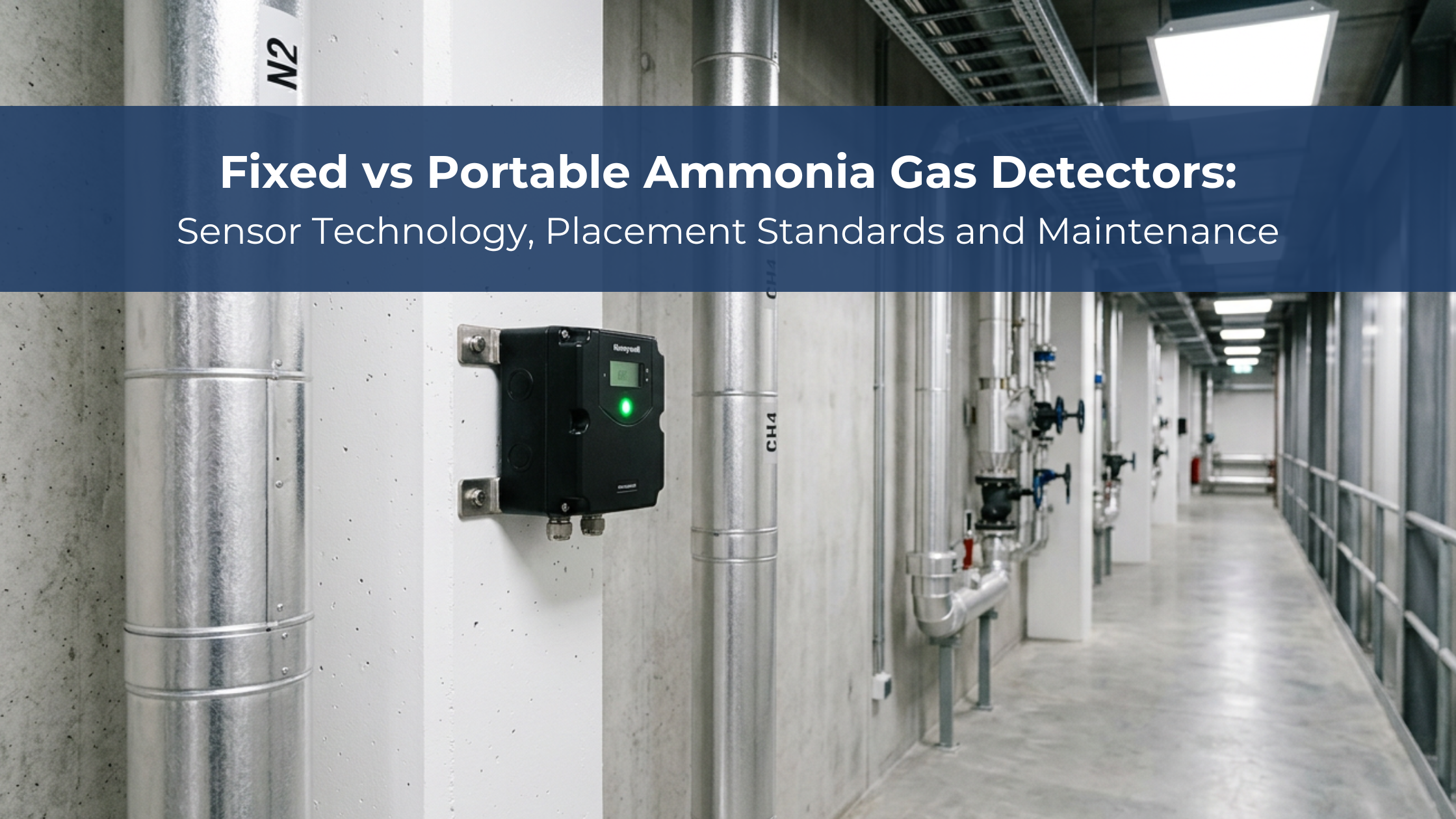
Fixed ammonia detectors are permanently installed units that continuously sample the atmosphere at a specific location. They are connected to a central control panel that displays real-time concentration readings, activates visual and audible alarms, and can trigger automatic responses such as ventilation fan activation, damper closure, or emergency shutoff of ammonia supply valves.
Components of a Fixed Detection System
A complete fixed system comprises sensor transmitter heads at each monitoring point, a control panel (often multi-channel) that processes signals and manages alarm outputs, audible and visual alarm devices, and relay outputs to activate automated safety responses. Modern systems also include data logging capability and MODBUS or 4-20 mA connectivity for integration with SCADA and building management platforms.
Advantages of Fixed Systems
Fixed systems provide 24/7 continuous monitoring regardless of whether workers are present, which is critical for unmanned overnight operations in cold storage and refrigeration plants. They provide a documented, time-stamped concentration record that is valuable for incident investigation and regulatory reporting. They can also be integrated with automated safety systems to initiate protective actions faster than any human response.
3. Portable Ammonia Gas Detectors
Portable ammonia gas detectors are handheld or body-worn devices that provide real-time personal exposure monitoring. They are indispensable during maintenance activities, confined space entry, emergency response, and any task that takes workers to locations not covered by fixed detection points.
Types of Portable Detectors
Single-gas portable detectors are dedicated to ammonia monitoring and offer maximum sensitivity for the target gas. Multi-gas portable detectors simultaneously measure ammonia alongside other common industrial hazards such as oxygen depletion, H2S, CO, and LEL combustible gases. For ammonia-handling facilities, a combination unit measuring ammonia and oxygen is often the most practical choice for confined space entry teams.
Advantages of Portable Systems
Portables follow the worker, providing personal protection everywhere the employee goes regardless of fixed system coverage. They are essential for leak pinpointing during maintenance, allowing technicians to trace the exact source of a release indicated by a fixed system alarm. They also serve as the primary detection tool during emergency response by incident commanders assessing perimeter concentrations.
Body-worn clip detectors positioned at the breathing zone (lapel level) give the most accurate representation of personal ammonia exposure. Detectors clipped to a belt or held at arm’s length may significantly underestimate inhalation exposure, especially when bending over equipment.
4. Sensor Technology Comparison
The sensor technology at the heart of an ammonia detector determines its sensitivity, selectivity, response time, operational life, and maintenance requirements. Matching sensor technology to the specific detection environment is as important as detector placement.
| Sensor Type | Measurement Range | Response Time (T90) | Lifespan | Best Application |
|---|---|---|---|---|
| Electrochemical (EC) | 0-500 ppm | 30-60 seconds | 2-3 years | Low-level personal and area monitoring |
| Catalytic Bead | 0-100% LEL | 10-30 seconds | 3-5 years | Flammability monitoring in high concentration areas |
| Photoacoustic IR (PA-IR) | 0-1000 ppm | 60-90 seconds | 5-10 years | Fixed systems requiring long-term stability |
| Metal Oxide Semiconductor (MOS) | 0-1000 ppm | 15-30 seconds | 3-5 years | Low-cost area monitoring; less selective |
| Optical Laser / TDLAS | 0-10,000 ppm | 1-5 seconds | 7-10 years | Open-path perimeter monitoring for large facilities |
Electrochemical sensors remain the dominant technology for ammonia monitoring due to their proven track record, low cost, and high sensitivity at the concentration ranges most relevant to worker health protection. However, they are susceptible to cross-sensitivity from amines, humidity extremes, and temperature variations. Photoacoustic IR sensors address these limitations for fixed installations where long-term reliability justifies the higher initial cost.
5. Placement Standards and Location Planning
Because ammonia vapour is lighter than air (vapour density 0.597 relative to air = 1), its dispersion behaviour differs from heavier gases like hydrogen sulphide or LPG. This physical property directly governs where sensors must be positioned to detect leaks before they reach dangerous concentrations at the breathing zone.
Ammonia Supply with Technical Safety Support
Jaysons Chemical Industries supplies anhydrous and liquor ammonia and can connect your facility with detection and safety equipment specialists across India.
Detector Height Guidelines
For sources at floor level or low-lying equipment, mount sensors at 1 to 1.5 metres above floor level to catch the initial rising plume. For ceiling-level accumulation zones in enclosed machine rooms, install additional sensors 0.3 to 0.5 metres below the ceiling. In outdoor areas with wind exposure, sensors should be placed on the downwind side of potential release points and closer to grade level to account for turbulent mixing.
Priority Placement Locations in Ammonia Facilities
Key fixed detector locations include compressor seal areas, refrigerant receiver rooms, condenser areas (especially for ammonia refrigeration systems), pipe flanges and valve stations, emergency relief valve discharge zones, loading and unloading bays, and access points to confined spaces such as cold store rooms and plant rooms. For fertiliser manufacturing facilities using ammonia in urea and ammonium nitrate production, reactors and scrubber vents are additional critical monitoring locations.
6. Alarm Set-Point Configuration
Proper alarm configuration is the bridge between detection and response. Set-points that are too low create nuisance alarm fatigue; set-points that are too high fail to provide adequate warning time for evacuation.
| Alarm Level | Concentration | Regulatory Basis | Required Action |
|---|---|---|---|
| Warning (Low) | 25 ppm | NIOSH REL / ACGIH TLV-TWA | Investigate source; increase ventilation |
| Alarm (High) | 50 ppm | OSHA PEL | Evacuate non-essential personnel; don PPE |
| Emergency (IDLH) | 300 ppm | OSHA IDLH | Full evacuation; emergency services activation |
| Fire/Explosion Risk | 15% LEL (approx. 26,250 ppm) | NFPA 72 / IEC standards | Eliminate ignition sources; emergency shutdown |
7. Calibration and Maintenance Schedules
A gas detector that is not regularly calibrated and maintained may fail to alarm when needed or generate false alarms that erode worker confidence in the system. Establishing a documented calibration programme is both a regulatory requirement and a practical safety necessity.
Calibration Standards and Frequency
IEC 60079-29-1 is the primary international standard governing the performance requirements and testing methods for gas detectors. It recommends calibration verification at intervals not exceeding 6 months for electrochemical sensors. In environments with high chemical contamination, humidity variations, or temperature cycling, quarterly calibration is strongly advisable. Full span calibration using certified ammonia reference gas (typically 50 ppm or 100 ppm NH3 in nitrogen) must be performed by trained personnel with traceable calibration equipment.
Bump Testing for Portable Units
Portable detectors used daily must undergo a bump test before each shift. A bump test involves briefly exposing the sensor to a known concentration of test gas to confirm that the sensor responds and the alarm activates. It does not replace full calibration but confirms that the sensor is functional. Workers who leave for the field without bump testing their portable detector are operating without confirmed protection.
Preventive Maintenance Tasks
Regular maintenance tasks include cleaning sensor housings and dust filters, inspecting cable connections and conduit seals on fixed systems, verifying control panel alarm outputs, checking battery backup systems, and reviewing and updating the maintenance log. Sensor replacement should follow manufacturer guidance, typically every 2 to 3 years for electrochemical cells. All maintenance activities must be documented and records retained for regulatory audit purposes.
8. Fixed vs Portable: Direct Comparison
| Feature | Fixed Detector System | Portable Detector |
|---|---|---|
| Coverage | Defined location; area monitoring | Follows the worker anywhere |
| Monitoring mode | Continuous 24/7 | On during use only |
| Alarm integration | Integrated with building safety systems | Local audible/visual alarm only |
| Data logging | Yes, continuous with timestamp | Limited; some models with datalogger |
| Cost | Higher (installation + infrastructure) | Lower initial cost |
| Calibration burden | Scheduled; less frequent | Frequent; daily bump test required |
| Best use case | Permanent hazard areas; unmanned monitoring | Maintenance, inspections, confined space entry |
9. How to Choose the Right Detection System
The choice between fixed and portable detection is not an either/or decision. Ammonia safety best practice, and most regulatory requirements, call for both systems operating in a complementary manner. The key questions that guide system design are the size and layout of the facility, the number of potential leak sources, whether the facility operates unmanned at any time, the specific tasks performed by workers and their movement patterns, and the integration requirements with existing safety infrastructure.
For a large cold storage or refrigeration plant with multiple machine rooms, a fully integrated fixed detection network with at least one sensor per 50 to 100 square metres of enclosed space, supported by portable detectors for all maintenance personnel, represents the industry-standard approach. For smaller facilities handling liquor ammonia in open or semi-open environments, a combination of strategically placed fixed sensors at the primary storage and dispensing areas, supplemented by portable personal monitors for all handling staff, provides appropriate protection. Learn more about the range of containers and supply formats available through our ammonia cylinder and tonner sizes and prices page.
10. Who Uses Ammonia Gas Detection Systems?
- Cold Storage and Industrial Refrigeration – Fixed multi-point systems mandated by IIAR and ASHRAE standards
- Food Processing and Ice Plants – Continuous monitoring protects food safety and worker health simultaneously
- Agriculture and Fertiliser Manufacturing – Anhydrous ammonia application and storage areas require fixed and portable coverage
- Water Treatment Facilities – Ammonia dosing rooms require fixed detection at dosing points and storage areas
- Textile and Dyeing Operations – Portable detection used during mixing and pH adjustment processes
- General Industrial Manufacturing – Mandatory under MSIHC Rules for all major hazard installations
Key Takeaways
- Fixed and portable ammonia detectors serve complementary functions; most facilities require both.
- Electrochemical sensors dominate low-concentration monitoring; photoacoustic IR sensors offer superior long-term stability for fixed installations.
- Ammonia’s lighter-than-air property means sensors must be installed both near potential leak sources and at ceiling level in enclosed spaces.
- A three-tier alarm configuration at 25, 50, and 300 ppm aligns with NIOSH, OSHA PEL, and IDLH thresholds respectively.
- IEC 60079-29-1 mandates calibration verification at maximum six-month intervals; portable units require pre-shift bump testing.
- MSIHC Rules 1989 and BIS IS 5572 make fixed gas detection legally required at major ammonia installations in India.
- Sensor lifespan ranges from 2 to 3 years for electrochemical cells to up to 10 years for optical laser systems.
Frequently Asked Questions
What is the difference between a fixed and portable ammonia gas detector?
A fixed ammonia detector is permanently installed at specific locations in a facility and provides continuous 24/7 monitoring with automatic alarms integrated into the building management system. A portable detector is a handheld device carried by workers to check personal exposure levels and to inspect specific areas or equipment during maintenance activities. Both types serve distinct and complementary roles in a comprehensive ammonia safety programme.
What sensor technology is most accurate for ammonia detection?
Electrochemical sensors are considered the gold standard for ammonia detection at low concentrations (0-500 ppm) due to their high sensitivity and selectivity. Catalytic bead sensors are better suited for flammability measurements at higher concentrations. Photoacoustic infrared (PA-IR) sensors offer excellent long-term stability and reduced cross-sensitivity to other gases, making them the preferred choice for fixed installations requiring minimal maintenance intervention.
Where should fixed ammonia detectors be placed in a cold storage facility?
Detectors should be placed near compressor seals, relief valve discharge points, condenser areas, pipe flanges and joints, refrigerant receivers, and at the entry points to enclosed machine rooms. Since ammonia is lighter than air, sensors should be mounted between 1 and 1.5 metres above floor level near likely leak sources, with additional high-level sensors at ceiling level in enclosed spaces to catch rising vapour accumulation.
How often should ammonia gas detectors be calibrated?
The IEC 60079-29-1 standard recommends calibration verification at least every 6 months for electrochemical sensors. In high-humidity or chemically aggressive environments, quarterly calibration is advisable. Portable detectors used daily should be bump tested before each use to confirm sensor response, with full calibration performed at least monthly using traceable reference gas.
What alarm set-points should ammonia detectors be configured to?
Typical alarm configuration includes a low-level warning at 25 ppm (NIOSH REL TWA), a high-level alarm at 50 ppm (OSHA PEL) triggering evacuation of non-essential personnel, and an IDLH alarm at 300 ppm activating full emergency response protocols. Some facilities also set an intermediate alarm at 100 ppm for additional warning time before the IDLH threshold is reached.
Can ammonia detectors be affected by other gases present in industrial environments?
Yes, cross-sensitivity is a known issue with electrochemical sensors. Amines, hydrogen sulphide, and certain organic solvents can produce false readings. Modern sensors incorporate cross-sensitivity filters and compensation algorithms. Always specify the complete chemical environment when selecting detectors and request manufacturer cross-sensitivity data to verify suitability for your specific application.
What is the lifespan of an ammonia gas detector sensor?
Electrochemical sensor cells typically last 2 to 3 years under normal operating conditions. Catalytic bead sensors can last up to 5 years. Factors that reduce sensor life include continuous exposure to high ammonia concentrations, high humidity, temperature extremes, and exposure to sensor-poisoning compounds such as silicone-based lubricants and solvents. Regular bump testing helps identify declining sensor performance before complete failure.
Are fixed ammonia detectors required by law in India?
Yes. The Manufacture, Storage and Import of Hazardous Chemical Rules (MSIHC) 1989 and BIS standard IS 5572 require gas detection systems in facilities storing hazardous quantities of ammonia above the defined threshold quantities. Facilities subject to OSHA PSM or EPA RMP regulations internationally are also required to maintain fixed detection systems with documented calibration and maintenance records available for regulatory inspection.